DeepSeek V4 Deep Dive: Three Core Technologies That Comprehensively Surpass GPT-4.0 in Coding

DeepSeek releases V4 coding model with million-token context, outperforming competitors at one-tenth the cost
In February 2026, DeepSeek released its programming-optimized V4 model, which comprehensively outperforms Claude Sonnet 4, GPT-4.0, and even Claude Opus 4.5 on coding benchmarks at just one-tenth the cost. V4 achieves a 1-million-token context window, enabling whole-codebase loading for multi-file reasoning. Its three core breakthroughs include: N-gram memory architecture separating knowledge storage from reasoning to reduce costs, and MHC (Manifold-Constrained Hyperconnections) architecture eliminating logical hallucinations in long-context generation.
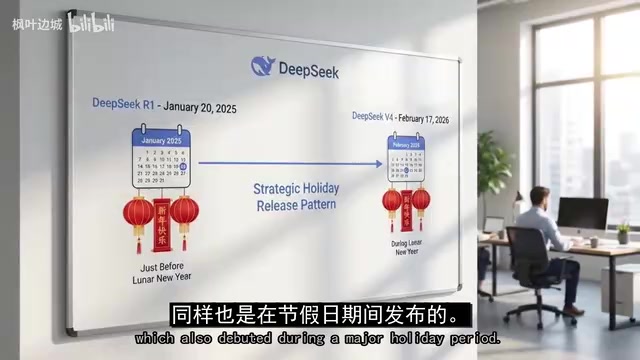
On February 17, 2026, during the Lunar New Year, DeepSeek dropped another bombshell — releasing the V4 model, purpose-built for programming. The last time DeepSeek made waves with its R1 model, NVIDIA lost $600 billion in market cap overnight, with the entire tech sector shedding over a trillion dollars. This time, V4 takes direct aim at AI coding assistants — the one area where developers are actually willing to pay — and according to published benchmarks, it comprehensively outperforms Claude Sonnet 4 and GPT-4.0 on coding tasks, even surpassing Claude Opus 4.5.
What's even more shocking: its usage cost is just one-tenth of competitors, and it can run locally on consumer-grade hardware. How is this even possible?
Million-Token Context Window: Letting AI Truly Understand Your Entire Codebase
Current mainstream AI models typically have context windows around 128K tokens — roughly equivalent to a small codebase, just a handful of files. Developers are forced to repeatedly feed in code snippets, praying that the AI still remembers what you said ten conversation turns ago.
Context Window refers to the maximum amount of text a large language model can process at once, measured in tokens. Tokens aren't simply equivalent to characters or words — in English, one token corresponds to roughly 0.75 words; in Chinese, one character typically maps to 1-2 tokens. A 128K token context window can hold approximately 100,000 English words, which sounds like a lot, but falls far short for a mid-sized software project — a typical React frontend plus Node.js backend easily exceeds 500,000 tokens. More critically, expanding the context window isn't a simple engineering exercise: the Self-Attention mechanism in Transformer architecture has computational complexity that grows quadratically with sequence length. This means scaling context from 128K to 1M theoretically increases computation by approximately 60x. This is precisely why a million-token context window represents a genuine architectural breakthrough, not a simple parameter tweak.
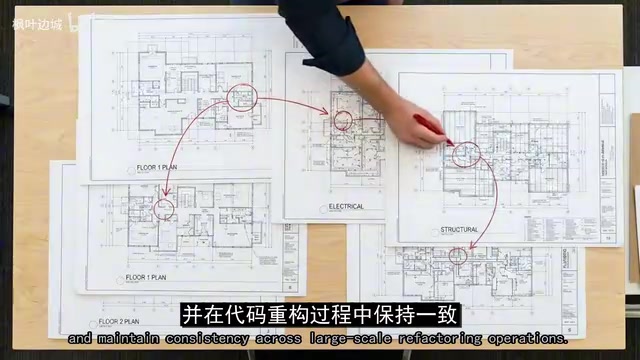
DeepSeekAd V4's context window breaks through to 1 million tokens. What does this mean? You can upload your entire project — every file, every dependency, every piece of documentation — all at once, and the AI can see everything simultaneously. This makes true multi-file reasoning possible: the model can understand relationships between components, trace dependency chains, and maintain consistency during large-scale refactoring operations.
Let's illustrate with a practical scenario: if you currently use GitHub Copilot or ChatGPT for coding assistance, you're essentially collaborating with an assistant suffering from short-term memory loss. You ask it to refactor a function, it does, but immediately forgets the context of your entire application. You're forced to repeatedly explain your architecture, design patterns, and naming conventions.
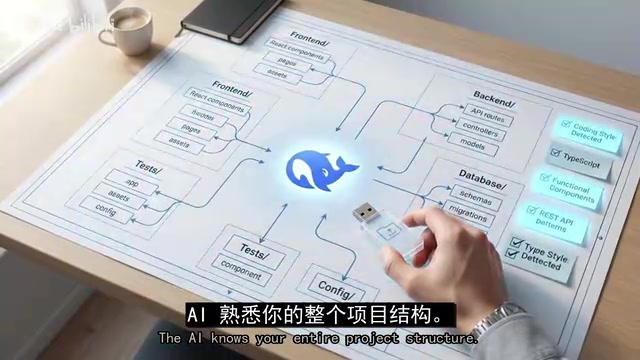
With DeepSeek V4, you load your complete codebase once. The AI understands your project structure, grasps your coding style, sees how the frontend connects to the backend, and how database schemas relate to API endpoints. It's like having a senior developer sitting beside you who has actually read and memorized your entire codebase.
Three Core Technical Breakthroughs: More Than Just a Bigger Window
DeepSeek V4 didn't simply expand the context window and call it a day — it redesigned the model architecture from the ground up.
N-gram Memory Architecture: Complete Separation of Knowledge Storage and Reasoning
V4 introduces the groundbreaking N-gram Memory Architecture, whose core idea is to completely separate "what AI knows" from "how AI thinks."
N-gram is a classic concept in natural language processing, referring to sequences of N consecutive elements (characters, words, or tokens) in text. The core advantage of N-gram models lies in their statistical patterns being efficiently indexable and retrievable, with time complexity approaching O(1) — meaning lookup speed remains nearly constant regardless of database size. DeepSeek V4 combines this approach with modern neural network architecture: using N-gram embeddings with O(1) lookup mechanisms, it encodes and stores static knowledge (such as API documentation, syntax rules, and common code patterns) in CPU memory rather than occupying expensive GPU VRAM. GPU VRAM is the core bottleneck in AI inference — an RTX 4090 has only 24GB of VRAM, while top-tier AI models require hundreds of gigabytes of storage for their parameters. By offloading knowledge storage to CPU memory (modern servers can be configured with TB-level capacity), the GPU is freed to focus on reasoning and generation tasks that truly require parallel computing power. This is the key architectural decision enabling the 10x cost advantage.
In plain terms, the model can memorize massive amounts of information without slowing down or getting confused. Its conditional retrieval mechanism can precisely recall specific details from over 10 million tokens of context without hallucinating.
MHC Architecture: Eliminating Logical Hallucinations at the Source
Another key innovation is the Manifold-Constrained Hyperconnections (MHC) architecture. This technology specifically addresses logical hallucinations and inconsistencies common in long-context generation.
AI Hallucination refers to large language models generating content that appears plausible but is actually incorrect — this is particularly dangerous in programming scenarios. An AI assistant that confidently provides wrong function signatures or non-existent APIs could cause developers to spend hours debugging problems that don't exist. The hallucination problem significantly worsens in long-context scenarios: as sequences grow longer, the model's ability to maintain consistent associations between distant tokens degrades, causing generated content to contradict earlier context. A Manifold is a mathematical concept describing low-dimensional structures within high-dimensional spaces — intuitively, think of it as finding a "plausibility constraint trajectory" within a chaotic high-dimensional parameter space. The MHC architecture introduces manifold constraints into the model's hyperconnection layers (a variant of cross-layer residual connections), forcing the model's internal states to maintain geometric consistency during generation, fundamentally reducing logical drift in long-sequence generation.
Put simply, when you ask the AI to refactor thousands of lines of code, it won't "forget" halfway through
Related articles
 Product Reviews
The Programmer's Desk Setup Guide: Building a Workspace That Feels Like Home
Discover how programmers build productive, comfortable workspaces. From multi-monitor setups to ergonomic design, explore the desk philosophy that drives focus and flow.
 Product Reviews
Qoder vs Cursor Real-World Comparison: Which $20/Month AI IDE Is Better?
Hands-on comparison of Qoder vs Cursor AI IDEs: Agent autonomy, human interaction count, and architecture decisions. Qoder needed only 2 interactions vs Cursor's 8.
 Product Reviews
Cursor Cloud Agent Demo: Eliminating Bottlenecks Across the Entire Software Development Lifecycle
Deep analysis of Cursor's Cloud Agent demo showing how cloud VMs, automated test artifacts, and a full-chain control plane systematically eliminate human bottlenecks across the software development lifecycle.