DeepSeek V4 Flash Real-World Test: Coding Ability Surpasses Pro Preview
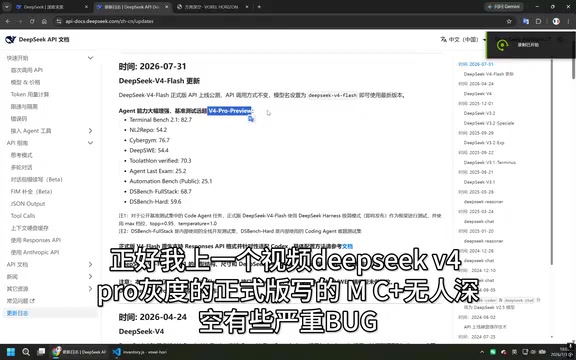
DeepSeek V4 Flash fixes a game bug in 1.5 min, outperforming Pro Preview's failed 5.5-min attempt.
A real-world comparison test using a game development inventory system bug reveals that DeepSeek V4 Flash official release significantly outperforms the Pro Preview version. Flash completed an accurate fix in just 1 minute 30 seconds, while Pro Preview failed to resolve the issue after 5 minutes 30 seconds—a 3.6x speed improvement with vastly superior results, challenging the assumption that heavier models always perform better.
Introduction: DeepSeek V4 Official Release Finally Arrives
DeepSeekAd V4 has officially launched, with the DeepSeek V4 Flash version being the first to go live. For developers who have been closely following AI coding capabilities, this update carries significant weight—not just because of the model iteration itself, but because it delivers a counterintuitive conclusion: the lighter-weight Flash official release actually outperforms the earlier Pro Preview version in real-world programming tasks.
This article is based on a real comparison test of DeepSeek V4 conducted by a Bilibili content creator. Using a specific game development project as the test scenario, the test applies identical prompts and tasks for a head-to-head comparison to verify whether the official claims hold up.
Test Scenario: A Real Bug in the MC + No Man's Sky Project
The test uses a game project that blends gameplay elements from Minecraft and No Man's Sky. When the project was previously built using the DeepSeek V4 Pro grayscale official release, the code contained some fairly serious bugs—making it perfect material for this comparison test.
The core test prompt was very specific: Fix the issue in this project's inventory system where items in the Traveler's equipment bay cannot be used or moved to the hotbar.
This type of inventory system interaction bug is quite typical in game development—it involves item state management, UI interaction logic, and data synchronization between different containers. It's a genuine test of a model's code comprehension and contextual reasoning abilities. From a technical perspective, the Inventory System is one of the most common and error-prone subsystems in game development. It involves item data structure definitions (attributes like item ID, stack count, durability, etc.), item transfer logic between multiple containers (inventory, equipment slots, hotbar, chests, etc.), drag-and-drop UI event handling, and state validation when items are used. A typical item movement operation goes through the complete pipeline of "remove from source container → validate target container → insert into target container → refresh UI," and any logical gap in this chain can cause items to get "stuck" or "disappear." The difficulty in fixing these bugs lies in the fact that they're rarely single-point errors—they're logical inconsistencies that arise from interactions between multiple modules, requiring an understanding of the entire system's data flow to accurately pinpoint the issue.
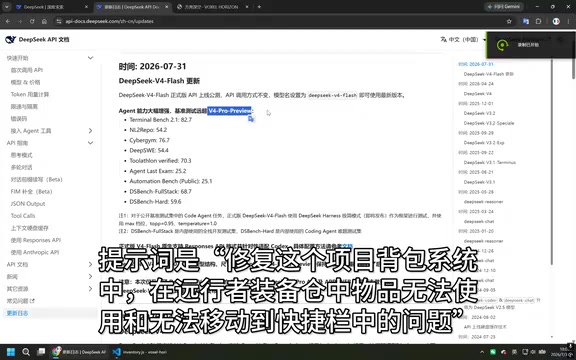
Using the same bug and the same prompt to test both versions is what makes this comparison so valuable: variables are strictly controlled, and any difference in results directly reflects the models' capability differences. Compared to standardized benchmarks like HumanEval and SWE-bench, this kind of real-world task testing places higher demands on a model's code context comprehension, cross-file reasoning, and problem localization abilities, and it better reflects the actual developer experience.
Pro Preview Performance: A Grueling 5.5-Minute Wait
First up was the DeepSeek V4 Pro Preview. After being given the same prompt to fix the bug, the model began its lengthy processing.
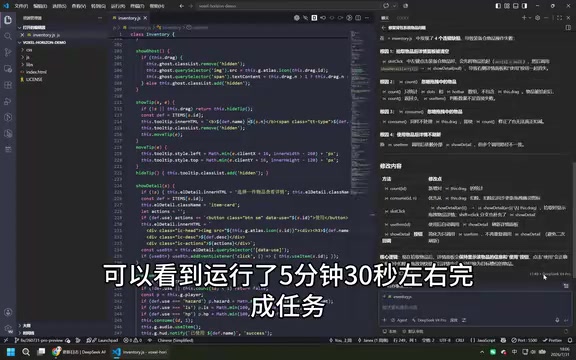
The entire task took approximately 5 minutes and 30 seconds to complete. Conventional wisdom suggests that longer processing means more thorough thinking, which should yield better results. However, the actual verification was jaw-dropping—despite all that processing time, the bug was not effectively fixed. Items still couldn't be used or moved properly.
In other words, the Pro Preview invested substantial compute and time on this task but delivered a failing grade. This also illustrates a key point: longer inference time does not equal higher output quality—it's the model's actual coding ability that determines success or failure. In the current LLM inference paradigm, there's an approach called "Inference-time Compute Scaling" that attempts to improve output quality by letting the model "think longer," with OpenAI's o1 series being a prime example. However, longer reasoning time doesn't always produce better results. Models can fall into the trap of "overthinking"—repeatedly deliberating in the wrong direction or spending their token budget on unnecessary details, ultimately drifting away from the core problem. What truly determines output quality is the model's foundational capability (pre-training quality) and alignment (whether it can accurately understand user intent and focus on key issues), not merely inference duration.
Flash Official Release Performance: Precise Fix in 1.5 Minutes
Next, it was time to switch to the DeepSeek V4 Flash official release, using the exact same prompt.
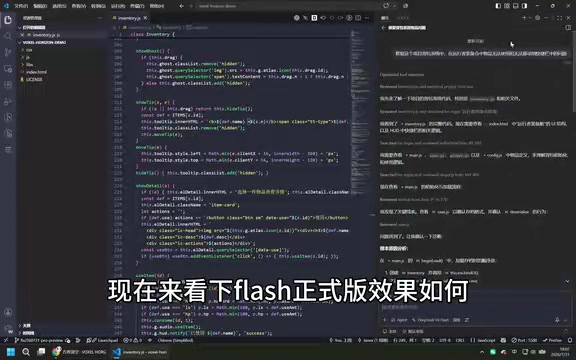
This time, the model completed its modifications and submitted a branch in just about 1 minute and 30 seconds. More importantly, the verification step confirmed that the fixed inventory system worked properly—items in the Traveler's equipment bay could be used normally and moved smoothly to the hotbar.
In terms of both speed and results, the Flash official release won across the board:
- Time: 1 min 30 sec vs. Pro Preview's 5 min 30 sec—a roughly 3.6x speed improvement
- Results: Bug actually fixed vs. Pro Preview failing to resolve the issue
The official claim of "far surpassing V4 Pro Preview" was validated in this real-world test case.
Deep Dive: Why the Flash Official Release Outperformed the Pro Preview
From a product positioning standpoint, Flash is typically the lightweight version optimized for speed and cost, while Pro is the flagship version with stronger capabilities. In the LLM product ecosystem, Flash and Pro represent two different design philosophies. Flash versions typically use smaller model parameter counts or more aggressive inference optimization strategies (such as fewer thinking tokens and more efficient KV Cache management) in exchange for faster response times and lower per-call costs, making them suitable for high-frequency, latency-sensitive scenarios. Pro versions tend to use larger models and longer Chain-of-Thought reasoning, pursuing peak performance on complex tasks. This tiered strategy is also reflected in product lines like OpenAI's GPT-4o/GPT-4o-mini and Google's Gemini Pro/Flash. Notably, as distillation techniques and training data quality improve, cases of lightweight versions matching or even surpassing heavyweight versions on specific tasks are becoming increasingly common.
The "lightweight version outperforming the flagship preview" result in this test actually has several layers of reasoning worth exploring.
The Generational Gap Between Official and Preview Releases
It's particularly important to note that this comparison pits the Flash official release against the Pro preview version. Preview versions are often intermediate products that haven't undergone thorough optimization and alignment, while official releases have gone through more complete training and fine-tuning. So this is more akin to comparing a "next-generation production product" against a "previous-generation immature product," rather than a capability contest between same-generation versions.
From an engineering perspective, the journey from a Preview to GA (Generally Available) release typically involves multiple rounds of critical optimization. This includes: further alignment training via Reinforcement Learning from Human Feedback (RLHF) or Direct Preference Optimization (DPO) to make model outputs better match user expectations; post-training fine-tuning for specific tasks (such as code generation); and inference-stage engineering optimizations like quantization strategy adjustments and sampling parameter calibration. The core purpose of a preview version is to collect user feedback and surface issues—its performance often doesn't represent the true level of the final product. Therefore, when comparing an official release against a preview, it's important to recognize that weeks or even months of iteration may separate the two.
The Evaluation Criteria for Coding Ability Are Changing
This test also reminds us that evaluating AI programming tools shouldn't rely solely on model parameters or inference duration—it needs to return to the core metric of whether it can actually solve the problem. The Pro Preview spent more than three times as long yet couldn't fix the bug, demonstrating that simply throwing more compute and thinking time at a problem isn't reliable. What truly matters is the model's depth of understanding of code context and the accuracy of its problem localization.
Current approaches to evaluating AI coding ability fall into two main categories: standardized benchmark tests and real-world task tests. The former—such as HumanEval, MBPP, and SWE-bench—quantify a model's code generation capability through predefined programming problems and automated test cases. The latter validates whether a model can solve real engineering problems in actual projects. Each approach has its pros and cons: benchmarks are reproducible but carry the risk of "overfitting to the leaderboard," while real-world tasks are closer to practice but difficult to standardize. The content creator in this article used the latter approach, and while the sample size is limited, it provides irreplaceable reference value for developers evaluating the core question of "is this tool actually useful."
Practical Impact on Developer Workflows
For frontline developers, completing an effective fix in 1 minute and 30 seconds versus getting an ineffective result after 5 minutes and 30 seconds represents a night-and-day difference in experience. The former integrates seamlessly into the coding workflow, enabling a rapid "ask → fix → verify" loop; the latter breaks rhythm and drains patience. After the test, the content creator even half-jokingly mentioned canceling subscriptions to other AI services—a testament to the real impact the Flash official release made on him.
From a development efficiency perspective, an AI coding assistant's response speed directly affects a developer's "flow" state. Research shows that when wait times exceed 10 seconds, users' attention begins to wander; when waits exceed 1 minute, many developers switch to other tasks, leading to context loss and decreased efficiency. While 1 minute and 30 seconds already exceeds the ideal threshold for instant feedback, compared to 5 minutes and 30 seconds, it's still within the acceptable range where developers are willing to "wait in place." This means the fix results can be directly verified and applied without needing to re-establish the problem context.
Conclusion: A Capability Leap Worth Watching
A single test case certainly isn't enough to comprehensively judge a model's overall capabilities, but DeepSeek V4 Flash official release's performance in this real-world programming task truly demonstrates impressive progress. It proves that Chinese-developed LLMs are achieving tangible capability leaps in hardcore tasks like code comprehension and bug fixing.
For developers interested in AI-assisted programming, the DeepSeek V4 Flash official release is worth incorporating into real projects for further validation—especially in scenarios with high contextual reasoning demands, such as game development and complex system debugging. As the full Pro official release rolls out in the future, the DeepSeek V4 series' overall performance has even more room for imagination.
Related articles

Chain of Thought Isn't Just for AI: How Humans Can Use CoT to Improve Thinking Quality
Chain of Thought isn't just a prompt trick for large models. Starting from a Hacker News discussion, this article analyzes why CoT works for human thinking too, breaks down actionable ways to transfer it, and highlights the key differences between human CoT and machine CoT.
Cloudflare Teams Up with OpenAI: Closi…
Cloudflare Teams Up with OpenAI: Closing the Loop from Vulnerability Discovery to Defense with AI
Cloudflare uses OpenAI Daybreak to investigate security vulnerabilities and generate reviewable remediation plans, while developers use Codex to boost coding efficiency and quality.

Orca Multi-Agent Orchestration in Practice: A Guide to Parallel Collaboration with Claude and Codex
Orca is Stable AI's free open-source agent workbench supporting 34 agents like Claude Code and Codex in parallel. Learn its Git worktree isolation, multi-model orchestration, and mobile management.