DeepSeek-V4-Flash-Vision-Exp Released: The First Multimodal Model in V4, Now Supported by vLLM
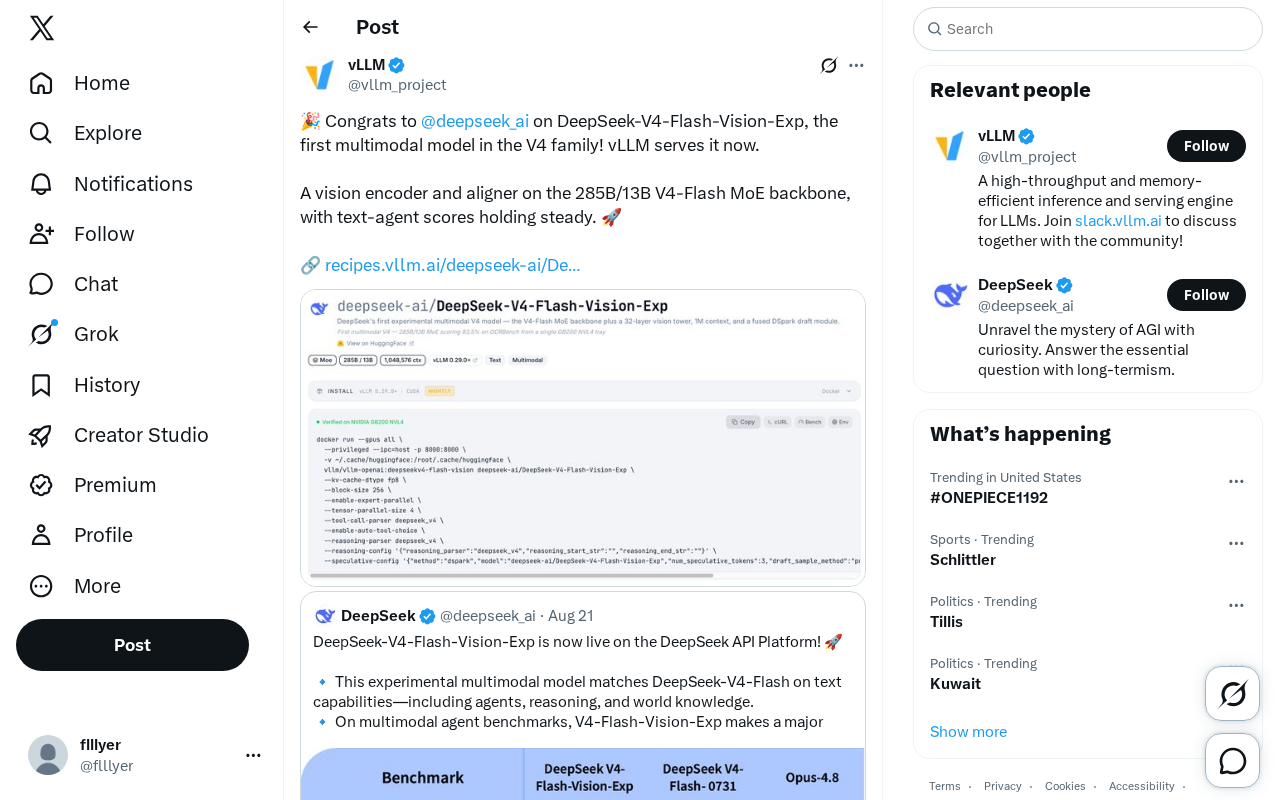
DeepSeek launches its first V4 multimodal model with 285B/13B MoE and same-day vLLM deployment support.
DeepSeek has released DeepSeek-V4-Flash-Vision-Exp, the first multimodal model in its V4 series, built on a 285B/13B MoE backbone extended with a vision encoder and aligner. The model maintains stable text-agent performance after multimodal extension and is immediately deployable via vLLM, marking a key step in DeepSeek's open-source multimodal roadmap.
The V4 Family Gets Its First Multimodal Member
DeepSeekAd AI has released DeepSeek-V4-Flash-Vision-Exp, the first multimodal model in the V4 series. Notably, the popular inference framework vLLM announced support for the model at launch, meaning developers can immediately deploy and test this vision-language model in production environments.
This release marks a significant step for DeepSeek into multimodal territory. Previous V-series models focused primarily on pure-text capabilities and code reasoning — the Vision variant extends that boundary into image understanding. Looking back at the V-series trajectory: V1 first demonstrated the competitiveness of MoE architecture in open-source models; V2 introduced the innovative Multi-head Latent Attention (MLA) mechanism for low-rank KV Cache compression; V3 reached performance levels competitive with GPT-4 across multiple benchmarks. Throughout this evolution, the V-series iterated rapidly in the pure-text domain. While DeepSeek had previously released standalone vision-language models (such as the Janus series), the main V-series line had always lacked native multimodal support. The Vision-Exp release fills that gap.
Architecture Breakdown: Vision Encoder + MoE Backbone
Based on official disclosures, DeepSeek-V4-Flash-Vision-Exp's core architecture breaks down into three components:
Vision Encoder and Aligner
The model adds a vision encoder and an aligner on top of the existing V4-Flash MoE backbone. This is the canonical design pattern for today's leading multimodal large models — a dedicated vision encoder extracts image features, and the aligner maps visual representations into the language model's semantic space, giving the text backbone the ability to "see."
The technical evolution of vision-language models (VLMs) has gone through several distinct phases. The early era was defined by CLIP (2021, OpenAI), which used contrastive learning to map images and text into a shared embedding space. The second phase, exemplified by Flamingo (2022, DeepMind) and BLIP-2 (2023, Salesforce), adopted a "frozen vision encoder + frozen LLM + trainable connector" architecture that dramatically reduced multimodal training costs. The current mainstream approach trends toward unfreezing more parameters for end-to-end fine-tuning in later training stages, achieving deeper cross-modal understanding. DeepSeek-V4-Flash-Vision-Exp's "vision encoder + aligner + LLM backbone" architecture sits at the frontier of this evolution. The aligner's core job is to bridge the "modality gap" between the visual and linguistic feature spaces — typically implemented as a lightweight MLP projection layer or a cross-attention module.
This modular "backbone + adapter" design has a clear advantage: it lets you rapidly equip a strong existing text model with multimodal capabilities without retraining the entire language model, saving compute while preserving the original model's language and reasoning performance as much as possible.
285B/13B MoE Parameter Configuration
The model uses a 285B total / 13B active parameter Mixture of Experts (MoE) architecture. That means the model has 285 billion parameters in total, but only approximately 13 billion are activated during any given inference pass.
The Mixture of Experts architecture was originally proposed by Jacobs et al. in 1991 and has seen a major renaissance in large-scale language modeling. The core idea is to distribute model parameters across multiple "expert" sub-networks, with a gating network dynamically selecting a small subset of experts for each inference call. Google's Switch Transformer (2021) was a landmark paper applying MoE to Transformer architectures, demonstrating that sparse activation can dramatically increase model capacity while keeping compute costs in check. DeepSeek has used MoE since V2, investing heavily in routing strategies and expert load balancing. The 285B/13B configuration implies a sparsity ratio of roughly 22:1, which is on the higher end of the industry spectrum.
The core value of MoE is trading lower inference cost for greater model capacity. For the Vision variant, this configuration ensures the model has enough representational capacity for complex image-text tasks while keeping actual inference overhead relatively manageable — the real compute is equivalent to a 13B dense model, but the model theoretically holds far more knowledge than a 13B model could. This is also the technical basis for the "Flash" (fast) designation.
Key Highlight: Zero Text Performance Loss After Multimodal Extension
A common pain point in multimodal model development is that adding vision capabilities often degrades pure-text performance. DeepSeek explicitly emphasizes that the Vision variant's text-agent scores remain stable.
This is worth paying attention to. It means DeepSeek added visual capability without sacrificing the model's original language and agent task performance. For developers who want a single model that handles both text-only and image-text tasks, this means no tradeoff between "multimodal" and "text performance."
From an engineering standpoint, achieving zero text performance loss typically depends on carefully designed training strategies — such as freezing portions of the text backbone, using staged training, or carefully balancing the ratio of image-text to pure-text data in the training mix, all to avoid catastrophic forgetting. Catastrophic forgetting is a classic problem in neural networks, referring to the phenomenon where a model severely damages its performance on previously learned tasks when learning new ones. In multimodal model development, this problem is particularly pronounced: heavy exposure to image-text data can significantly degrade original capabilities like pure-text reasoning and code generation. Common mitigation strategies in the field include: parameter freezing — freezing all or most of the LLM backbone during visual alignment training and only training the vision encoder and aligner; staged training — first running visual-language alignment pretraining, then instruction fine-tuning, unfreezing different parameter sets at each stage; data ratio engineering — mixing a certain proportion of pure-text data into multimodal training (often called "replay") to maintain text capabilities; and parameter-efficient fine-tuning methods like LoRA — introducing visual capability through low-rank adapters without directly modifying the original weights. DeepSeek's ability to maintain zero text-agent score loss likely reflects a combination of several of these strategies.
Simultaneous vLLM Support: From Release to Deployment Without a Gap
Another noteworthy signal is that vLLM announced support at the same time the model launched. vLLM is one of the most widely used high-performance LLM inference frameworks in the industry, known for its high-throughput, low-latency serving capabilities.
vLLM was open-sourced in 2023 by a research team at UC Berkeley. Its core innovation is PagedAttention — inspired by virtual memory paging in operating systems, it organizes the KV Cache (key-value cache) into non-contiguous memory blocks, boosting KV Cache memory utilization from the 20–40% typical of traditional implementations to near 100%. This directly translates to higher batch throughput and lower inference latency. Beyond PagedAttention, vLLM also supports continuous batching, tensor parallelism, speculative decoding, and other optimizations. For MoE models specifically, vLLM also needs to handle expert parallelism scheduling, ensuring that compute loads across different experts are distributed reasonably across multiple GPUs. vLLM's support for multimodal models is also evolving rapidly, and it can already handle VLM-specific engineering challenges such as image input preprocessing and visual feature cache management.
Getting vLLM support at launch means this model isn't just a research-flavored experimental drop (though the "Exp" in the name does signal an experimental nature) — it already meets the engineering bar for real deployability and serviceability. Developers can use vLLM to stand up an inference service quickly and plug it into their own application workflows.
This pattern of synchronizing "model release" with "inference framework support" is becoming the new normal in the open-source LLM ecosystem, dramatically compressing the time between open-source release and practical deployment.
Summary and Outlook
DeepSeek-V4-Flash-Vision-Exp is an important step in the V4 family's evolution toward multimodality:
- It validates the feasibility of rapidly extending vision capabilities on top of a strong MoE text backbone.
- It demonstrates that multimodal extension can be done without degrading existing text performance.
- It achieves immediate deployability via vLLM, so developers can get hands-on right away.
As a release carrying the "Exp" (experimental) label, it reads more like an early exploration of DeepSeek's multimodal roadmap. It's reasonable to expect the V4 family will eventually ship a more mature, fully capable multimodal release — one that may support higher-resolution image input, video understanding, and multi-image reasoning. For developers and researchers following the open-source multimodal ecosystem, this vision-language model is worth spinning up and trying today.
Related articles

DeepCell: One-Click AI Generation of Documents, Spreadsheets, and Slides
DeepCell tops Product Hunt with one-click generation of documents, spreadsheets, and slides, using the .deepcell format for linked updates, designed for System 2 tasks like modeling and sales reviews.

Doneas: 15-Minute Daily Accountability Calls That Keep Indie Developers From Procrastinating
Doneas is a daily accountability tool for indie developers: plan tasks on Monday, join a 15-minute call with five builders each day, and log deliveries on a public progress page. This article analyzes its core mechanics, effectiveness, and potential issues around retention and matching.

Fastlane 2.0: Fully Automated AI Ad Campaigns, From Creative to Optimization
Fastlane 2.0 is an AI ad automation tool: enter your website and it learns your brand, generates video and image ads, and runs and optimizes them on Meta, TikTok, Instagram, and YouTube.