DeepSeek V4 Pro Hands-On Review: A No-Weakness Flagship LLM from China

DeepSeek V4 Pro delivers comprehensive Agent capabilities with no weaknesses at a fraction of overseas model pricing.
DeepSeek V4 Pro launches with a 1.6 trillion parameter MoE architecture activating only 49B parameters per inference. Agent capabilities jumped nearly 5x, with software engineering hitting 62.7 and cybersecurity topping charts at 83.3. Priced at just 3 RMB per million input tokens — a fraction of GPT-4o or Claude Opus — it offers three reasoning modes, 1M context window, and MIT open-source weights with full API compatibility.
DeepSeek V4 Pro Quietly Arrives
Late on the night of August 12, DeepSeekAd quietly dropped a bombshell — V4 Pro officially launched, version 0813. While the model name hasn't changed, if you call it via API now, you're already getting an entirely new model.
This marks the third iteration of the DeepSeek V4 series in just four months: the preview version on April 24, Flash going official on July 31, and Pro making its grand finale on August 13, simultaneously going live on OpenRouter for global access. OpenRouter is an LLM API aggregation platform where developers can call models from dozens of different providers through a unified interface — DeepSeek's simultaneous launch there means global developers can try it immediately without separate registration.
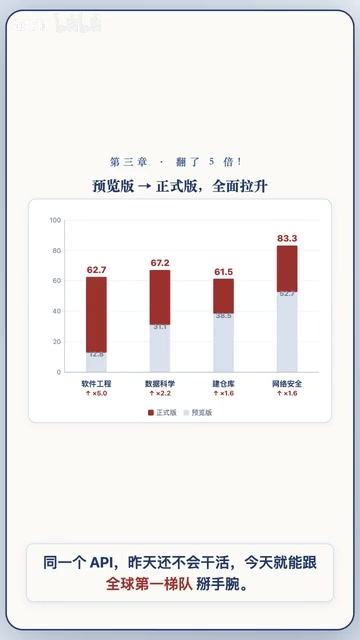
The most stunning aspect is the massive leap in Agent capabilities. An Agent refers to a model that can not only converse but also autonomously plan tasks, call external tools, operate software interfaces, execute code, and iterate based on feedback — a comprehensive capability orders of magnitude more difficult than simple Q&A. Software engineering jumped from 12.8 in the preview to 62.7, nearly a 5x increase, meaning the model leaped from "barely able to complete tasks" to "capable of independently solving most real GitHub Issues." Hard-level data science doubled, and cybersecurity hit 83.3. The same API that couldn't do the job yesterday is now competing with the global first tier today.
Underlying Architecture: The Foundation of DeepSeek V4 Pro's Strength
This capability leap is built on a comprehensive architectural upgrade. According to analysis by Bilibili creator Shizheng, V4 Pro employs a MoE (Mixture of Experts) architecture with 1.6 trillion total parameters and 49 billion activated per inference.
MoE (Mixture of Experts) is an architectural design that splits a large model into multiple "expert sub-networks." For each input, a gating network (Router) selectively activates only a few experts to handle the current task, rather than engaging all parameters simultaneously. This means the model can have an enormous total parameter count (representing knowledge capacity) while only consuming a fraction of compute during actual inference. Google's Switch Transformer and GPT-4 reportedly use similar architectures. Of V4 Pro's 1.6 trillion total parameters, only 49 billion (~3%) are activated each time — an activation ratio that represents extreme optimization by industry standards.
Even more critical are two attention mechanism optimizations: inference compute reduced to 27%, and memory usage down to 10%. Standard Transformer attention has O(n²) computational complexity, with compute and memory growing quadratically as context length increases. DeepSeek's MLA (Multi-head Latent Attention) technology, first introduced in V2/V3, dramatically reduces KV Cache memory overhead by compressing Key-Value pairs into a low-dimensional latent space. V4 Pro likely represents a further evolution of MLA, combined with more efficient expert routing strategies, massively compressing actual running costs while maintaining large parameter scale. Pre-training exceeded 3.6 trillion total parameters across 32 trillion tokens, with expert dispatch merged in the inference flow — these engineering optimizations collectively support this performance breakthrough.
For large models, parameter scale is just a number on paper. What truly determines cost and usability is activation efficiency and inference overhead. DeepSeek's sustained investment in this area is the fundamental reason it can achieve "strong capability at low prices." The same GPU cluster can serve more user requests — this is the core technical moat behind its low-price strategy.
Horizontal Comparison: Comprehensive Balance Rather Than Single-Category Champion
Looking across the entire leaderboard, V4 Pro achieves "no weaknesses" among six mainstream flagship models. Terminal operations scored 87.9, second only to Kimi K3; cybersecurity at 83.3 tops the chart.
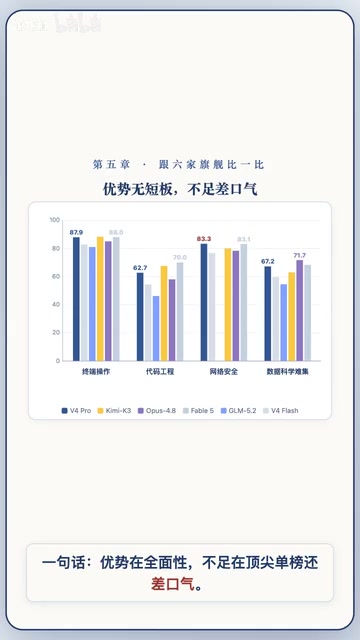
But objectively, there are still gaps in top single-category performance. Code engineering at 62.7 trails Fable 5 by 7.3 points; hard-level data science at 67.2 is about 4.5 points behind Opus 4.8; hard reasoning at 60 is 3 points behind Fable 5, ranking second globally.
This is the official full-model comparison table released by DeepSeek, covering 8 mainstream models across 11 Agent benchmarks — authoritative data. To summarize V4 Pro's characteristics in one sentence: Its advantage lies in comprehensiveness; its shortcoming is still being a notch below the top in individual categories.
For Agent models, "no weaknesses" is actually harder to achieve than "first in one category" — real business scenarios often require models to perform stably across multiple dimensions like reasoning, coding, and tool calling simultaneously, rather than hitting extreme scores on a single benchmark. This is like the difference between a decathlete and a single-event champion: an Agent that can autonomously complete the full pipeline of "analyze requirements → write code → debug and run → deploy" cannot afford to drop the ball at any step — any weakness in any dimension causes the entire task to fail.
V4 Pro Max Mode: Full-Power Reasoning Goes Head-to-Head
With the full-power V4 Pro Max mode enabled, capabilities ramp up even further: algorithm competition scores 3206, coding 93.5, science Q&A hits 90.1, software engineering 80.6, terminal operations 67.9, and full-power hard reasoning 37.7.
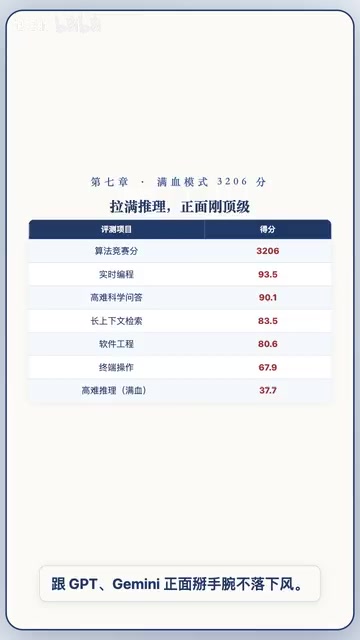
In this mode, V4 Pro can already go head-to-head with GPT and Gemini without falling behind.
Looking at Pro's improvement over Flash official: automation tasks up 27% (the largest gain), deep reasoning with tools up 17%, software engineering up 15%, hard-level data science, repository creation, and cybersecurity all up 9% to 13%, with full-stack development and agent exams also seeing 2% to 5% improvements. All 11 metrics improved across the board — not a single regression. This kind of comprehensive progress is the hardest state for an Agent model to achieve.
Three Reasoning Modes and Pricing Strategy Explained
V4 Pro offers three freely switchable modes: no-thinking, high reasoning, and full-power reasoning, supporting up to 1 million context tokens and 38K token output — handling long documents and large codebases with ease.
A 1-million-token context window is equivalent to roughly 7.5 million English words or 4 million Chinese characters — enough to read in over a dozen complete technical books or an entire mid-size code repository at once. This is especially critical for Agent scenarios: when the model needs to understand a code project with hundreds of files and fix bugs, it must hold massive amounts of context in its "working memory" simultaneously. Combined with 380K token output length, generating complete long documents or large-scale code refactoring becomes possible.
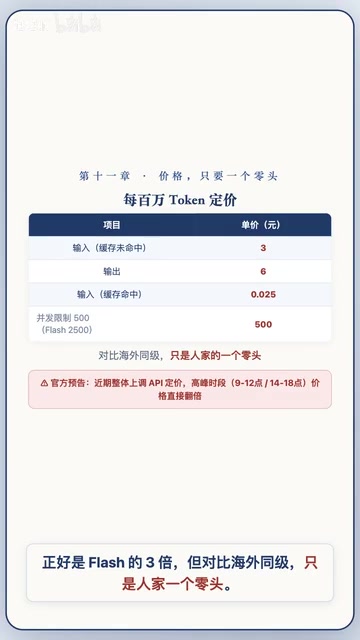
The pricing strategy is aggressive: input at 3 RMB per million tokens, output at 6 RMB, and cache hits at just 0.025 RMB. While 3x the Flash price, compared to overseas models at the same tier (like Claude Opus at $75/million input tokens or GPT-4o at $2.5/million input tokens), this price is a fraction of theirs.
The trade-off is that concurrency drops from 2,500 to 500 — the stronger the capability, the more GPU compute each inference consumes, naturally reducing the number of simultaneous requests that can be served. The official team also announced that prices will be raised soon, potentially doubling during peak hours.
Integration is zero-barrier: switching models requires no code changes — OpenAI interface, Anthropic interface, and Codex are all supported. This means any project already using the ChatGPT API or Claude API only needs to change one endpoint address to switch to DeepSeek, with zero changes to code logic. The model uses MIT open-source weights — one of the most permissive open-source licenses, allowing anyone to freely use, modify, and distribute the model weights, even for commercial products. Enterprises can deploy the model on private servers without paying API fees or worrying about data privacy. Downloads have already reached 1.4 million in one month, validating the market's strong approval of this open strategy.
What DeepSeek V4 Pro's Breakthrough Means
Overall, V4 Pro opens up possibilities in four directions:
- Long-task Agents are finally practical: The massive improvement in Agent capabilities moves complex long-chain tasks from "demo-able" to "deployable." Past Agent products often started accumulating errors after 3-5 steps, but V4 Pro-level stability means 10-step or 20-step long-chain tasks now have a realistic chance of reliable completion.
- Chinese LLMs enter the no-weakness tier: No longer excelling in one area while flopping in another — now comprehensively stable. This marks a key transition for Chinese LLMs from "catching up" to "running alongside."
- AI application barriers are dropping: Cheap pricing plus strong capabilities means more developers and enterprises dare to experiment. AI features that previously required tens of thousands of RMB per month might now be achievable for just a few thousand.
- Open source + multi-API compatibility: MIT open source plus full compatibility with mainstream interfaces means near-zero migration cost. This strategy is reshaping the competitive landscape of LLMs — when switching costs approach zero, model providers can only compete on capability and price.
One sentence to summarize the current landscape: Nothing stronger is cheaper, and nothing cheaper is stronger. For daily use, Flash is sufficient — only complex Agent tasks truly warrant calling V4 Pro. As a flagship achievement of Chinese LLMs, DeepSeek V4 Pro has indeed delivered an impressive result.
Related articles

Why Does the Tesla Roadster Need to Fly? A Deep Dive into Musk's Wild Demo
Tesla's Roadster launch showed wall-climbing, upside-down driving, and flying stunts—but The Vergecast notes the demo car may lack a battery, the Rocket version is invite-only and not street-legal, and the website terms don't guarantee delivery. After nine years of delays, why does this car still need to exist?

AI Is Not a Replacement: Human-AI Collaboration Through the Lens of Factory Root Cause Analysis
Starting from factory root cause analysis, this article explains how AI accelerates evidence chain construction rather than replacing human experts, exploring the pragmatic implementation logic and business value of 'AI supporting people rather than replacing them.'

AI Agent Decision Auditing: Building an Evidence Chain in Regulated Workflows
Starting from a Reddit discussion, this article analyzes three core issues in AI agent decision auditing within regulated workflows: what fields audit records should contain, how to handle feedback latency for erroneous decisions, and how to continuously calibrate LLM judge consistency with human judgment.