DeepSeek V4 Pro In-Depth Review: Compared Against 8 Flagship Models — Which One Is Worth Using?

DeepSeek V4 Pro launches with DSA mechanism enabling commercial million-token context at a fraction of competitors' cost.
DeepSeek releases V4 Pro (1.6T parameter MoE architecture), with the core breakthrough being the DSA Absorptive Attention mechanism that reduces million-token context computation to 27% and KV cache to 10% of V3.2, turning million-level context from a paper spec into a commercially viable capability. Priced at just $3.33/million tokens — far below GPT 5.5's $53. It ranks #1 among open-source models in reasoning (GPQA 90.1%), with coding as its only weak spot (SWE Bench Pro 55.4%, trailing Claude and GLM).
Overview: DeepSeek V4 Pro Has Arrived
DeepSeekAd has finally released the V4 series, featuring two versions: V4 Pro (1.6 trillion parameters) and V4 Flash (284 billion parameters). The brand-new DSA (Absorptive Attention) mechanism is the core technical breakthrough of this upgrade — in million-token context scenarios, it reduces computation to 27% and KV cache to 10% of what V3.2 required. This means million-level context is no longer just a number on paper — it's now a genuinely usable capability.
Technical Background on the DSA Mechanism: DSA (Differential Sparse Attention, or Absorptive Attention) targets the "quadratic complexity" bottleneck of traditional Transformer attention mechanisms — when context length doubles, computation and memory consumption quadruple. Previous mainstream solutions in the industry included sliding window attention, linear attention approximation, and others, but all sacrificed accuracy for distant information. DSA uses a dynamic sparsification mechanism that lets the model "selectively absorb" key information rather than treating all tokens equally, drastically compressing computational complexity. KV Cache (Key-Value Cache) is the memory structure that stores historical attention states during inference — compressing it to 10% means the same hardware can serve far more concurrent users, which directly determines the ceiling for API pricing.
This article provides a comprehensive comparison of V4 Pro against today's 8 strongest flagship models, including GPT 5.5, Claude Opus 4.7/4.6, GLM 5.1, Kimi K2.6, MIMO V2 Pro, and MiniMax M2.7, covering dimensions such as pricing, coding, reasoning, Agent capabilities, and role-playing.
Pricing & Context: DeepSeek V4 Pro's Crushing Cost-Performance Advantage
Using USD as the unified currency, DeepSeek V4 Pro's output price is $3.33 per million tokens, while GPT 5.5 costs $53 (roughly a 16x gap), and Claude Opus 4.7 costs $25 (roughly a 7.5x gap). V4 Pro isn't the cheapest model on the market, but within the high-performance tier, its pricing advantage is exceptionally pronounced.
On the context window front, V4 Pro comes standard with a 1M (million) token context across the board. While GPT 5.5 also offers a 12M context, V4's killer feature is that the DSA attention mechanism makes its million-token context genuinely usable in practice.
Why "Million-Token Context" Was Previously Just a Paper Number: KV cache memory usage scales linearly with context length. Taking a typical 70B parameter model as an example, processing 1M tokens requires approximately 80–120GB of VRAM for the KV cache alone, far exceeding a single H100's 80GB limit. This is the fundamental reason why "million-token context" has largely remained on paper — even if the model architecture supports it, inference costs are too high to commercialize. DSA compresses the KV cache to 10% of V3.2's, meaning the same VRAM can handle 10x the context length, or serve the same length at 1/10 the cost. This is the critical leap from "technically feasible" to "commercially viable," and it directly underpins V4 Pro's $3.33/million token pricing strategy.
V3.2 claimed 256K, but in actual use it frequently forgot earlier content and produced inconsistencies — the biggest pain point for longtime users. V4 Pro has thoroughly resolved this issue.
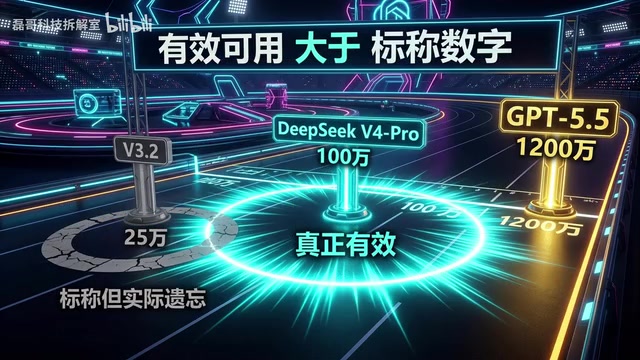
In hands-on testing, V4 Pro's long-document comprehension far surpasses V3.2 — early details can be precisely recalled, with consistent performance between near and distant contexts. For long screenplay writing, long document analysis, and Agent long-running tasks, this represents a generational quality leap.
Coding Capability Comparison: V4 Pro's Only Weak Spot
On the SWE Bench Pro benchmark, Claude Opus 4.7 took the crown at 64.3%, GLM 5.1 led among domestic open-source models at 58.4%, and DeepSeek V4 Pro scored 55.4%. The subjective experience indeed falls short of GLM 5.1, consistent with the benchmark data.
About the SWE Bench Pro Evaluation System: SWE Bench (Software Engineering Benchmark) is a software engineering benchmark proposed by Princeton University, specifically designed to evaluate AI models' ability to solve real GitHub Issues — including understanding codebase structure, locating bugs, writing fix patches, and passing unit tests. SWE Bench Pro is its upgraded version, introducing more complex multi-file, cross-module tasks that more closely approximate real engineering scenarios. Unlike LeetCode-style evaluations, SWE Bench assesses the ability to "work within unfamiliar large codebases." The gap between 64.3% and 55.4% means in engineering practice: when handling complex legacy codebases, Opus solves roughly 9 more issues per 100 on average — a perceptible difference for heavy coding users.
Coding is the only track where V4 Pro hasn't pushed to the front. For heavy coding users, GLM 5.1 remains the top open-source choice, with V4 Pro as a solid backup. However, considering that DeepSeek may release a dedicated Coding Plan in the future, this direction is worth watching.
Reasoning Capability: Open-Source #1, Closing the Gap with Closed-Source
On the GPQA Diamond (PhD-level reasoning) benchmark, Claude Opus 4.7 took the crown at 94.2%, but DeepSeek V4 Pro claimed the open-source top spot at 90.1%. The brute-force elegance of 1.6 trillion parameters is steadily closing the reasoning gap between open-source and closed-source.
GPQA Diamond Evaluation Background: GPQA (Graduate-Level Google-Proof Q&A) Diamond is currently one of the most rigorous AI reasoning benchmarks recognized by academia, developed by a research team at New York University. Questions span PhD-level problems in biology, chemistry, and physics, designed on the principle that "answers cannot be found directly through Google search" — requiring genuine cross-domain reasoning and knowledge integration. The Diamond subset is the hardest collection within GPQA; human experts (PhD students) achieve an average accuracy of about 65%, while non-expert humans score around 34%. V4 Pro achieving 90.1% means its reasoning ability systematically surpasses human expert levels, offering direct reference value for knowledge-intensive scenarios such as research assistance, medical diagnosis, and legal analysis.
On the Engineering Implications of 1.6 Trillion Parameters: V4 Pro uses an MoE (Mixture of Experts) architecture rather than a dense model. MoE splits the model into hundreds of "expert sub-networks," with a routing mechanism dynamically activating only a small subset during each inference pass (typically 10–20% of total parameters). This means that although V4 Pro has 1.6T total parameters, the actually activated parameter count per inference may only be in the 20–30 billion range, comparable in computation to GPT-4 class dense models. The "brute-force elegance of 1.6T parameters"
Related articles
 Product Reviews
The Programmer's Desk Setup Guide: Building a Workspace That Feels Like Home
Discover how programmers build productive, comfortable workspaces. From multi-monitor setups to ergonomic design, explore the desk philosophy that drives focus and flow.
 Product Reviews
Qoder vs Cursor Real-World Comparison: Which $20/Month AI IDE Is Better?
Hands-on comparison of Qoder vs Cursor AI IDEs: Agent autonomy, human interaction count, and architecture decisions. Qoder needed only 2 interactions vs Cursor's 8.
 Product Reviews
Cursor Cloud Agent Demo: Eliminating Bottlenecks Across the Entire Software Development Lifecycle
Deep analysis of Cursor's Cloud Agent demo showing how cloud VMs, automated test artifacts, and a full-chain control plane systematically eliminate human bottlenecks across the software development lifecycle.