DeepSeek V4 vs GLM-5.1 Real-World Coding Test: Authentication Migration & Full-Stack Development

DeepSeek V4 Pro vs GLM-5.1 head-to-head in real-world coding projects
This article compares DeepSeek V4 Pro and Zhipu GLM-5.1 through real coding projects and workflow agent tasks. In the authentication migration test, GLM-5.1 showed strengths like autonomous planning mode and complete requirements comprehension. Despite minor issues, it outperformed DeepSeek V4 Pro, which suffered from serious session isolation flaws.
Test Background & Methodology
In today's crowded AI coding assistant landscape, there's often a massive gap between benchmark scores and real-world project performance. This test skips parameter comparisons entirely and puts DeepSeekAd V4 Pro and Zhipu GLM-5.1 directly into real projects, evaluating their performance on long-horizon coding tasks and workflow agents.
Long-horizon coding tasks refer to programming scenarios where the model must continuously track large amounts of code context, cross-file dependencies, and task state across single or multi-turn conversations. These tasks place extreme demands on a model's context window and attention mechanisms. Most mainstream large models today have context windows ranging from 32K to 200K tokens — but window size doesn't equal effective utilization. Research shows that many models experience a "Lost in the Middle" phenomenon once context exceeds a certain length, where their ability to process information in the middle of the context window degrades significantly.
Workflow agents are automated execution architectures that chain large language models together with external tool pipelines. The core technology is Function Calling or Tool Use — the model outputs structured tool-call instructions during inference, the host program executes them and returns results to the model, forming a closed loop of "reasoning → execution → observation → re-reasoning."
The test was designed around two categories of tasks:
- Real coding projects: including user authentication system migration and CLI-to-web full-stack development
- Social media content analysis agent: a complete workflow covering video download, audio extraction, transcription, and analysis
All tests used identical prompts and the same project foundation to ensure a fair comparison. The final code was also submitted to GPT-5.5 and Claude Opus 4.7 for independent code review and scoring.
Coding Project Test 1: Authentication System Migration
Task Difficulty Analysis
The first project involved migrating a user authentication system for an image generation agent — specifically, porting existing auth code from another project. This task spans backend, frontend, and database layers simultaneously, while requiring cross-project code exploration, making it extremely demanding in terms of long-horizon processing. Authentication migrations are particularly representative: the model must simultaneously understand the source project structure, target project structure, database schema changes, and frontend/backend API contracts. Any loss of context in any one of these dimensions can lead to broken logic or security vulnerabilities.
In the previous round of testing, DeepSeek V4 scored only 7.0 out of 10 on this project, while GPT-5.5 scored 8.5.
GLM-5.1 Highlights
After receiving the task, Zhipu GLM-5.1 demonstrated several noteworthy characteristics:
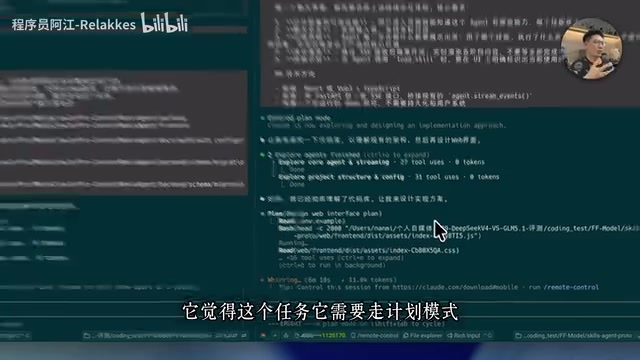
- Autonomously entering planning mode: After exploring the project, the model independently assessed task complexity and switched into planning mode — demonstrating accurate self-evaluation of task difficulty. This behavior is underpinned by Chain-of-Thought (CoT) and Task Decomposition techniques. Planning mode means the model first outputs a structured execution plan before generating any code, enumerating subtasks, identifying dependencies, and anticipating potential risk points. This aligns with the "slow thinking" paradigm used by OpenAI's o-series and DeepSeek's R-series. Research shows that for tasks requiring multi-step planning, explicit plan generation can improve final code correctness by 15% to 30%. The model's ability to autonomously determine when to enter planning mode is itself a form of metacognition.
- Complete requirements comprehension: GLM-5.1 received and completed the landing page requirements in a single pass, whereas DeepSeek V4 Pro missed the landing page entirely in the first round of conversation.
- Clearer task descriptions: Compared to DeepSeek V4 Pro, GLM-5.1's task decomposition descriptions were more structured and precise.
The entire authentication migration task took GLM-5.1 approximately 50 minutes to complete, with code changes spanning multiple frontend and backend files.
Functional Validation Results
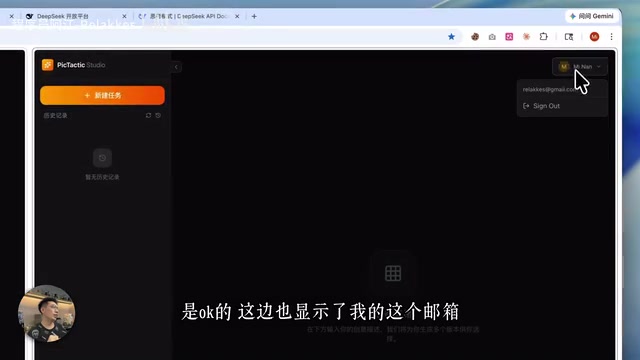
When testing the login functionality, GLM-5.1's implementation supported both Google and GitHub login (both implemented via the OAuth 2.0 protocol for identity verification), and both successfully accessed the image generation agent dashboard. However, one minor issue remained: the left sidebar failed to correctly fetch the user's avatar and history.
By comparison, DeepSeek V4 Pro exposed a far more serious issue in the previous test — chat history was not bound to the user system, causing chat records from different users to bleed into each other. This is a classic session isolation defect. In web application security, it falls under Access Control vulnerabilities and, in severe cases, can be classified under "Broken Access Control" in the OWASP Top 10.
Related articles
 Product Reviews
The Programmer's Desk Setup Guide: Building a Workspace That Feels Like Home
Discover how programmers build productive, comfortable workspaces. From multi-monitor setups to ergonomic design, explore the desk philosophy that drives focus and flow.
 Product Reviews
Qoder vs Cursor Real-World Comparison: Which $20/Month AI IDE Is Better?
Hands-on comparison of Qoder vs Cursor AI IDEs: Agent autonomy, human interaction count, and architecture decisions. Qoder needed only 2 interactions vs Cursor's 8.
 Product Reviews
Cursor Cloud Agent Demo: Eliminating Bottlenecks Across the Entire Software Development Lifecycle
Deep analysis of Cursor's Cloud Agent demo showing how cloud VMs, automated test artifacts, and a full-chain control plane systematically eliminate human bottlenecks across the software development lifecycle.