DeepSeek V4 vs Qwen3.6 Real-World Testing: In-Depth Comparison Across 8 Categories and 150 Scenarios

BenchLocal tests DeepSeek V4 vs Qwen3.6 across 85 scenarios — V4 Pro leads at 691 points.
Using the open-source BenchLocal evaluation tool, four models — DeepSeek V4 Pro, V4 Flash, and Qwen3.6 27B (Q4/Q6 quantization) — were comprehensively tested across 85 daily-use scenarios. V4 Pro leads with 691 points, but its advantage is only about 6%. Testing revealed that quantization precision significantly affects tool calling, while a "quantization reversal" occurred in bug-finding tasks where Q4 outperformed Q6. V4 Flash performed best on command-line tests, proving model size doesn't determine everything.
Introduction: A More Rigorous Real-World LLM Evaluation
Comparative benchmarking between large language models has always been a hot topic in the community. This evaluation uses the professional testing tool BenchLocal from GitHub, covering 8 test categories, 85 daily-use scenarios, and 12 tool-calling functions to conduct a comprehensive head-to-head comparison of DeepSeekAd V4 Pro, V4 Flash, and Qwen3.6 27B (in both Q4 and Q6 quantization levels) — four models in total.
Unlike academic benchmarks, this testing tool focuses on real-world usage scenarios — tool calling, command-line operations, bug finding, instruction following, structured output, agent engines, reasoning & math, and data extraction — aiming to reflect the actual user experience.
Evaluation Methodology and Design Philosophy
Testing Tool: BenchLocal
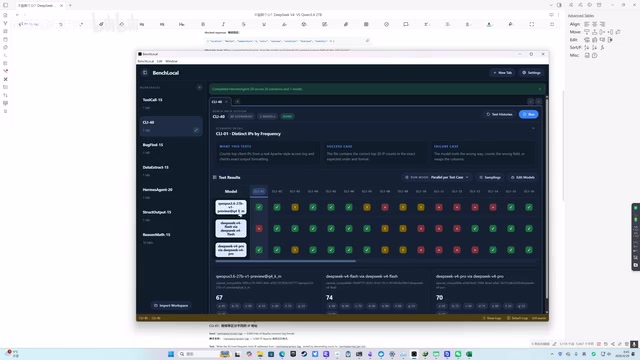
BenchLocal is an open-source local LLM evaluation tool whose core design philosophy is staying close to real-world work scenarios. Take the ToolCore15 test as an example — the very first question is "What's the weather like in Berlin right now?" — testing not the model's knowledge base, but whether it can correctly call the GetWeather API to fetch real-time weather data.
Tool Calling (Function Calling / Tool Use) is one of the core capabilities of modern LLMs, allowing models to identify during inference when they need to call external APIs or functions and generate structured call parameters. The technical implementation typically relies on special system prompt templates, where the model outputs function call requests conforming to JSON Schema, which are executed by an external runtime and the results fed back to the model for continued reasoning. This capability is the foundation for building AI Agents — without reliable tool calling, agents cannot interact with the real world. OpenAI pioneered the standardization of Function Calling in 2023, and it has since become the de facto industry standard, supported by all major models.
The scoring criteria are straightforward and practical:
- Full score: Correctly calls the tool chain and returns accurate results
- Half score: Partial call success but incomplete results
- Zero score: Fails to call any tools and fabricates an answer (i.e., "hallucination")
Reproducibility Assurance
The evaluation results are reproducible. For example, questions that Qwen3.6 27B failed in certain test items still couldn't be passed on a second attempt, eliminating any possibility of fabrication. Anyone can verify the results using the same tool.
Model Configuration Overview
- DeepSeek V4 Pro / V4 Flash: Called via API Key with thinking mode enabled
- Qwen3.6 27B Q4: Locally deployed, Q4 quantization precision
- Qwen3.6 27B Q6: Locally deployed, Q6 quantization precision (supplementary test added due to low Q4 scores)
About Quantization Precision: LLM quantization is a technique that compresses model weights from high-precision floating point (e.g., FP16/BF16) to low-bit integer representations. Q4 means each weight is stored using 4-bit integers, while Q6 uses 6 bits. The core trade-off of quantization is: lower precision means smaller model size, faster inference, and less VRAM usage, but also greater information loss. For a 27B parameter model, full FP16 precision requires approximately 54GB of VRAM, Q4 quantization reduces this to about 14-16GB, and Q6 to about 20-22GB, making it possible to run on consumer-grade GPUs (such as the RTX 4090 with 24GB VRAM). Currently, the most popular quantization format for local deployment is GGUF, popularized by the llama.cpp project, supporting hybrid CPU+GPU inference.
Overall Score Comparison: V4 Pro Leads but the Margin Is Limited
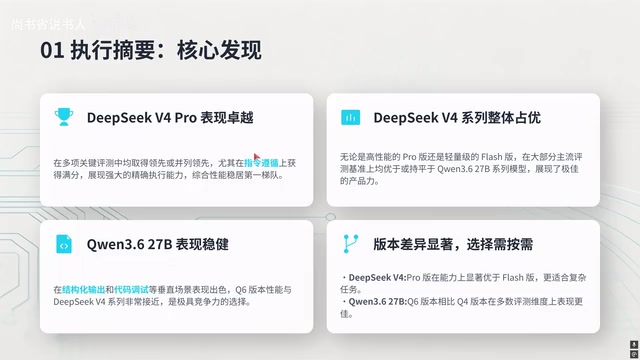
The final overall rankings are as follows:
| Rank | Model | Total Score | Relative to Baseline |
|---|---|---|---|
| 1 | DeepSeek V4 Pro | 691 | +6.3% |
| 2 | DeepSeek V4 Flash | 676 | +4.0% |
| 3 | Qwen3.6 27B Q6 | 670 | +3.0% |
| 4 | Qwen3.6 27B Q4 | 650 | Baseline |
Using Qwen3.6 27B at Q4 precision as the baseline, V4 Pro leads by about 6%, V4 Flash by about 4%, and the Q6 quantized version by about 3%. The lead isn't overwhelming — but if V4 Pro hadn't unexpectedly stumbled on the reasoning & math section, its lead might have exceeded 10%.
Detailed Analysis of All Eight Test Categories
1. ToolCore15: Basic Tool Calling Test
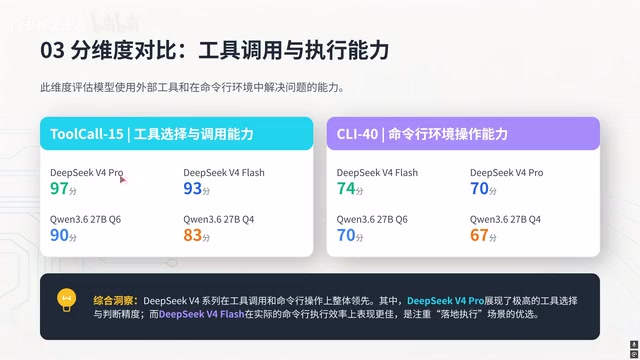
The Q4 quantized 27B model failed two items and got half credit on one, scoring 83 points; the Q6 version only missed one question, achieving 90 points. V4 Pro also had a minor issue, seemingly "overthinking" and losing points. In this test, quantization precision significantly impacts tool-calling capability — this is directly related to quantization loss degrading the model's formatted output abilities. Low-bit quantization may weaken the model's precise control over structured output formats when compressing weights.
2. CLI40: Command-Line Operations Test
Difficulty is a full tier above ToolCore15 — even V4 Pro got 12 out of 40 questions wrong. The Q4 version scored only 67 points. The best performer in this test was actually V4 Flash, demonstrating that having more parameters doesn't guarantee superiority in every scenario. This phenomenon is not uncommon in engineering practice: smaller models with targeted optimizations can often outperform larger general-purpose models on specific tasks.
3. BugFind: Code Bug-Finding Test
An interesting "quantization reversal" phenomenon appeared: Q4 precision scored 87 points, actually higher than Q6's 80 points, even surpassing V4 Flash. This demonstrates that quantization's impact on different capability dimensions is not linear — lower precision quantization may sometimes preserve certain specific abilities. From an information theory perspective, quantization is equivalent to applying a special form of regularization to the weight space, and this "lossy compression" effect can sometimes be beneficial.
Related articles
 Product Reviews
The Programmer's Desk Setup Guide: Building a Workspace That Feels Like Home
Discover how programmers build productive, comfortable workspaces. From multi-monitor setups to ergonomic design, explore the desk philosophy that drives focus and flow.
 Product Reviews
Qoder vs Cursor Real-World Comparison: Which $20/Month AI IDE Is Better?
Hands-on comparison of Qoder vs Cursor AI IDEs: Agent autonomy, human interaction count, and architecture decisions. Qoder needed only 2 interactions vs Cursor's 8.
 Product Reviews
Cursor Cloud Agent Demo: Eliminating Bottlenecks Across the Entire Software Development Lifecycle
Deep analysis of Cursor's Cloud Agent demo showing how cloud VMs, automated test artifacts, and a full-chain control plane systematically eliminate human bottlenecks across the software development lifecycle.