DeepSeek V5 Reportedly Moves to Huawei Ascend for Training as GPT-6.2 and Qwen 4.0 Surface

DeepSeek V5 reportedly to train on Ascend 950; GPT-6.2 and Qwen 4.0 imminent; WeChat open-sources VS1 VL.
The article rounds up same-day developments from Chinese and overseas large-model developers across compute routes, model generations, and toolchains. Most watched: DeepSeek V5 reportedly to use Huawei Ascend 950 as core training compute for the first time, which if realized would upgrade domestic chips from inference substitutes to primary training workhorses. OpenAI's GPT-6.2 Astra is said to be "coming soon," with internal prototypes reportedly outperforming the current version on open math problems; Alibaba's Qwen 4.0 appears on Arena as four anonymous models. On the open-source side, WeChat's vision team open-sources VS1 VL, integrating detection, OCR, segmentation, and matting in one model, with 96.4% rejection accuracy in target-free scenes. On the engineering side, OpenAI rebuilt Codex's Git server Pando, cutting median push latency by nearly 80%. On the research side, MIT finds frontier models can hand-write neural networks. The article groups these threads into two parallel main lines: compute autonomy and the generational race.
Title
DeepSeek V5 Reportedly Moves to Huawei Ascend for Training as GPT-6.2 and Qwen 4.0 Surface
Meta Description
DeepSeekAd V5 is reported to adopt Huawei Ascend 950 as its core training compute for the first time, OpenAI's GPT-6.2 Astra is rumored to be imminent, and Alibaba's Qwen 4.0 appears anonymously on Arena. Meanwhile, WeChat's vision team open-sources the VS1 VL multi-task model, OpenAI rebuilds Codex's Git server Pando, and MIT finds that frontier models can hand-write neural networks.
Article Content
Chinese and overseas frontier model developers released a dense cluster of signals on the same day: DeepSeek is reported to fully adopt Huawei Ascend chips for training its next-generation flagship model for the first time, OpenAI is rumored to be close to launching GPT-6.2 Astra, and Alibaba's Qwen 4.0 has appeared anonymously on an evaluation platform. According to a roundup by Bilibili's "Will叔每日AI动态" (Uncle Will's Daily AI Updates), this wave of developments spans three layers: compute路线, model generations, and toolchain optimization.
DeepSeek V5 Partners with Huawei Ascend, Domestic Chips May Cover the Full Chain from Training to Inference
The most closely watched item is DeepSeek's shift in compute. According to reports cited in the video, DeepSeek V5 will use Huawei Ascend 950 as its core training compute for the first time, with rollout expected next year. If the plan materializes, it means domestic chips will upgrade their role in large-model training from "inference substitute" to "primary training workhorse."
Previously, the more common industry practice was to use domestic chips for inference workloads while training still relied on overseas high-end GPUs. Will's assessment in the video is that domestic chips may thus achieve full-chain coverage across both training and inference. This is a directional judgment rather than a confirmed engineering conclusion; actual results will depend on stability at cluster scale and ecosystem compatibility.

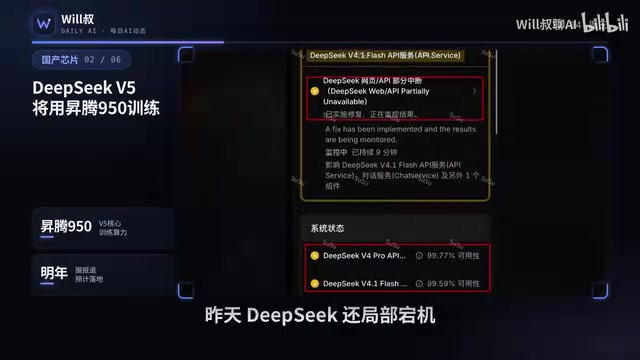
Another noteworthy thread is that DeepSeek experienced a partial outage the day before. Some in the community speculate that this may be a test run ahead of the V4.1 Pro launch. The causal link between the outage and the version iteration has not been officially confirmed; it is a combination of observed phenomena and speculation.
Ascend 950 and the Training/Inference Divide
Before discussing the "primary training workhorse," it is necessary to distinguish the two compute stages of the large-model lifecycle. The training stage requires repeatedly running forward and backward propagation over massive token volumes, placing extremely high demands on chip interconnect bandwidth, memory capacity, and cluster stability; the inference stage performs only forward computation and is relatively more forgiving on precision and ecosystem requirements. Domestic chips have historically entered through inference precisely because the engineering bar for training clusters is higher. Huawei's Ascend series is a representative domestic AI accelerator, and its software stack CANN plays a role similar to CUDA, handling operator libraries, communication libraries, and framework adaptation. If Ascend 950 is used for core training, it means solving not only per-chip compute but also validating communication efficiency and fault recovery at thousand-card/ten-thousand-card scale. Ecosystem adaptation is another hurdle: mainstream training frameworks and operators need to be ported and tuned for Ascend, and the maturity of this step often determines real-world deployment outcomes more than hardware specs.
GPT-6.2 Astra Imminent, Anonymous Models Point to Qwen 4.0
On the OpenAI side, Altman publicly stated that GPT-6.2 Astra is "coming soon." OpenAI's Timbo also posted a remark about "fat GPT." According to the video, its internal prototype's lowest-tier performance on open math problems already exceeds the highest tier of the existing Astra. Such internal prototype data usually lacks a public evaluation standard and can only serve as directional reference.
On Alibaba's side, four anonymous models appeared simultaneously on the Arena evaluation platform, all with model fingerprints pointing to Qwen 4.0. Anonymous testing is a common practice before official releases, and fingerprint指向 has some reference value, but it likewise does not equal official confirmation.
Arena Anonymous Evaluation and Model Fingerprints
LMArena (formerly Chatbot Arena) uses a pairwise blind-test, user-voting Elo-style ranking mechanism and is an important window for the industry to observe new model capabilities. By releasing models under anonymous codenames before official launch, vendors can both collect real user preferences in advance and avoid revealing version information too early. So-called "model fingerprints" usually refer to stable characteristics of anonymous models in answering style, refusal phrasing, tokenizer behavior, or under specific prompts, which the community compares against known models to infer attribution. Such inference has reference value but room for misjudgment: different fine-tuned versions of the same base may be highly similar, and vendors may deliberately obfuscate. Therefore "fingerprints point to Qwen 4.0" should be understood as a high-probability clue, not official confirmation.
WeChat Vision Team Open-Sources VS1 VL, One Model for Multiple Tasks
The open-source move comes from WeChat's vision team, whose open-sourced VS1 VL integrates object detection, OCR, segmentation, and matting into a single model. One particularly practical design: when there is no target in the image, the model directly answers "none," achieving 96.4% rejection accuracy.
This ability to "dare to say none" is uncommon among detection models; most tend to force output boxes in target-free scenes. Building rejection into the model itself has practical significance for downstream false-positive control.

According to data mentioned in the video, the team has previously open-sourced more than 470 models, with cumulative downloads exceeding 4 billion. This scale shows that its open-source strategy has achieved large-scale impact.
Rejection and the False-Positive Problem in Object Detection
Object detection models are typically trained on large numbers of images containing targets, learning "given an image, find the box," and lack explicit supervision for "no target in image," so in empty scenes they tend to output low-confidence boxes or background false positives. Rejection capability means the model proactively outputs "none" when there is no target rather than forcing a box, and its accuracy requires a dedicated negative-sample set for evaluation. Building rejection into a multi-task vision model is clearly meaningful for downstream scenarios such as industrial quality inspection, content moderation, and autonomous driving perception: false positives translate directly into manual review costs or false triggers. A 96.4% rejection accuracy is only truly usable if it holds in out-of-distribution scenes, which still requires more independent evaluation.
Codex Swaps Out Its Git Server, Push Latency Drops Sharply
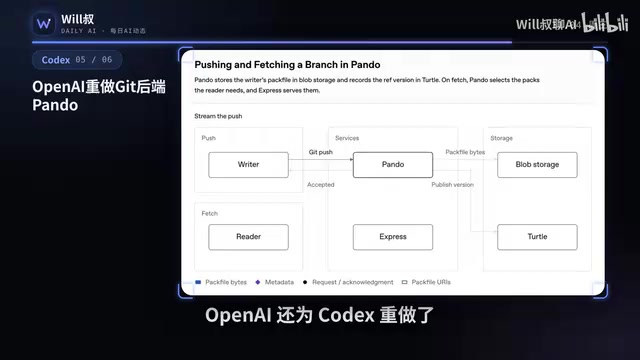
On the engineering side, OpenAI rebuilt the Git server Pando for Codex. The median push latency is said to have been cut by nearly 80%, handling about 1 PB of data per day. For scenarios centered on code generation, the latency of the underlying version-control service directly determines the ceiling of interaction experience; such infrastructure overhauls are often less conspicuous than model releases but have a more direct impact on daily usage.
MIT Finds Frontier Models Can "Hand-Write" Neural Networks
The last item is more research-oriented. MIT found that frontier models can directly hand-write neural networks; the Breakout network written from scratch by GPT-6.2 Astra is said to score 20 times that of a PPU-trained version. If valid, this result points to the model possessing a degree of architecture-level generation capability, not just code completion. Experimental conclusions from a single source still require more replication and validation.
Taken together, the day's developments show two parallel main threads: one is compute autonomy, with the DeepSeek-Ascend combination attempting to bring the training stage into the domestic system; the other is the generational race, with OpenAI and Alibaba both building up for their next versions. The intersection of these two lines will ultimately come down to who can train models more cheaply and stably and deliver them to users.
Neural Architecture Search and "Models Writing Models"
Having models automatically design neural networks is not a new concept; earlier neural architecture search (NAS) relied on search algorithms iteratively evaluating within a candidate space. What is different about MIT's finding is that frontier models directly write trainable network structures from scratch in code form, skipping the explicit search loop. Reinforcement-learning tasks like Breakout are sensitive to network structure, and scores are heavily influenced by training stability, hyperparameters, and random seeds; comparisons like "20 times" are only meaningful with a clearly specified baseline configuration. If reproducible, it points to the model having some architecture-level inductive capability, but there is still a gap before it can reliably replace human network design, and conclusions from a single experimental source should be treated with caution.
One-line Summary
DeepSeek V5 reportedly to train on Ascend 950; GPT-6.2 and Qwen 4.0 imminent; WeChat open-sources VS1 VL.
Paragraph Summary
The article rounds up a dense cluster of same-day developments from Chinese and overseas large-model developers, spanning three layers: compute路线, model generations, and toolchain. Most closely watched is the report that DeepSeek V5 will for the first time use Huawei Ascend 950 as core training compute; if realized, it means domestic chips upgrade from inference substitutes to primary training workhorses. On OpenAI's side, GPT-6.2 Astra is said to be "coming soon," with internal prototypes reportedly outperforming the existing version on open math problems; Alibaba's Qwen 4.0 appears on the Arena evaluation platform as four anonymous models. On the open-source side, WeChat's vision team open-sources VS1 VL, a single model integrating detection, OCR, segmentation, and matting, with 96.4% rejection accuracy in target-free scenes. On the engineering side, OpenAI rebuilt the Git server Pando for Codex, cutting median push latency by nearly 80%. On the research side, MIT finds frontier models can directly hand-write neural networks. The article summarizes these threads into two parallel main lines: compute autonomy and the generational race.
Related articles
 Tech Frontiers
Coldframe: A Honeypot Disguised as a Supermarket Freezer Controller
Coldframe is a honeypot disguised as Danfoss AK-SM 800A and Dixell XWEB freezer controllers, built as a single Python file that detects CVE-2025-41450 attempts and is identified as real devices on Shodan.
 Tech Frontiers
GRFNet: A Lightweight PyTorch Model Designed for Multichannel Time-Series Classification
GRFNet is a lightweight PyTorch model for multichannel time-series classification, originating from EEG decoding research. With only 3,847 parameters, it is based on the ROCKET architecture, combining random convolution kernels with learnable spatial filters, supports arbitrary input lengths, and will soon be evaluated on the PhysioNet dataset.
 Tech Frontiers
CUDA-Accelerated Rocket League Simulator: A Player-Made Hardcore Experiment
A Reddit post shows a "100% Accurate" Rocket League simulator accelerated with CUDA. We analyze its technical context, CUDA's value in game physics simulation, and the significance and limitations of such community projects.