DeepSeek Vision Lead Zhang Bo Launches Open-Source Linger: Departure After Billion-Yuan Funding and the New Agent Battle
After DeepSeek's billion-yuan funding, core scientist Zhang Bo departs to launch open-source desktop agent Linger, diverging from the cloud API path.
Just three days after DeepSeek completed a 105.5 billion yuan second funding round, its vision-language model project lead Zhang Bo announced a new company and open-source product Linger—a desktop-focused personal agent with no mobile app. Zhang Bo has a strong résumé, having worked on VQ Diffusion and the Rodin digital human, and joined DeepSeek in 2023 to lead the VL project. Linger advocates pulling intelligence back to local devices, connecting third-party models and optimizing local large-model execution—reportedly an RTX 3060 with 12GB VRAM can run a 125B-parameter model at 45.5 tokens per second. Meanwhile, several core DeepSeek members have moved to Xiaomi, Tencent, ByteDance, and other big tech firms, spanning base models, inference, OCR, and multimodality. The article draws out the philosophical contest between open-source local agents and token-billed cloud services, noting that retaining scientists depends on shared direction, not valuation.
Just After Billion-Yuan Funding, a Core Scientist Announces Going Solo
According to Bilibili creator "36克" in a video, DeepSeekAd's second funding round has just completed its business registration change, with 31 investors entering the holding platform built by Liang Wenfeng, involving 105.5 billion yuan. Yet just three days after the funding news landed, former DeepSeek vision-language model project lead Zhang Bo publicly announced his new company and new product—Linger, an open-source desktop personal agent.
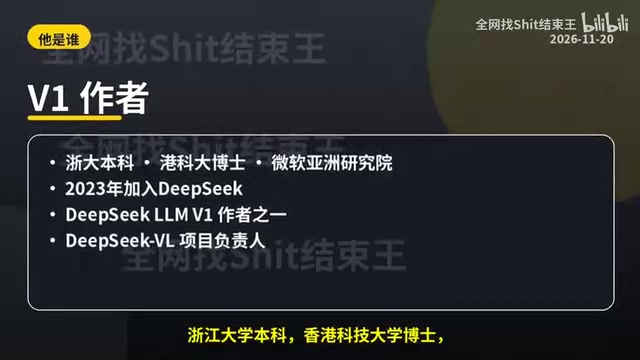
The timing makes it hard not to read the two events together. On one side, billions in cash have arrived and morale looks stable; on the other, a core project lead has chosen to leave and start a company. Zhang Bo is no marginal figure: undergraduate at Zhejiang University, PhD at Hong Kong University of Science and Technology, formerly at Microsoft Research Asia, author of VQ Diffusion and the Rodin digital human, joined DeepSeek in 2023, participated in the R&D of the first-generation large model V1, and served as lead of the DeepSeek VL project. A résumé like that is enough to make his departure a signal.
VQ Diffusion (Vector Quantized Diffusion) is a class of generative models combining diffusion models with vector quantization, mainly used for high-quality image generation. Its core idea is to first encode images into a discrete latent space with VQ-VAE, then run the diffusion process on discrete tokens, balancing generation quality and sampling efficiency. Zhang Bo is one of the model's authors; the work was published around 2022 and has had some influence in the image generation field.
Rodin (Digital Human) is another work Zhang Bo participated in, focusing on the generation and modeling of digital humans, typically involving 3D human reconstruction, expression driving, or neural rendering. Both works reflect Zhang Bo's accumulated expertise in generative vision and multimodality, and explain why he could serve as lead of the vision-language model (VL) project at DeepSeek.
Linger's Product Logic: No Mobile App, Desktop Only
Zhang Bo's positioning of Linger is very clear: an open-source personal agent focused on desktop, with no mobile app. His announcement was pointed—in the 1960s computing was centralized, until the personal computer put power in everyone's hands; now AI is trained in data centers and then rented to you by the token.
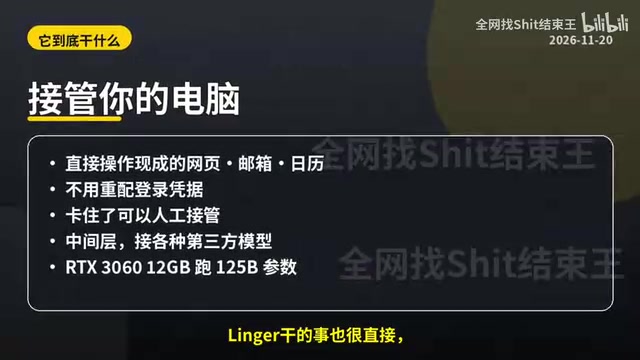
The idea lands concretely: the web pages, email, and calendar already on your computer require no reconfiguring of a pile of login credentials—Linger takes over as a middle layer at any time. It connects to various third-party models while being specially optimized for local large models. According to the video, an RTX 3060 with 12GB of VRAM can run a 125B-parameter QN model at 45.5 tokens per second—a number that is no embarrassment on a local machine. More critically, the entire system is open source; in Zhang Bo's words, compute and models need not be rented—they can be moved back onto your own machine.
This logic runs directly against DeepSeek's just-opened API business model. While leading companies package intelligence as a token-billed cloud service, Zhang Bo chooses to pull intelligence back to local devices and individuals—a contest over product direction and over philosophy.
Agent refers to an AI system that can perceive its environment, plan autonomously, and call tools to complete multi-step tasks. Unlike single-turn Q&A, agents typically have memory, tool-calling (such as browser, email, calendar APIs), and task decomposition capabilities. A personal agent emphasizes centering on personal devices, handling users' daily affairs with data and execution completed locally or in a controlled environment. Cloud agents bill by token and rely on remote APIs, while local agents place model inference on the user's machine, offering stronger privacy and controllability but with hardware compute requirements. Linger is a typical representative of a local personal agent.
Talent Drain Is No Isolated Case: DeepSeek's Departure List
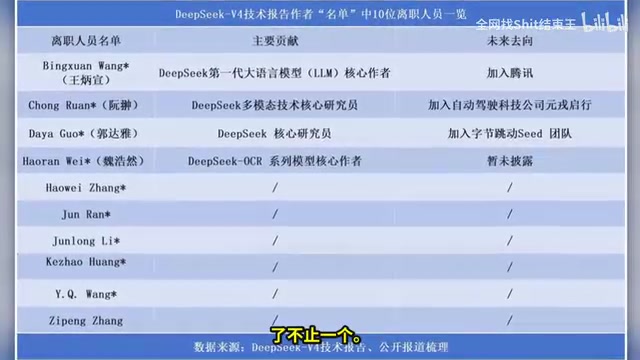
Zhang Bo's departure is not an isolated case. According to the Bilibili video, several core DeepSeek members have moved to big tech: Luo Fuli went to Xiaomi to lead MIMO, Wang Bingxuan went to Tencent, and Guo Daya joined ByteDance SEED as agent lead. The video notes that in a research list of nearly 300 people in a technical report, 10 names are marked "departed," spanning four main lines: base models, inference, OCR, and multimodality.
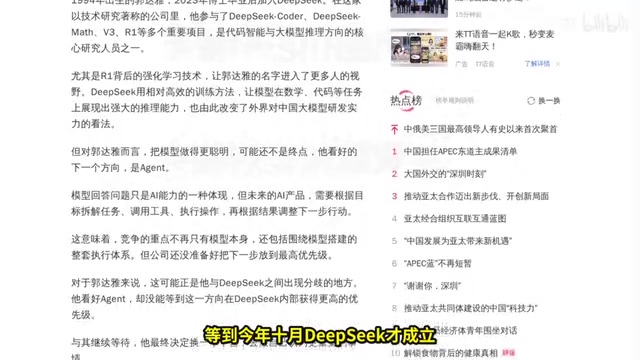
Guo Daya's reason for leaving is especially telling: he was bullish on the agent direction, but it had low priority inside DeepSeek, while ByteDance was willing to commit resources for him to focus on it. Only in October this year did DeepSeek establish a product department, merging the Harness, Web, App, and Platform teams under Cui Tianyi, who comes from a quantitative background. By the time it bought the ticket, the person most eager to sail the ship was already on another one.
The video author calls a Paper headline "very clever"—"No one at DeepSeek is starting a company; Liang Wenfeng has finally retained people." The funding did stabilize morale, and for over half a year no core member departures were heard of. But Zhang Bo's shot reminds everyone: retaining people doesn't depend on valuation, but on letting them do what they believe in. The company has no clock-in, no overtime, no clear performance metrics; Liang Wenfeng's logic is that one person can do in a day—the video cuts off there, but the meaning is clear: organizational freedom does not equal alignment on direction.
Open-Source Agents vs. Cloud APIs: The Fork Between Two Paths
Linger's emergence puts a question on the table: is the future of personal agents a pay-as-you-go service in the cloud, or open-source software living on everyone's computer?
Zhang Bo chooses the latter. Open source means users control models and compute themselves and need not entrust data and behavior to remote APIs; local optimization means the barrier is lowering, and consumer-grade GPUs can run models of considerable size. For the narrative accustomed to solving everything with cloud services, this is a reverse bet.
Of course, this path has obvious challenges: the performance ceiling of local models, the stability of multi-model orchestration, and the commercialization path of an open-source project are all questions Linger must answer. On DeepSeek's side, the establishment of the product department shows it is also catching up on agents. The two sides now stand at different entrances to the same track—one moving down from the cloud, the other moving up from local.
Zhang Bo's departure and Linger's open source may not change the landscape immediately, but they clearly mark one thing: when leading companies retain people with funding and valuation, what truly keeps scientists is the direction itself.
Open-source agents generally mean model weights, inference frameworks, and tool-calling logic are open to the public, allowing users to deploy, modify, and audit on their own. Advantages include data staying local, customizability, and no metered billing; challenges include local model performance often lagging behind cloud flagship models, plus the extra investment needed for multi-model orchestration, tool ecosystem maintenance, and commercial sustainability. The cloud API model, by contrast, has vendors host models and bill by token or call count; users need not worry about compute and operations, but data must be uploaded and costs grow with usage. The two paths are not entirely mutually exclusive—many open-source agents also support connecting to cloud models as a supplement.
Related articles
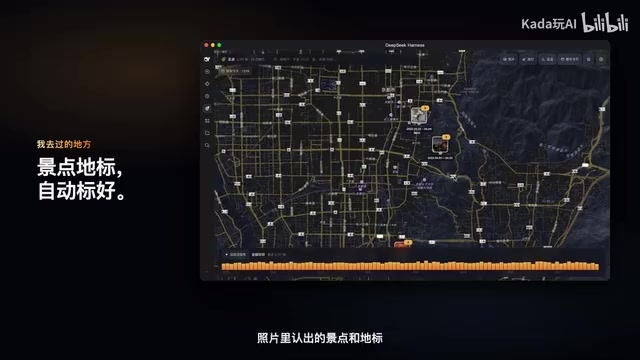
DeepSeek Harness Plugin "Footprints": Turn Your Photo Album into a 3D Earth
DeepSeek Harness plugin "Footprints" projects album photos onto a 3D Earth by GPS location, auto-generates travel storylines, and supports natural language photo search, "that day in years past," and landmark recognition, with a local read-only index for privacy.
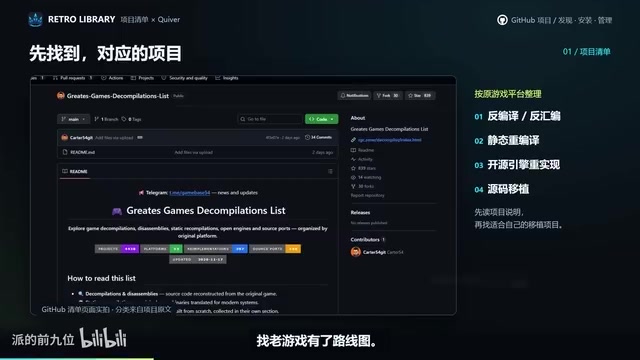
Quiver Launcher + Game List: One-Stop Management for PC Ported Games
Learn how the open-source Quiver launcher (localized) and game project list work together: the list discovers PC port and recompilation projects, while the launcher handles installation, version updates, and tag management, with full workflow and manual import options.

Lost DSH Crash Logs? This Open-Source Black Box Makes Every Crash Traceable
DSH WARN logs flash by and vanish on restart? The open-source DSH Runtime Lock black box writes WARN/ERROR to local JSONL in real time, auto-rotates to keep four segments, zero dependencies, no network requests, one-command setup.