DeepSeek Web Adds Quota Limits, Google Releases Gemini 4 Hydrogen

DeepSeek web tests quota prompts, Google opens Gemini 4 Hydrogen, NVIDIA CEO Jensen Huang resigns.
This AI Evening Report covers major product and industry news: DeepSeek's web code now includes quota status queries and over-limit handling, though limits aren't enforced for all accounts yet; Google officially opens Gemini 4 Hydrogen for everyday coding and agent tasks, reportedly 2.5x faster than Gemini 3.8 Flash with 1M-token context; NVIDIA announces Jensen Huang's resignation as President, CEO, and Director, with CFO Colette Kress as interim CEO. Other updates include DeepSeek Harness RC, Thinking Machines opening model weights, OpenAI enterprise security products, Cloud Code and Meetings, Anthropic self-hosted agents, SpaceX compute campus plans, funding rounds, hardware launches, and new models/tools from multiple companies.
The November 13 AI Evening Report brings several major updates: DeepSeek's web version begins adding model quota status queries, Google officially opens Gemini 4 Hydrogen, NVIDIA CEO Jensen Huang announces his resignation, and multiple AI tools and models see new progress.
DeepSeek Web Adds Quota Limits, But Not Yet Fully Enforced
According to reports from a Bilibili creator, the new version of DeepSeekAd's web code now includes a model quota status query feature. When users hit the usage limit, the page prompts them to wait for the quota to recover before trying to send messages again, and file uploads also have corresponding over-limit handling logic. This indicates that the web version has made technical preparations for quota prompts, but it does not mean all accounts have already started being limited. The specific quota rules and recovery mechanism have not yet been confirmed.
This change may signal that DeepSeek is preparing for more refined resource management, especially as its user base grows rapidly—using quota limits to balance service load is a common practice. However, it is currently unclear whether this will affect free users' daily usage.
Google Gemini 4 Hydrogen Officially Opens, Positioned for Everyday Coding and Agents
Google's previously teased Gemini for Hydrogen is now officially open. Google positions it as a fast model for everyday coding and agentic tasks. According to Google's testing, Gemini 4 Hydrogen completes tasks 2.5 times faster than Gemini 3.8 Flash. Developers can now use the model through AI Studio and the Gemini API, with a context length of 1 million tokens, priced at $1.5 per million input tokens and $7.5 per million output tokens.
This release further enriches Google's model matrix, offering developers a new option that balances speed and cost. Especially for agent application scenarios, which have high requirements for response speed, Gemini 4 Hydrogen's fast characteristics may make it an ideal choice.

Context Window and Token Pricing: The "context length" of a large language model refers to the total number of input plus output tokens the model can accommodate in a single inference. 1 million tokens is roughly equivalent to hundreds of thousands of Chinese characters or hundreds of pages of documents, enabling the model to ingest an entire medium-sized code repository or multiple long reports at once. API billing by token is industry standard: input tokens refer to the prompts and context fed into the model, while output tokens refer to the model's generated replies. The two typically have different unit prices, with output being more expensive because token-by-token generation during decoding consumes more compute. Based on the pricing in this article, processing 1 million input tokens costs about $1.5, and generating 1 million output tokens costs about $7.5—output is 5 times the input price, a ratio common among mainstream vendors that reflects the cost structure of inference. When evaluating a model's cost-effectiveness, developers need to estimate actual expenses based on the ratio of input to output in their tasks; long-context retrieval tasks incur more cost on the input side.
NVIDIA Leadership Change: Jensen Huang Resigns as CEO
NVIDIA announced that Jensen Huang has resigned from his roles as President, CEO, and Director, effective immediately. Current CFO Colette Kress has been appointed Interim CEO and will continue as head of finance. The board has begun searching for a permanent successor from both inside and outside the company. This sudden change has drawn widespread industry attention; as the leader in AI chips, NVIDIA's leadership transition could influence the company's strategic direction.
Zhipu New Model Rumors: KingBench 4 Leaderboard Sparks Speculation
A KingBench 4 leaderboard image has sparked speculation about a new model from Zhipu. The original image only shows the suffixes Pro, Mad, and Small, while the circulated GLM Nano name and scores come from another speculative image. Zhipu has not officially confirmed this information. Such rumors are common in the AI community, but they should be treated with caution while waiting for official news.
Other Important Updates
DeepSeek Harness 0.2.2 rc3 Released
DeepSeek Harness released the third release candidate (rc3) of version 0.2.2. The new version adds an experimental plugin that can import the history of DeepSeek App or web version drawings into the workspace, making it convenient for users to continue previous conversations. In addition, this version fixes an issue where the Windows desktop version sometimes failed to update or did not automatically reopen after updating.

Thinking Machines Opens Inkling 2 Small Weights
Thinking Machines has opened the weights of Inkling 2 Small under the Apache 2.0 license. Previously, this model was mainly used through the Tinker platform; now developers can download the weights and deploy them themselves. This lowers the barrier to use and promotes model accessibility and secondary development.
Open Weights and the Apache 2.0 License: "Open weights" means the vendor publicly releases the trained model parameters, which developers can download to deploy, fine-tune, or distill themselves. This differs from the closed-source model of offering only API calls, and it is not the same as fully open source with public training data and code. Apache 2.0 is a permissive open-source license that allows commercial use, modification, and redistribution, requiring only that copyright and license notices be retained; it does not force derivative works to use the same license, making it friendly for enterprise secondary development. By contrast, some models use custom licenses that impose restrictions on user scale or purpose. Open weights reduce inference costs and data export concerns, allowing models to run locally or in private clouds, but they also mean vendors lose direct control over model usage.
OpenAI Releases Enterprise Security Products
OpenAI released two enterprise security products: Daybreak Defense Factory and Daybreak Red Team. The former can turn discovered security issues into patches for team review, while the latter is aimed at authorized security assessments for enterprises. This shows OpenAI's further expansion in the enterprise security space.
Cloud Code Updated to 2.1.323
Cloud Code has been updated to version 2.1.323, adding Code Mode, which is off by default. When enabled, Cloud can write JavaScript to call tools. The new version also filters compatible plugins based on the Cloud Code version to avoid loading incompatible versions.
Cloud Meetings Begins Testing
Cloud Meetings has begun rolling out testing to Team and Enterprise plans, initially supporting Google Meet. After inviting Cloud into a meeting, teams can ask it on the spot to write documents or create whiteboards; afterward, meeting notes, action items, and artifacts remain on the meeting page.
Anthropic Opens Self-Hosted Cloud Manage Agents
Anthropic has opened self-hosting for Cloud Manage Agents. Eligible enterprises can place running services, sandboxes, and session records in their own cloud or on-premises data centers, while model requests are still sent to the service provider chosen by the team. This meets enterprise needs for data privacy and compliance.
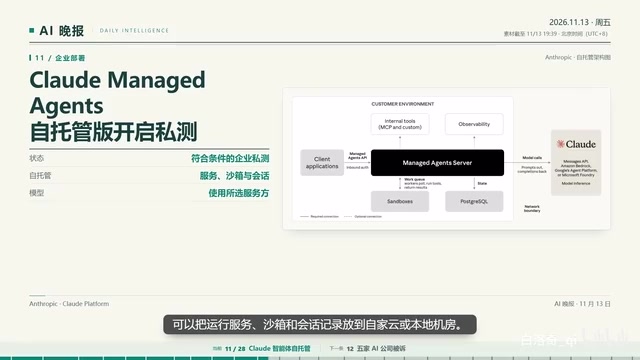
Agents and Sandboxes: An agent refers to a system driven by a large model that can autonomously plan steps and call tools (writing files, executing code, searching the web, etc.) to complete multi-step tasks. Unlike single-turn Q&A, it often needs to run continuously for extended periods and retain an execution trace. A "sandbox" is an isolated environment provided for such execution, allowing model-generated code and tool calls to run inside a restricted container so as not to affect the host system or leak data. Self-hosting means enterprises deploy running services, sandboxes, and session records in their own cloud or on-premises data centers, with only model inference requests still sent to the model service provider—thereby retaining model capabilities while meeting compliance and data residency requirements. This hybrid architecture of "self-held control plane, externally sent inference plane" is a common compromise for enterprises adopting closed-source frontier models today.
Nonprofits Sue Multiple AI Companies
Four nonprofit organizations have sued Anthropic, Google, Meta, OpenAI, and SpaceXAI, asking the court to restrict the development of certain advanced AI systems. This is a request filed by the plaintiffs; the court has not yet ordered a halt.
SpaceX Announces AI Compute Campus Plans
SpaceX announced plans for two AI compute campuses, with proposed investment exceeding $74 billion. The Texas project exceeds $24 billion, and the Arizona project is about $50 billion; the latter still requires local approval.
Report on Weight Initialization Traces in Chinese AI Models
A report from Unemployment Labs claims that the public weights of six Chinese AI models carry initialization traces consistent with NVIDIA Blackwell chips. This can suggest what type of hardware the weights may have been generated on, but it is not enough to prove the full training process, training location, or whether any rules were violated.
Sarabras Earnings Disclose Microsoft Cloud Inference Agreement
Sarabras disclosed in its earnings report that its cloud inference agreement with Microsoft is subject to life agreement conditions. The company's third-quarter revenue hit a new high of $210.8 million, up 55% year-over-year.
Mirindio Completes $1 Billion Series A Funding
Mirindio, an agent company focused on scientific R&D, announced the completion of a $1 billion Series A round. The company has now turned its R&D process into a product called Lore, which can assist with writing code and running experiments; it is currently in its fourth round of testing.
Google and Samsung's Gemini Smart Glasses Open for Preorder
Google and Samsung's co-developed Gemini smart glasses are now open for preorder, starting at $395 in the U.S. market, with a planned launch on December 10. Wearing the glasses lets Gemini translate, converse, or describe what the camera sees.
Perplexity Launches Decider V13 and Flash V1.3
Perplexity launched two models, Decider V13 and the lighter Flash V1.3, both with open weights. A new Locate feature can locate and extract a segment of content from the input according to instructions, and it can now also be called through the Decisions API. Replay Agent adds procurement and ad placement features; Core and Pro users in the U.S. can use Link and Visa to make purchases, and global Pro users can use it to create Google ads, with user approval required before payment and official launch.
World Labs Opens Atlas Tool Site Viewfinder
World Labs has opened the Atlas tool site Viewfinder, which can reconstruct scenes from images and then generate new viewpoints. Chazel is used to build and edit 3D geometry and can also render visuals. Developers can access the same capabilities through APIs.
ByteDance's Cdream 5 Launches
ByteDance's Cdream 5 has launched. File provides image generation and editing APIs, allowing multiple rounds of edits to the same image; you can also directly change text in the image, and Layerize can split an image into separate layers.
Runway Supports Triple H 3.1 for 3D Model Generation
Runway now supports generating 3D models from text or images using Triple H 3.1. You can also upload your own GLB files, choose an angle as a reference for generating the next image or video, and export the model.
Expo Launches Cloud Simulator
Expo has launched a cloud simulator for paid plans. Coding assistants can install and test iOS or Android apps in the cloud and leave screen recordings for developers.

AWS Makes New Amazon Bedrock Agent Core Runtime the Default
AWS has made the new Amazon Bedrock Agent Core Runtime the default runtime for new environments. AWS says the new runtime can start sessions up to 15 times faster; existing environments are not affected by this default change.
Salesforce Opens Speech Transcription Model SOV Transcribe 1
Salesforce has opened the weights of its speech transcription model SOV Transcribe 1. According to Artificial Analysis's non-streaming evaluation, its word error rate is 2.3%, ranking first among open-weight models on that leaderboard.
Lama Index Releases Document Parsing Evaluation Parse Bench 2
Lama Index released Parse Bench 2, a document parsing evaluation that breaks down more than 330 error types and also adds forms. On the same day, it launched OCRER 1.5 for evaluating document parsing in Lama Parse, as well as complex tables and forms.
Arena.ai Proposes Having Evaluator Models Actually Operate Web Apps
Arena.ai proposes having evaluator models actually operate web applications before scoring them. The team has opened two datasets: one with 6,390 app pairs with human preferences, and another recording human-verified functional requirements.
DeepSeek V4OnePro Rumors
Finally, rumors about DeepSeek V4OnePro: the circulated clues come from a public submission by Verso Labs, in which only a codename appears in the code used to test the ordering of the model list. DeepSeek has not officially released this model.
That's all for today's AI news. Thanks for watching.
Benchmarks and Evaluation Credibility: Several leaderboards and evaluations appear in this article, such as KingBench 4, Artificial Analysis, and Parse Bench 2; understanding their nature helps judge the value of the information. A benchmark is a standardized evaluation using a fixed set of questions to measure model capabilities. Different leaderboards vary greatly in question composition, scoring methods, and update frequency, and a high score does not necessarily mean stronger performance on real tasks. In addition, model names and scores often leak before official release through screenshots, code commits, or community speculation; such rumors may come from misreading or stitching together information and should be treated as unconfirmed. When reading evaluation conclusions, it is advisable to check whether the evaluation discloses its methodology, whether it distinguishes open-weight from closed-source models, and whether it reports breakdowns of error types.
One-line Summary
DeepSeek web tests quota prompts, Google opens Gemini 4 Hydrogen, NVIDIA CEO Jensen Huang resigns.
Paragraph Summary
This AI Evening Report rounds up multiple product and industry developments. DeepSeek's web code now includes model quota status queries and over-limit handling logic, but quotas are not yet enforced for all accounts; Google officially opens Gemini 4 Hydrogen, positioned for everyday coding and agentic tasks, reportedly 2.5 times faster than Gemini 3.8 Flash and supporting 1 million tokens of context. NVIDIA announced that Jensen Huang has resigned as President, CEO, and Director, with CFO Colette Kress as interim CEO. Other updates cover the DeepSeek Harness release candidate, Thinking Machines opening model weights, OpenAI enterprise security products, Cloud Code and Meetings, Anthropic self-hosted agents, SpaceX compute campus plans, multiple funding rounds and hardware launches, and new models and tools from several companies.
Related articles

RePlan-VLA: Progress-Aware Replanning Breakthrough for Long-Horizon Robotic Manipulation
The RePlan-VLA framework converts VLA models' short-horizon capabilities into reliable long-horizon execution through progress-aware adaptive replanning, improving success rates by 21.9% and 10.4% on RoboCasa365 and CALVIN, and validating real-world deployment on a Franka Research 3 robot.

Geometric Bridge Flow Matching: A New Breakthrough in Blind Rigid Motion Correction
Geometric bridge flow matching enables blind rigid motion correction in head CBCT, achieving 37.1 dB PSNR and 0.27 mm RPE on simulated data in ~9.1 minutes, outperforming existing methods.

Google Releases Gemini 4 Hydrogen: 2.5x Faster Without Sacrificing Intelligence
Google releases the lightweight Gemini 4 Hydrogen: 2.5x faster task completion, AA Intelligence Index of 54 beating its flagship sibling, 7.3s single-step on Agent Arena faster than Claude and GPT rivals, four thinking levels with pay-as-you-need pricing, now available across AI Studio and more.