Deezer to Launch AI Music Filter, Championing Human Creativity

Deezer will launch an AI music filter toggle this year, putting the choice in users' hands.
Streaming platform Deezer has announced that within the year it will launch a "Hide AI-generated music" toggle that users can enable in settings so that recommendations, editorial playlists, and personalized radio no longer include content identified as AI-created. The detection mechanism combines audio feature analysis and metadata tagging, but technical details have not been disclosed. Deezer emphasizes that this is not a ban on AI music, but a way to satisfy some listeners' preference for "human-made" music. The article analyzes the governance lag caused by the influx of bulk AI music, noting that accurate identification remains difficult and that misjudgments could harm human musicians who use AI assistance. The industry is calling for mandatory upload labels on AI music to achieve transparency, and the transparency requirements of the EU AI Act also bring compliance pressure to platforms. Deezer's move could pressure competitors such as Spotify to follow suit, forming a new industry standard.
Streaming platform Deezer has announced that it will roll out a new feature this year allowing users to filter out AI-generated music from recommendations and playlists. The move marks the first time a mainstream music platform has directly addressed the user experience problems caused by the flood of AI music, and it has sparked widespread discussion about creative authenticity and platform responsibility.
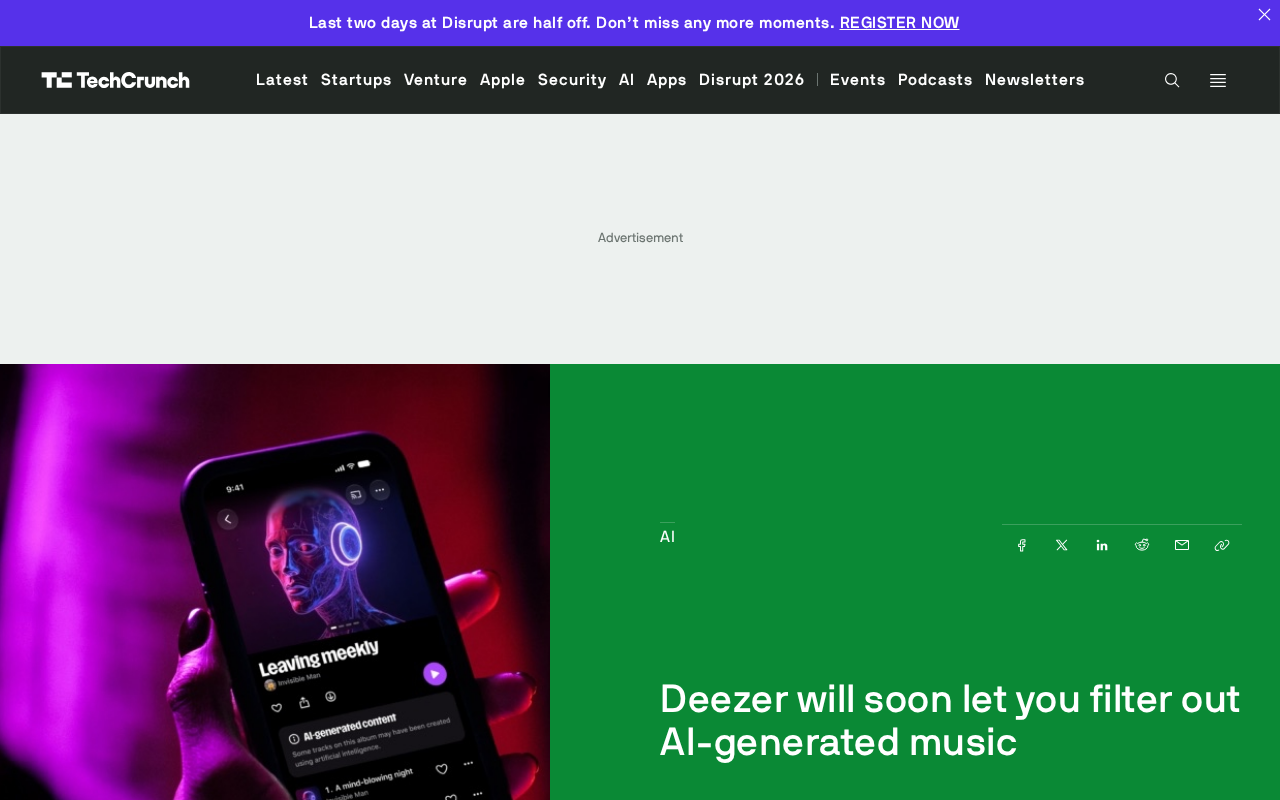
Feature Details: Users Can Choose to Block AI Tracks
According to Deezer, the feature will launch as a toggle that users can enable in their settings under a "Hide AI-generated music" option. Once turned on, algorithmic recommendations, editorial playlists, and personalized radio stations will no longer surface content identified as AI-created. Deezer says the detection mechanism will combine audio feature analysis with metadata tagging, but has not disclosed specific technical details.
This design puts the choice in users' hands rather than imposing a blanket ban on AI music. Deezer emphasizes that the move is not a rejection of AI as a legitimate creative tool, but rather a way to accommodate listeners who prefer "human-made" music. For users who rely on background music while working or relaxing, the filter can reduce the annoyance of unexpectedly hearing low-quality AI-assembled tracks.
Industry Context: AI Music Floods In as Platform Governance Lags
Over the past year, generative AI tools have dramatically lowered the barrier to music production. From Suno and Udio to various open-source models, users can produce complete songs simply by entering text prompts. These tracks are uploaded to major streaming platforms at a rate of tens of thousands per day, and many are distributed in bulk through automated scripts, crowding out human-curated recommendation slots.
According to industry observers, Deezer is not the first platform to face this problem, but it is the first mainstream service to publicly commit to offering a filtering option. Spotify and Apple Music currently rely mainly on rights-holder complaints and manual review to handle AI content, and have yet to launch proactive filtering tools for listeners. Deezer's move could pressure competitors to follow suit, forming a new industry standard.
Suno and Udio are currently the most representative AI music generation platforms. Suno was founded in 2022, and users can input a single lyric line or theme description to generate a song complete with vocals, accompaniment, and full arrangement within tens of seconds; early versions could already imitate pop, rock, rap, and many other styles. Udio was founded by former DeepMind researchers and focuses on high-fidelity sound quality and fine-grained style control, allowing users to redo and extend generated results section by section. What both share is an extremely low generation barrier, fast single-track output, and the ability to call APIs in bulk—which has directly led to exponential growth in the number of AI tracks on streaming platforms. At the same time, they also face infringement lawsuits from rights holders such as Universal Music, with the dispute centering on whether training data included copyrighted music. Understanding these two platforms helps clarify the supply-side pressure Deezer faces in launching its filtering feature.
Technical Challenges and Controversy: Identifying AI Music Is Not Simple
Accurately identifying AI-generated music remains technically difficult. After mastering or human remixing, some AI tracks differ only minimally in audio characteristics from human works. If Deezer relies only on uploader self-declarations or third-party detection tools, false negatives and false positives may occur. Mistakenly labeling works by human independent musicians as AI would provoke protests from creators.
On the other hand, supporters of AI music argue that filtering features may reinforce bias against AI art. The value of music should be based on how it sounds rather than who created it, and a platform actively distinguishing "human" from "AI" may hinder new forms of artistic exploration. Deezer has not yet responded to how it will balance these controversies, saying only that it "will continue to optimize the detection model."
Audio feature analysis and metadata tagging are the two main technical paths for AI music identification. Audio feature analysis typically extracts signal-level indicators such as spectral centroid, harmonic structure, rhythmic stability, and compression artifacts, then trains classifiers to distinguish human performances from model generations—but AI models iterate extremely quickly, and generated audio increasingly resembles real recordings, making classifiers prone to failure. Metadata tagging relies on uploaders declaring whether AI was used in file headers or platform backends, or on third-party detection services (such as AI audio detection APIs) providing confidence scores. Its advantages are low cost and scalability; its disadvantages are that it is easy to circumvent or can produce false positives. The transparency requirements for deepfake content in the EU AI Act are also essentially pushing metadata tagging toward standardization. Deezer has not disclosed a specific approach, suggesting it will likely adopt a hybrid strategy of "initial screening via feature analysis + metadata review" to balance accuracy and coverage.
Potential Impact on Creators and Listeners
For independent musicians, Deezer's filtering feature is a double-edged sword. On the positive side, original human works may gain more exposure in recommendation feeds and face less direct competition from bulk AI content. But if the platform's detection algorithm is not precise enough, some musicians who use AI-assisted arrangement or timbre design could be wrongly affected and lose traffic they deserve.
For listeners, more choice means a more personalized experience. Jazz fans who prefer purely human performance can block endless AI-generated piano pieces, while electronic music enthusiasts may be willing to keep experimental AI works. Deezer's toggle design exactly meets this divided demand rather than making the decision for users.
Future Outlook: Labeling and Transparency May Become Mainstream
Deezer's plan is only the beginning. The industry widely believes that a more thorough solution is to require that AI music be uploaded with a non-removable metadata tag, similar to an ingredient list on food packaging. That way, users on any platform can tell at a glance whether a song was generated by AI, and filtering would not need to rely on after-the-fact detection.
The EU AI Act has already set transparency requirements for deepfake content, and similar regulation may soon arrive in the music sector. Deezer's launch of a filtering feature now is both a product-level defense and an advance compliance move. Whether or not the technology can be perfectly implemented, letting users know and giving them choice is a responsibility streaming platforms cannot avoid.
The EU AI Act is the world's first systematic regulatory law targeting AI, formally adopted in 2024 and taking effect in stages. The act adopts a risk-tiered approach and sets clear transparency obligations for "deepfakes" and AI-generated content: providers of generative AI systems are required to ensure that synthetic content can be identified, usually by embedding machine-readable markers in outputs or disclosing them to users. Although the music sector is not listed separately, AI-generated songs that imitate real singers' voices or styles may simultaneously trigger deepfake provisions and copyright law. For streaming platforms, this means they may in the future be required to proactively label AI content rather than merely offer a filter toggle. Deezer's launch of a filtering feature now can be seen as building the infrastructure for content identification and user awareness ahead of formal regulation, reducing future compliance costs.
One-line Summary
Deezer will launch an AI music filter toggle this year, putting the choice in users' hands.
Paragraph Summary
Streaming platform Deezer has announced that within the year it will launch a "Hide AI-generated music" toggle that users can enable in settings so that recommendations, editorial playlists, and personalized radio no longer include content identified as AI-created. The detection mechanism combines audio feature analysis and metadata tagging, but technical details have not been disclosed. Deezer emphasizes that this is not a ban on AI music, but a way to satisfy some listeners' preference for "human-made" music. The article analyzes the governance lag caused by the influx of bulk AI music, noting that accurate identification remains difficult and that misjudgments could harm human musicians who use AI assistance. The industry is calling for mandatory upload labels on AI music to achieve transparency, and the transparency requirements of the EU AI Act also bring compliance pressure to platforms. Deezer's move could pressure competitors such as Spotify to follow suit, forming a new industry standard.
Related articles

Chain of Thought Isn't Just for AI: How Humans Can Use CoT to Improve Thinking Quality
Chain of Thought isn't just a prompt trick for large models. Starting from a Hacker News discussion, this article analyzes why CoT works for human thinking too, breaks down actionable ways to transfer it, and highlights the key differences between human CoT and machine CoT.
Cloudflare Teams Up with OpenAI: Closi…
Cloudflare Teams Up with OpenAI: Closing the Loop from Vulnerability Discovery to Defense with AI
Cloudflare uses OpenAI Daybreak to investigate security vulnerabilities and generate reviewable remediation plans, while developers use Codex to boost coding efficiency and quality.

Orca Multi-Agent Orchestration in Practice: A Guide to Parallel Collaboration with Claude and Codex
Orca is Stable AI's free open-source agent workbench supporting 34 agents like Claude Code and Codex in parallel. Learn its Git worktree isolation, multi-model orchestration, and mobile management.