Defrag98: A Nostalgic Browser-Based Simulator That Recreates the Windows 98 Disk Defragmenter

Defrag98 recreates the Windows 98 Disk Defragmenter in the browser as a nostalgic web simulator.
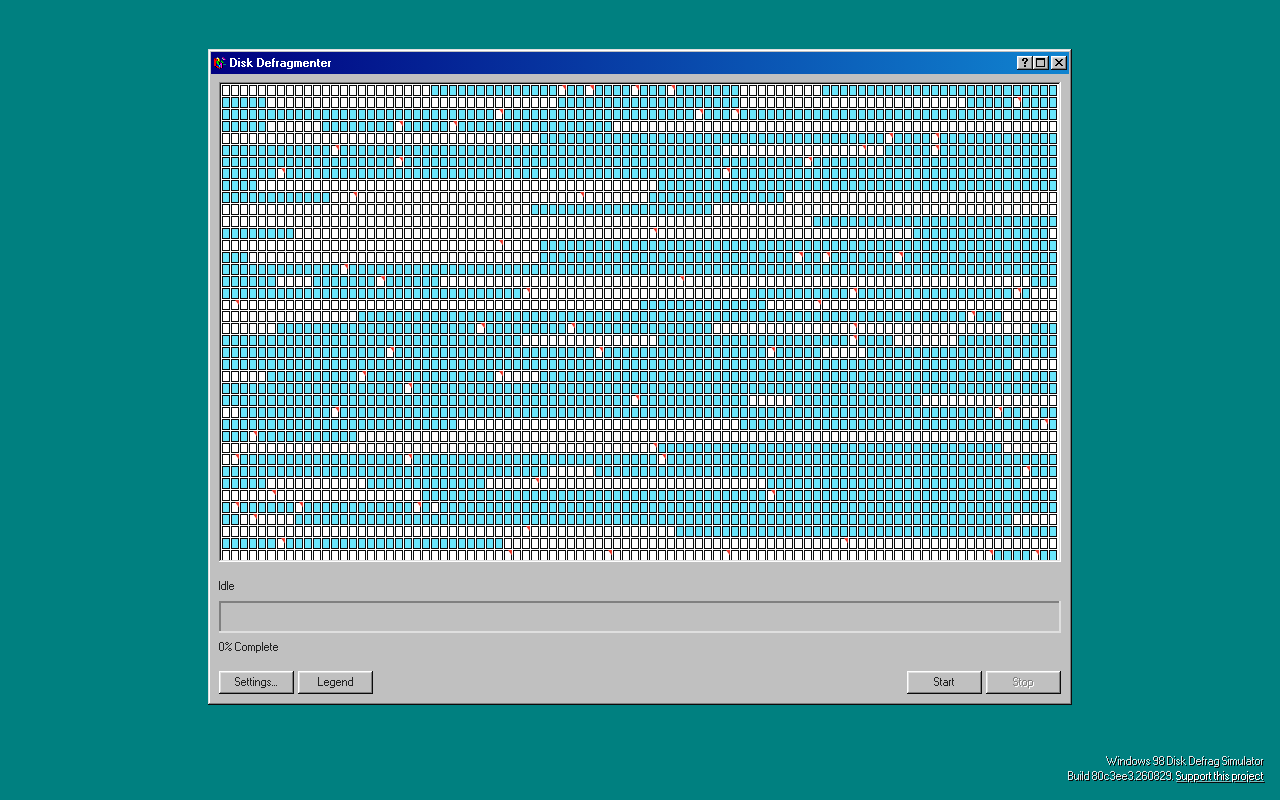
Defrag98 is a browser-based simulator that faithfully recreates the iconic Windows 98 Disk Defragmenter interface, complete with colorful block animations and pixel-perfect UI. While purely visual and devoid of practical function, the project highlights the emotional power of computing nostalgia, the growing expressiveness of modern web technologies, and the enduring value of passion-driven side projects in the developer community.
When Disk Defragmentation Becomes Nostalgia
If you lived through the Windows 98 era, you probably haven't forgotten the hypnotic sight of colorful blocks slowly shuffling around in the Disk Defragmenter. It was arguably one of the most mesmerizing visual experiences of early personal computing. Recently, a web app called Defrag98 appeared on Hacker News, faithfully recreating the classic tool's visuals and interactions right in the browser.
While the project didn't generate massive discussion, it touches on an interesting question: Why does a simulator with absolutely zero practical utility still manage to capture people's attention?
What Is Defrag98
At its core, Defrag98 is an online, purely visual disk defragmentation simulator. It doesn't perform any actual operations on your hard drive — in fact, modern operating systems no longer require users to manually defragment their disks (especially on devices with SSDs). What it actually does is recreate that iconic interface in the browser:
- A grid of disk clusters made up of differently colored blocks
- Animations of blocks continuously moving and rearranging during the "defragmentation" process
- The familiar progress indicators and legend at the bottom
The core of this design isn't utility — it's faithful experience reproduction. It belongs to a growing category of "nostalgia simulators" in the developer community — projects that use modern web technologies to resurrect long-gone software interfaces.
The "Usefulness of Uselessness" from a Technical Perspective
From an engineering standpoint, Defrag98 is a solid frontend exercise. It involves grid rendering, animation state machines, and pixel-perfect recreation of the original UI. While projects like this lack commercial value, they offer developers excellent opportunities to sharpen their skills: how to efficiently render large numbers of dynamic blocks using Canvas or DOM, how to simulate defragmentation logic that appears "random yet systematic" — these are all technical details worth digging into.
Why Nostalgia Simulators Keep Thriving
Defrag98 is far from an isolated case. Similar retro recreation projects have been popping up constantly in recent years: someone rebuilt the Windows XP desktop in a webpage, others recreated classic screensavers, and there's even a full Windows 95 web simulator. Together, these projects form a unique internet cultural phenomenon.
Emotional Connection Outweighs Functional Value
The attention these nostalgic projects receive largely stems from the emotional value of collective memory. For tech-savvy people over 30, the disk defragmentation screen carries memories of their very first encounters with computers. In the era of mechanical hard drives and sluggish systems, watching those blocks fall into place one by one delivered a peculiar but genuine sense of satisfaction.
A Mirror of Technological Evolution
The "disappearance" of disk defragmentation tools is itself a vivid snapshot of technological progress. In the mechanical hard drive era, files scattered across different physical locations on the disk would significantly slow down read speeds, making regular defragmentation a necessity. With the advent of SSDs, flash memory's random reads have virtually no seek latency, rendering defragmentation not only pointless but potentially harmful — the extra write operations can actually shorten the drive's lifespan.
From this perspective, Defrag98 is also a tribute to a computing habit made obsolete by a hardware revolution. It reminds us that many operations once considered "essential" were merely artifacts of a particular stage of technology.
The Value of Small Projects, as Seen Through Defrag98
Although Defrag98 is just a niche project, it reflects several trends worth noting.
The web platform is now powerful enough. Modern browsers can smoothly reproduce complex interfaces and animations that once required native applications. This is precisely why more and more nostalgia projects choose to ship as web apps — no installation needed, instantly accessible, with a natural advantage for sharing and distribution.
"Nostalgia-driven" projects hold a unique place in the developer community. These projects are typically built by individuals in their spare time, with no profit motive — driven purely by interest or the desire to share something technical. This kind of creative motivation is exactly what deserves to be cherished most in open-source and indie development culture.
It also serves as excellent learning material. Developers looking to learn frontend animation, state management, or retro UI design can absolutely start by recreating an interface like this, gaining practical understanding of rendering performance optimization and interaction design trade-offs along the way.
Final Thoughts
Defrag98 won't boost your computer's performance or solve any real-world problems. But in a lighthearted and heartwarming way, it brings back a memory from the early days of personal computing. In an age where apps and tools are overwhelmingly utilitarian, pausing to appreciate a "completely useless" piece of nostalgia might just be a rare form of relaxation in itself.
If you happened to live through that era of dancing blocks, give it a try. Watching that familiar interface come alive again might deliver an unexpectedly therapeutic experience.
Related articles

Python 3.15 New Feature: Is the sentinel Type Better Than None?
Python 3.15 adds the sentinel type, using named unique sentinel objects to replace None and bare object(), resolving confusion among missing values, explicit emptiness, and invalid input while avoiding type hint failures.

Deep Learning's Three Architectures and the Universal Approximation Theorem: A Complete Guide to MLPs, CNNs, and Transformers
Explaining the inductive bias differences among MLP, CNN, and Transformer, the existence meaning of the Universal Approximation Theorem (UAT), and the role of Taylor expansion in approximation analysis, while clearing up common misconceptions.

GitLab Emergency Patch Release: Analysis of Critical Security Fixes
GitLab releases critical patch 19.5.1, sparking 355 points of discussion on Hacker News. This article analyzes the background, upgrade steps for self-hosted instances, and verification points to help DevOps teams respond quickly to security updates.