Delegate Everything to AI or Watch Every Step? The Key Is Where You Place Your Takeover Points
The key to AI collaboration isn't how much you delegate, but placing takeover points at high-cost nodes.
The article points out that when using AI, both "handing everything over" and "watching every step" are inefficient: the former goes off track because AI lacks your sense of purpose, while the latter turns you into a confirm button with fragmented attention. Built-in permission confirmations (like Codex pausing when writing files beyond permissions) only cover operational safety, not direction correctness. The takeover points that really matter — is the goal right, has the direction drifted, does the result pass — must be set by humans based on business understanding. The author suggests allocating takeover point density by "which step has the highest cost if wrong," personally intervening at goal alignment, midway calibration, and delivery acceptance, while letting AI handle the rest — forming a non-uniform collaboration style of "delegate most, take over at core points."
When using AI to get things done, many people swing between two extremes: either they hand everything over at once and come back to find it went off track long ago, or they watch every single step and end up more exhausted than if they'd done it themselves. A sharing session on Bilibili about AI collaboration breaks this problem down clearly — the key isn't how much you delegate versus how much you monitor, but where you place your takeover points.
Delegating everything and watching everything are both inefficient collaboration
The problem with handing everything over is straightforward: AI lacks your sense of purpose. It can read files, run commands, and push forward along the way, but it doesn't know "whether this step has drifted from the real problem the project is trying to solve." By the time it finishes and you take a look, the rework cost may be higher than if you'd done it yourself from the start.
The problem with watching everything is more subtle. Confirming every step turns you into a "confirm button" — your attention gets fragmented, and your cognitive load actually increases. The author's exact words: set them too densely, and you become his confirm button.
Built-in takeover points only solve half the problem
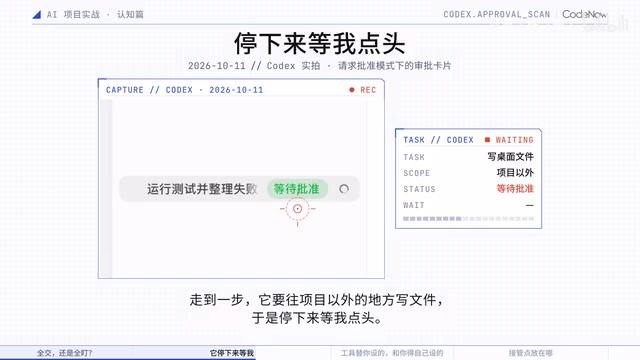
The sharing session gives a real Codex task as an example: AI reads files, runs commands, and moves forward along the way. At a certain step it needs to write a file outside the project, so it stops and waits for the user to nod. The user sees clearly what it wants to do, clicks allow, and it keeps running — the whole process takes just a few seconds.
These kinds of takeover points are pre-set by the tool — for hard boundaries like writing files beyond permissions or dangerous commands, the tool automatically pauses. It's valuable, but it only covers the "operational safety" layer, not the "direction correctness" layer.
The Codex mentioned in the article is an AI coding agent tool launched by OpenAI. It can read files, execute commands, modify code, and autonomously advance multi-step tasks in a local environment. Unlike ordinary conversational AI, Codex has "agent" capabilities — it can continuously call tools, observe results, and decide the next action. This is precisely why it needs a permission confirmation mechanism: when the agent attempts to write files outside the project directory or execute dangerous commands, the system pauses and requests user authorization. This "human-in-the-loop" design is a common safety paradigm in current AI agent products, but it only addresses operational-level permission risks — it cannot judge whether the task itself is worth doing or whether the direction is correct.
The takeover points that really matter — the tool won't stop for you
The author identifies three takeover points that must be set by humans: is the goal right, has the direction drifted, and does the result count as passing. These three judgments depend on your understanding of the business — the tool can't do them for you.
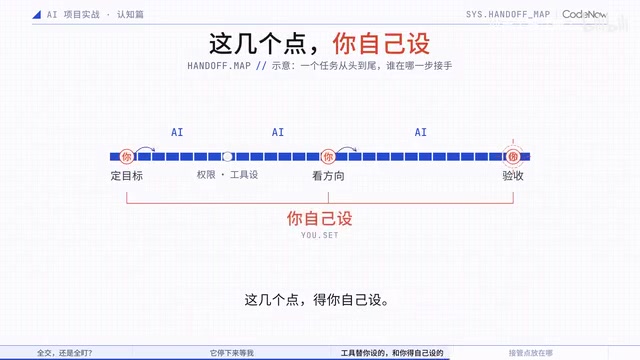
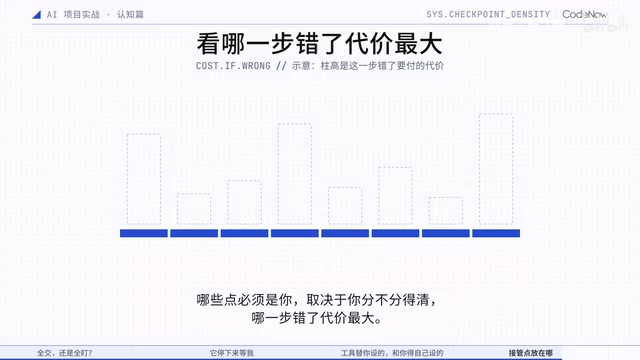
The difficulty lies in density. If takeover points are too dense, the person becomes a confirm button; if too sparse, the AI goes off track and you don't even know. The author's criterion is "which step has the highest cost if wrong" — concentrate takeover points at high-cost nodes, and let AI run freely in all other stages.
Specifically: goal alignment before project launch, direction calibration midway, and acceptance judgment before delivery — these three places have the highest cost if wrong and are worth your personal involvement. The middle steps — reading files, running commands, writing code, changing formats — are more cost-effective to hand to AI.
The concept of "takeover points" borrows from the "takeover" idea in automation and autonomous driving: during a system's autonomous operation, humans intervene at specific moments and take responsibility. In AI collaboration scenarios, the density design of takeover points is similar to "alert thresholds" — set too low, the system interrupts frequently and people tire of confirming; set too high, anomalies slip through and correction costs surge. The "allocate by error cost" approach proposed in the article is essentially a risk-oriented attention allocation strategy, akin to the engineering concept of Failure Mode and Effects Analysis (FMEA): prioritize manual checkpoints at stages with high severity and high rework cost, while trusting automation at low-risk stages.
Delegate most of it, take over at the core points yourself
The complete form of this collaboration style is: hand most of the work to AI, take over at core nodes yourself, then hand it back after taking over. It's not a compromise of "hand over half, watch half" — it's a non-uniform allocation based on cost: fully let go at low-cost stages, firmly intervene at high-cost stages.
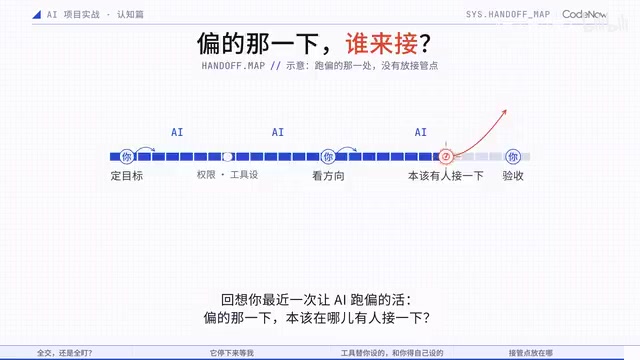
The author believes this is the most worthwhile collaboration style to learn right now, and offers a self-check question: think back to the most recent task where you let AI go off track — at that moment it drifted, where should someone have caught it? This question is more direct than any methodology, because the specific location where it went off track is often exactly where your takeover point should be set.
How to set takeover points
In practice, you can start with a cost inventory: break the task into several stages, and mark the rework cost if each stage goes wrong. Set the two or three highest-cost stages as takeover points, and let the rest pass by default.
Takeover points can also be graded by form: goal-type takeover points are "confirm before starting," direction-type takeover points are "pause and report midway," and acceptance-type takeover points are "manual review after completion." After grading, the person doesn't need to be online the whole time, and the AI doesn't need to wait frequently.
The essence of this approach is to treat human attention as a scarce resource to be allocated, rather than spreading it evenly across every step.
The "cost inventory" can be put into concrete practice: first list the key stages of the task, and for each stage estimate "if this goes wrong, how much time is needed for rework and how much downstream work is affected." Stages with high rework cost and broad impact are high-cost nodes. Note that cost includes not only time but also reputational risk in external delivery and irreversible data loss. After the inventory, keep the number of takeover points to two or three, to avoid falling back into the "confirm button" trap due to too many checkpoints. Graded takeover forms can also be implemented with tools — for example, explicitly requiring AI in the prompt to output a plan summary before entering the next phase, or to output a progress brief midway, turning "pause and report" into an executable agreement.
Related articles

Vibe Coding Full-Stack in Practice: AI Programming from Beginner to Enterprise Deployment
From Cursor to Claude Code, this Bilibili AI programming course uses four progressive projects to cover full-stack development, open-source secondary development, and team collaboration. The article analyzes the shock to frontend roles, the efficiency shift from 50 people to 5, and the methodology required for enterprise-grade projects.

David Blaine's Global Quest for Real Magic: From South Africa to Japan and India
David Blaine travels to South Africa, Japan, and India in his Do Not Attempt special, documenting Spinning drivers, black mamba rescuers, iaijutsu masters, and ascetics—exploring the boundary between magic and real human极限 challenges.

Is a Touchscreen MacBook Coming? Vergecast Reveals Apple Executive's Response
Vergecast podcast reveals a conversation between a reporter and Apple executive John Ternus about a touchscreen MacBook and Apple Pencil support. Ternus says iPad is the best device for a stylus, while the reporter bets MacBook will eventually support Apple Pencil.