Delegent: Multi-Agent Collaboration Cuts Frontier Model Costs by 67% Without Sacrificing Performance

Delegent lets frontier models lead and delegates simple subtasks to small models, cutting costs by 67% without sacrificing performance.
Delegent is a study addressing the cost pain points of frontier language model agents. The frontier model retains overall control while delegating simple subtasks to SLM sub-agents. Unlike cascades or routers, it dynamically divides labor at the subtask level without training extra components. Experiments show a 67% reduction in coding cost and 59% in search cost with no performance loss; even a 2B laptop-class SLM cuts coding cost by 66%. The code is open-sourced.
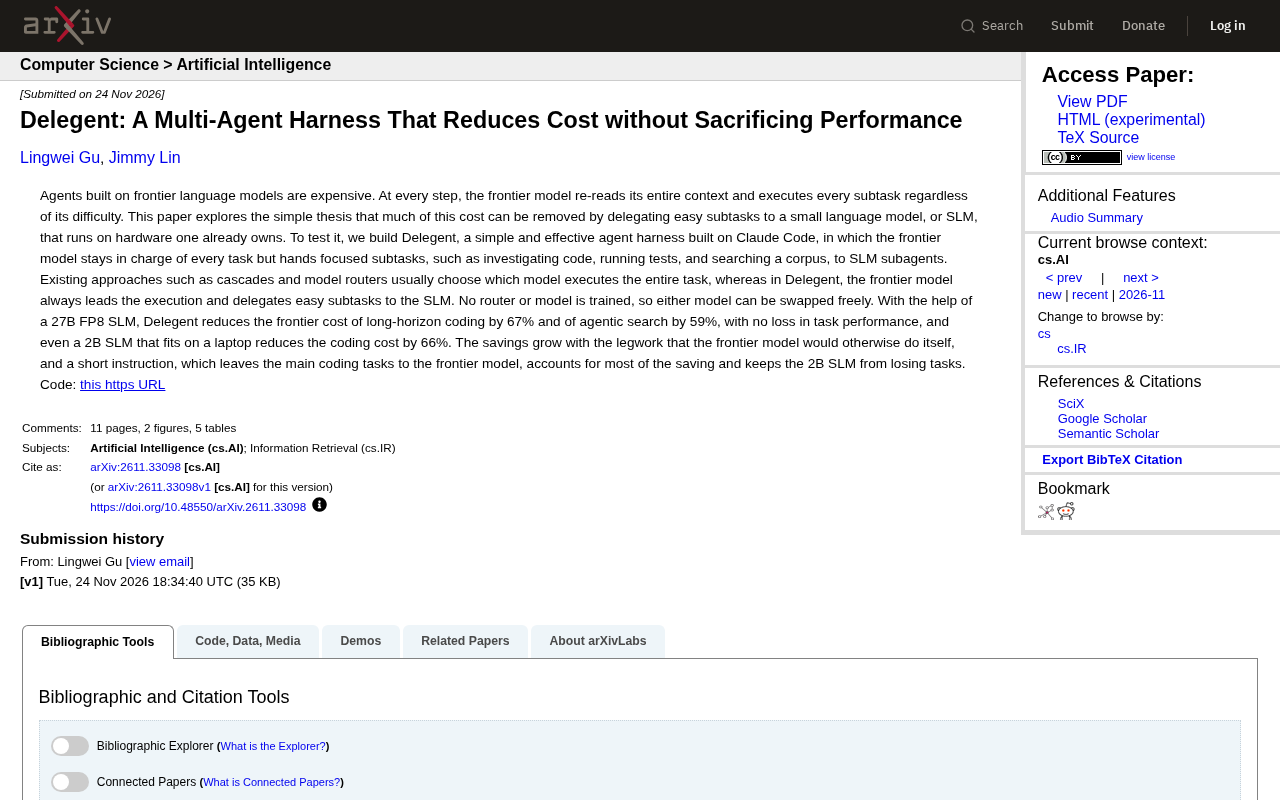
Agents built on frontier language models excel at long-horizon tasks, but cost remains a sword hanging overhead. On every inference pass, the model re-reads the entire context, and every subtask—no matter how simple—is handled by the frontier model itself. Recently, a study called Delegent proposed a simple yet effective idea: let the frontier model retain overall control while delegating simple subtasks to small language models (SLMs), thereby dramatically reducing overhead without sacrificing task performance.
The Cost Pain Point and Core Idea
Frontier models are expensive because of their "omniscient" mode of operation: every step re-reads the full context and executes every subtask, no matter how simple. For example, in coding tasks, surveying a codebase, running tests, and searching documentation don't require the full capabilities of a frontier model—yet existing workflows let these operations consume the most precious compute.
Delegent's starting point is very direct—hand easy subtasks to small language models that run on the user's existing hardware. Unlike cascades or model routers, Delegent does not pre-train a router to decide which model executes the entire task. Instead, the frontier model always leads execution and only delegates subtasks to SLM sub-agents when it encounters ones that are suitable. This design yields a key advantage: no router or model needs to be trained, and both models can be freely swapped.
Cascades and model routers are two common cost-optimization paradigms. A cascade typically sets a threshold or confidence judgment: simple requests go first to a small model, and if the small model's output is unsatisfactory or its confidence is insufficient, the request is escalated to a large model. A router trains a lightweight classifier that, when a request arrives, decides which model executes the entire task—usually a one-time "either-or" decision. What they share is that they allocate compute at the task level, and they often require additional training data or threshold tuning; once a judgment is wrong, either performance drops or the cost savings fail to materialize. Delegent's fundamental difference is that it does not perform global routing; instead, the frontier model dynamically decides at the subtask level whether to delegate, and no additional components need to be trained.
Architecture Design: Frontier Model Leads, SLM Executes Subtasks
Delegent is built on top of Claude Code and is a simple yet effective agent framework. Its core logic is: the frontier model handles planning, decision-making, and complex reasoning, while SLM sub-agents handle focused subtasks such as surveying code, running tests, and searching corpora. These subtasks usually have clear steps and limited context, so an SLM is fully up to the job.
The framework's cleverness lies in its "short instruction" strategy. The researchers found that a single short instruction—reserving the main coding task for the frontier model—achieves most of the cost savings while preventing the 2B SLM from "dropping the ball" during the task. This means users don't need complex scheduling logic; they just need to specify the division of labor clearly in the prompt, and the small model can safely take on an auxiliary role.
Claude Code is a command-line agent tool released by Anthropic that allows Claude models to read and write files, run commands, search code, and perform other operations in a local codebase. It is itself an agent loop of "frontier model + tool calls": the model reads context, decides the next action, executes tools, and observes results, repeating this cycle. Delegent is built on Claude Code because the framework naturally provides interfaces for subtask decomposition and tool calls; researchers only need to add delegation instructions at the prompt level to let the frontier model hand certain tool calls or subtasks to SLM sub-agents without modifying the underlying execution engine. This also explains why Delegent can remain "plug-and-play" and model-swappable.
Experimental Data: Costs Drop Significantly, Performance Uncompromised
The paper provides specific quantitative results. Using a 27B FP8 SLM, Delegent reduced the frontier-model cost of long-horizon coding tasks by 67% and agent search cost by 59%, with no loss in task performance whatsoever. Even more surprisingly, even when switching to a mere 2B SLM that fits in a laptop, coding cost still drops by 66%.
Behind these numbers is a clear pattern: the magnitude of savings is proportional to the amount of "legwork" the frontier model would otherwise have had to do itself. When a task is filled with many simple survey, test, and search operations, the benefits of delegating to an SLM are greater. The role of the short instruction is to keep the SLM focused on auxiliary work and prevent it from failing because the task is too complex, thereby locking in the cost advantage while maintaining performance.
FP8 is an 8-bit floating-point number format. Compared with the common FP16/BF16, it halves the memory occupied by each parameter, allowing a 27B-scale model to run on a single or a small number of consumer/professional GPUs while maintaining inference quality close to full precision through low-precision quantization. In the text, "27B FP8 SLM" means that the small model is deployed at FP8 precision, with memory requirements of approximately 27B × 1 byte ≈ 27GB (excluding activations and caches), far lower than an FP16 model of the same scale. Meanwhile, "2B fits in a laptop" means that a 2-billion-parameter model, after quantization, requires only a few GB of memory and can perform local inference on edge devices. These two scale tiers show that Delegent's cost-reduction effect does not depend on specific hardware; everything from small servers to personal laptops can benefit.
Differences from Existing Solutions
Existing cost-optimization solutions fall roughly into two categories: cascades and model routers. A cascade typically routes simple requests to a small model and escalates complex requests to a large model; a router trains a classifier to decide which model executes the entire task. Both approaches attempt to make an "either-or" choice at the task level.
Delegent makes a different choice: it keeps the frontier model in the driver's seat at all times and delegates only at the subtask level. This fine-grained division of labor avoids the overhead and errors of router training and sidesteps the performance fluctuations that cascades may introduce. Because no additional components need to be trained, models can be swapped at any time, leaving room for future model upgrades.
Open Source and Reproducibility
The researchers have open-sourced Delegent's code on GitHub (castorini/delegent). This means developers can directly reproduce the experiments or integrate it into their own agent workflows. For users who frequently use frontier models in daily development and are cost-sensitive, Delegent offers a plug-and-play path to cost reduction.
From a broader perspective, this study validates a simple but important hypothesis: not all subtasks require frontier intelligence. Through a reasonable division of labor, small models can deliver enormous value in auxiliary roles, while frontier models focus on the complex decisions that truly require their capabilities. This "master-servant collaboration" model may become a common paradigm in the design of future agent systems.
One-line Summary
Delegent lets frontier models lead and delegates simple subtasks to small models, cutting costs by 67% without sacrificing performance.
Paragraph Summary
Delegent is a study addressing the cost pain points of frontier language model agents. Its core idea is: the frontier model always retains overall control, and when it encounters simple subtasks such as surveying code, running tests, or searching documentation, it delegates them to small language model (SLM) sub-agents. Unlike cascades or model routers, Delegent does not perform global routing at the task level, nor does it train any additional components; instead, it dynamically divides labor at the subtask level, so models can be freely swapped. Experiments show that with a 27B FP8 SLM, the frontier-model cost of long-horizon coding tasks drops by 67% and agent search cost by 59%, with no performance loss; even with a 2B laptop-class SLM, coding cost still drops by 66%. The short-instruction strategy is key to preventing the SLM from dropping the ball. The code has been open-sourced.
Related articles

Michael Nielsen Takes Down His Classic Neural Network Textbook, Sparking Community Discussion
Michael Nielsen's classic free textbook Neural Networks and Deep Learning has been taken offline, sparking discussion on Hacker News about the reasons and impact.

Inside the AI Training Data Market: The Trade-off Between Exclusivity and Discounts
G2i founder Gabe Greenberg reveals the dual-track pricing of the AI training data market: labs pay a premium for exclusive data or accept discounts that allow others to buy it.

SessionGraph: Unifying All Coding Agent Sessions in One Interactive Graph
SessionGraph aggregates coding agent sessions into an interactive graph, helping developers review, debug, and manage AI coding workflows across sessions. This article examines its positioning, value, and open questions.