Deneb-Vritra: Using Attention Knockout to Localize Name Shortcuts in Models

The study uses attention knockout to localize the name shortcut in layers 14-17 of the Laya model and reveals it can be weakened by data augmentation.
Deneb-Vritra investigates whether multiple-choice QA models rely on name shortcuts rather than understanding descriptions. In the 421M-parameter Laya encoder, models follow names when they contradict descriptions (53% released, 59% fine-tuned), dropping to 11% with name randomization. Attention knockout localizes the shortcut to layers 14-17, reducing it from 67% to 16% while accuracy stays at 90%. Cross-checkpoint validation shows similar windows, and in name-randomized models, blocking description edges rebounds the shortcut, indicating a readout that is voted down. Marker states decode names from layer 0, and layer copying partially restores shortcut reduction. 9 of 12 pre-registered predictions failed, highlighting fragile intuition.
Do multiple-choice question-answering models truly understand the option descriptions, or do they just take a shortcut via name matching? A study called Deneb-Vritra precisely localizes the network layers where the name shortcut occurs in the 421M-parameter encoder Laya, using attention knockout and token state restoration.
The Laya Model and the Discovery of the Name Shortcut
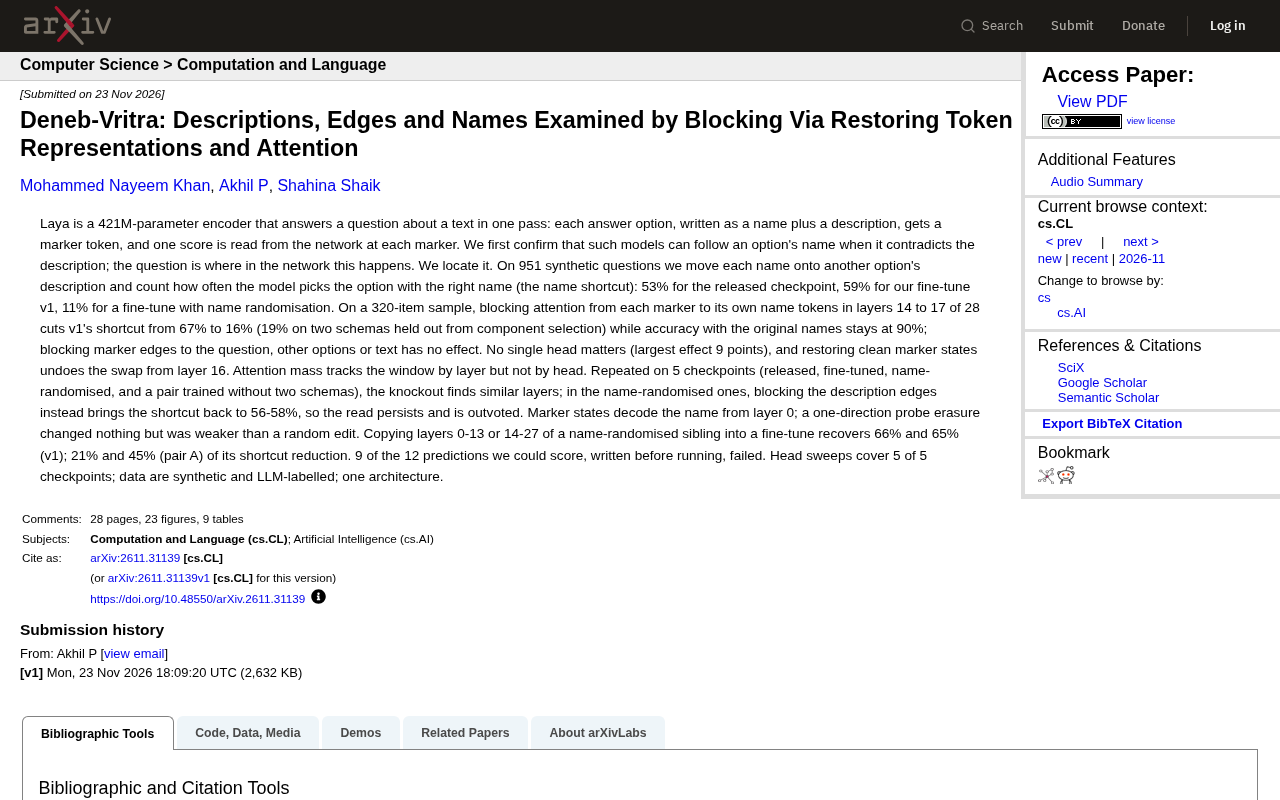
Laya is a 421M-parameter encoder that answers questions about text in a single forward pass: each answer option (a name plus a description) corresponds to a marker token, and the network reads a score at each marker. The researchers first confirmed that when an option's name contradicts its description, the model follows the name rather than the description—this is the so-called "name shortcut." On 951 synthetic questions, they moved each name onto another option's description and counted how often the model chose the option whose name was correct: the released checkpoint was 53%, the fine-tuned v1 was 59%, and the fine-tuned version trained with name randomization was only 11%.
This result shows that the name shortcut is pervasive under standard training but can be significantly weakened through data augmentation.
Name Shortcut is a typical spurious-correlation phenomenon in multiple-choice question answering: the model does not reason based on the descriptive content of the options but instead relies on statistical associations between option names (such as entity names) and surface patterns in the question. When names and correct answers co-occur frequently in the training data, the model learns a heuristic rule of "see a certain name, pick it" rather than genuinely understanding the description. This shortcut is pervasive in standard supervised learning because name tokens often appear earlier than long descriptions, are more readily captured by attention, and have higher mutual information with the label. Name randomization training (randomly permuting names onto different descriptions) is a data augmentation technique that breaks the spurious association between names and labels, forcing the model to attend to the description content and thereby significantly reducing the shortcut rate.
Attention Knockout: Localizing the Critical Layers
The research team's core technique is attention knockout. On 320 samples, they blocked each marker token's attention to its own name token and found that, at layers 14 to 17 of the 28-layer network, v1's name shortcut dropped sharply from 67% to 16% (19% on the two schemas not involved in component selection), while accuracy with the original names remained at 90%. In contrast, blocking the marker's attention edges to the question, other options, or the text had no effect.
Further analysis showed that no single attention head is decisive (the largest effect was only 9 percentage points), and restoring clean marker states can undo the effect of name substitution from layer 16 onward. Attention mass tracks this window by layer but is not distributed by head.
Attention Knockout is a causal intervention method in mechanistic interpretability: during the forward pass, it forcibly sets the attention weight from one token to another to zero (or masks the corresponding edge) and observes how the model output changes. Unlike correlation analysis that merely observes attention weights, knockout provides intervention-level causal evidence—if blocking a certain edge causes a specific behavior to disappear, then that edge is a necessary pathway for that behavior. In this study, blocking the attention of "the marker token to its own name token" directly tests whether name information flows into the answer marker through this edge. Token State Restoration is the reverse operation: replacing the hidden state of a token at a certain layer with a clean version (such as the state under the original name) to test whether the information after that layer is sufficient to restore the original behavior. Combining the two allows precise localization of the layer window where the shortcut readout occurs.
Cross-Checkpoint Validation and Reversal under Name Randomization
Repeating the experiments on 5 checkpoints (the released version, the fine-tuned version, the name-randomized version, and two paired models not trained on specific schemas), knockout found similar layers. Interestingly, in the name-randomized model, blocking the description edge instead made the shortcut rebound to 56-58%, indicating that the readout still exists but is being "voted down."
The marker state can decode the name from layer 0 onward; one-way probe erasure did not change any results but was weaker than random editing. Copying layers 0-13 or layers 14-27 from the name-randomized sibling model into the fine-tuned model restored 66% and 65% (v1) and 21% and 45% (paired A) of the shortcut reduction, respectively.
Linear Probe is a tool commonly used in representation analysis: a simple linear classifier is trained on the token hidden states at a certain layer of the model to detect whether a specific property (such as name identity) can be linearly decoded from that state. In this study, "the marker state can decode the name from layer 0 onward" was achieved through a probe, indicating that name information enters the marker representation at very early layers. Probe Erasure is the intervention on hidden states using the probe direction (such as projection removal) to test the causal contribution of that property to behavior. One-way probe erasure did not change the results and was weaker than random editing, suggesting that name information may be encoded in a nonlinear or distributed manner, and simple linear erasure is insufficient to eliminate its influence. Layer Copying is copying a segment of layers from one model to another to test whether a specific layer segment carries the shortcut mechanism; partial restoration of the shortcut reduction indicates that the shortcut involves distributed computation across multiple layers rather than a single layer segment.
Prediction Failures and Limitations
Before running the experiments, the research team wrote down 12 scorable predictions, 9 of which failed. This reveals the fragility of intuitive judgments in this field. The experiments covered head scans of 5 checkpoints, the data was synthetic and LLM-annotated, and only one architecture was involved. These limitations mean that the generality of the conclusions still needs further validation.
Overall, Deneb-Vritra provides a fine-grained tool for dissecting shortcut behavior in multiple-choice question answering and highlights both the potential and the boundaries of attention knockout as a mechanistic interpretability method.
One-line Summary
The study uses attention knockout to localize the name shortcut in layers 14-17 of the Laya model and reveals that it can be weakened by data augmentation.
Paragraph Summary
The Deneb-Vritra study investigates whether multiple-choice question-answering models rely on name shortcuts rather than understanding descriptions. On the 421M-parameter encoder Laya, when names contradict descriptions the model follows the names, with shortcut rates of 53% for the released version and 59% for the fine-tuned version, dropping to 11% after name randomization training. Through attention knockout, the study localizes the marker's attention to its own name at layers 14-17 as the key pathway for the shortcut; blocking it reduces the shortcut from 67% to 16% while accuracy remains at 90%. Cross-checkpoint validation shows a similar layer window, and in the name-randomized model, blocking the description edge instead causes the shortcut to rebound, indicating that the readout still exists but is voted down. The marker state can decode the name from layer 0 onward, and layer copying partially restores the shortcut reduction. 9 of 12 pre-registered predictions failed, highlighting the fragility of intuition in this field.
Related articles

Nightmare Mode: Engineering Practices for Simulating Disk Failures
Starting from the Hacker News Nightmare mode discussion, this article analyzes typical forms of simulated disk failures, fault injection implementation approaches, and how to integrate fault drills into the development process to improve distributed system fault tolerance.

Datasette-charts-pie Plugin Released: New Options for Pie and Sunburst Charts
Datasette-charts-pie 0.1a0 is released, adding pie, donut, sunburst, and rose charts to Datasette. The author dislikes pie charts but built the plugin to test the plugin architecture.

Diablo II: A Classic Retrospective That Changed Gaming History
From game history writing and tech community discussion, a retrospective on Diablo II's random drops, numerical systems, and multiplayer design—analyzing why this classic ARPG is still discussed by developers today.