Deno Acquired by Cloudflare: Dinosaur Extinction, or Rebirth?

Deno's team joins Cloudflare with its self-hosted project Cell D, ending the era of the independent runtime.
The article traces Deno's journey from its "anti-Node" ideals to being acquired by Cloudflare. Ryan Dahl founded Deno over Node's package management and security flaws, yet about half of recent commits went to Node compatibility. In August 2026 he released open-source Cell D, replicating Cloudflare's stack with self-hosted durable objects and Workers; two months later the Deno team joined Cloudflare, with Cell D central to the deal. It's not about killing competition but filling Cloudflare's missing self-hosting path. The Deno runtime gets one year of maintenance, while paid Deno Deploy shuts down after six months with migration support.
Deno's ending surprised many. This "anti-Node" runtime built by Node.js creator Ryan Dahl ultimately didn't become what he had envisioned. According to an analysis by a YouTube channel, in August 2026 Ryan launched the open-source project Cell D, and two months later the entire Deno team joined Cloudflare, with Cell D becoming the core of the acquisition. Laments of "RIP Deno" echoed across Hacker News, but this story is far more complex than "shut down after being acquired by a big company."
The Fate of an "Anti-Node" Project
In 2018, Ryan Dahl gave his famous talk "10 Things I Regret About Node.js," directly pointing at the flaws in package management and the security model. Node's post-compile scripts have full machine access, which has led to wave after wave of worm-style security incidents. His conclusion at the time was resolute: you can't be compatible with Node, otherwise "you're just rebuilding Node."
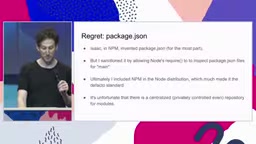
Deno was born from this, attempting to fix all the problems from scratch. But the reality is that over the past year, about 50% of Deno's commits and nearly half of its lines of code have gone toward Node compatibility. According to the video author's observation, Ryan's vision gradually slid from "a better runtime" toward "another Node"—precisely the outcome he had fought hardest to avoid back then.
The post-install script problem in Node.js stems from npm allowing packages to execute arbitrary code at install time. Because npm runs with the current user's permissions by default, malicious packages can read environment variables, steal credentials, and even laterally infect other projects, forming supply-chain worms (such as the 2018 event-stream incident). Ryan Dahl's criticism zeroed in on this design: package installation and execution permissions aren't isolated by a sandbox, and the security boundary rests entirely on developer caution. Deno's response was to not execute arbitrary code by default, require explicit permission declarations (--allow-net, --allow-read, etc.), and pin dependencies to URLs or integrity hashes. But ecosystem compatibility pressure forced Deno to later reintroduce npm support and node_modules, which itself was a compromise with the existing security model.
Cell D: A Technical Loop Closed in Two Months
In August 2026, Ryan released Cell D—a self-hosted implementation of distributed durable objects and Workers. It almost replicates Cloudflare's tech stack: the V8 engine, S3-compatible storage, SQLite, R2, durable objects, and even experimental containers, all open-sourced under the Apache 2.0 license, complete with a cost comparison against Cloudflare.

The key turning point came on October 9: Ryan announced that the Deno team was joining Cloudflare. The video author points out that this isn't the "acquire the competitor and shelve it" playbook. Cloudflare previously had no path for users to self-host off its platform, and once you use durable objects, migration costs are extremely high. Cell D's arrival filled exactly this gap.
What Durable Objects Actually Solve
The video author gripes that the name "Durable Objects" is "the worst naming in history," but its technical value is enormous. As Ryan describes it, it's like an addressable miniature server: it comes with a SQLite database, executes single-threaded (easy to reason about), supports WebSocket, and allows synchronous data access. It automatically sleeps when idle and resumes running when there's a request.
A chat room is the most intuitive example—each room corresponds to a durable object that stores message history and online members, and once multiple people connect simultaneously, they get real-time push. This architecture is extremely friendly to collaborative applications, which also explains why Ryan has repeatedly brought it up since 2022.
Single-threaded execution is a key design constraint of durable objects. Traditional stateless functions (like Workers) may land on different instances for each request, so state must be externalized to a database or cache, creating consistency challenges; durable objects, by contrast, fix one instance per key, and all requests enter the same thread serially, naturally avoiding concurrent write conflicts so developers don't have to handle locks or transactional races. The cost is that throughput is limited by a single instance, and scaling depends on sharding data across a large number of objects. The auto-sleep mechanism reduces costs by persisting the state of idle objects to storage and freeing memory, then restoring them when requests arrive, making it suitable for long-tail state scenarios partitioned by tenant or room.
The Mismatch Between Community Sentiment and the Official Narrative
Deno's official statement: the runtime will continue to be maintained for one year (including monthly bug fixes and security updates), after which development stops but it remains open source; the paid Deno Deploy service will shut down after six months of operation, with support for paid users to migrate to Cloudflare Workers.
Community sentiment centers on the sense of loss that "the dinosaur goes extinct again." Some comments view this as the standard playbook of a cloud vendor eliminating competition. But Cloudflare Workers architect Kenton Varda publicly responded that when the Deno team released Cell D, they were "very happy"—because the self-hosting need finally had an answer outside the official offering, and users could migrate seamlessly from Cell D to Workers, and vice versa.

The video author's stance is clear: he has never used Deno and has always been a Bun user. In his view, what most developers want isn't "a different Node" but "a better Node," Bun satisfies that need, and Deno's positioning was always awkward.
Vendor lock-in refers to users becoming so deeply dependent on a platform's proprietary APIs that migration costs become too high to switch vendors. Cloudflare Workers' durable objects previously could only run on the Cloudflare network, and local development relied on an emulator with no true self-hosting, which critics viewed as a classic example of lock-in risk. Cell D provides a self-deployable compatible implementation under Apache 2.0, effectively giving users an exit path: an application can first run on Cell D on its own servers, then migrate to Workers once it scales up, or migrate back the other way. This bidirectional portability commercially weakens the lock-in accusations and lets Cloudflare respond to antitrust concerns with an "open ecosystem" narrative.
The Real Logic Behind the Deal
From a business perspective, this acquisition works for both sides. Deno needed to find a home that could carry on its technical ideals, and Cloudflare needed to prove its ecosystem isn't a walled garden. With Cell D open-sourced, developers can first build locally or on their own servers, then choose to migrate to Workers once they scale up—this "self-host first, move to the cloud later" path lowers the adoption barrier and also answers the long-standing vendor lock-in concerns.

For Ryan Dahl personally, this may be the ideal ending: he no longer has to agonize over making Deno "a better Node," but instead directly participates in building the computing abstraction he truly believes in. The video author's assessment is quite blunt—"I'm excited for him." Deno's era as an independent project is over, but its unfinished goals may live on in another form.
One-line Summary
Deno's team joins Cloudflare with its self-hosted project Cell D, marking the end of the independent runtime era.
Paragraph Summary
The article traces Deno's journey from its "anti-Node" ideals to its acquisition by Cloudflare. Ryan Dahl founded Deno out of dissatisfaction with Node's package management and security model, but in recent years about half of its commits went toward Node compatibility, straying from the original vision. In August 2026 he released the open-source project Cell D, which replicates Cloudflare's tech stack and supports self-hosted durable objects and Workers; two months later the entire Deno team joined Cloudflare, with Cell D at the core of the deal. The article notes this isn't about eliminating competition but about filling in the missing self-hosting path in Cloudflare's ecosystem. The Deno runtime will be maintained for one year before development stops, and the paid Deno Deploy service will shut down after six months with migration support. Community sentiment is one of loss, but officials emphasize bidirectional migration and technical continuity.
Related articles

Chain of Thought Isn't Just for AI: How Humans Can Use CoT to Improve Thinking Quality
Chain of Thought isn't just a prompt trick for large models. Starting from a Hacker News discussion, this article analyzes why CoT works for human thinking too, breaks down actionable ways to transfer it, and highlights the key differences between human CoT and machine CoT.
Cloudflare Teams Up with OpenAI: Closi…
Cloudflare Teams Up with OpenAI: Closing the Loop from Vulnerability Discovery to Defense with AI
Cloudflare uses OpenAI Daybreak to investigate security vulnerabilities and generate reviewable remediation plans, while developers use Codex to boost coding efficiency and quality.

Orca Multi-Agent Orchestration in Practice: A Guide to Parallel Collaboration with Claude and Codex
Orca is Stable AI's free open-source agent workbench supporting 34 agents like Claude Code and Codex in parallel. Learn its Git worktree isolation, multi-model orchestration, and mobile management.