Deno Deep Dive: A Secure JavaScript Runtime Powered by Rust

Deno is a secure, Rust-powered JavaScript/TypeScript runtime designed to fix Node.js's shortcomings.
Deno is a modern JavaScript/TypeScript runtime created by Node.js founder Ryan Dahl to address Node's design flaws. Built with Rust and V8, it features a secure-by-default permission sandbox, native TypeScript support, ES Modules, and a built-in toolchain. Its architecture leverages Rust's memory safety and Tokio's async performance, while maintaining Web standard API compatibility.
What Is Deno
Deno is a modern JavaScript and TypeScript runtime built by Ryan Dahl, the original creator of Node.js. It was born out of a desire to fix the various design flaws that Node.js has exposed over more than a decade of development. In his 2018 JSConf EU talk titled "10 Things I Regret About Node.js," Ryan Dahl publicly listed Node.js's design mistakes—including not sticking with Promises, insufficient security considerations, build system complexity, centralized dependency management caused by package.json, the bloat of node_modules, and not requiring file extensions. These deep reflections directly gave birth to the Deno project, whose name is itself a rearrangement of the letters in "Node" (De-No), symbolizing the deconstruction and reconstruction of Node.
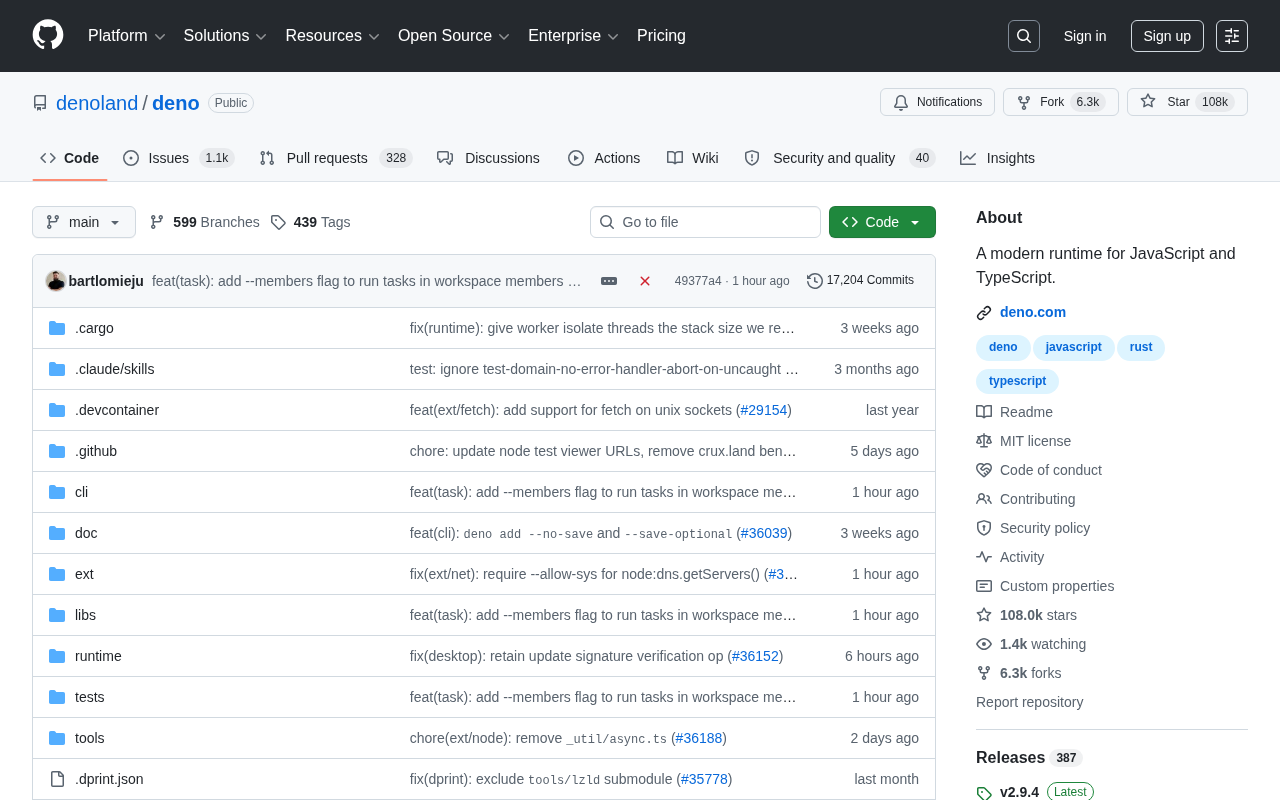
Currently, Deno has garnered over 107,000 Stars on GitHub, with 6,297 forks, and maintains an active growth rate of 27 new stars per day—a clear testament to its sustained popularity in the developer community.
Unlike the traditional notion that "JavaScript runtimes are written in C++," Deno's core is built with Rust. It still uses Google's V8 engine under the hood and leverages Rust's Tokio async runtime to handle the event loop. Rust is a systems-level programming language originally developed by Mozilla, whose core innovations—the Ownership system and Borrow Checker—eliminate data races and memory safety issues at compile time without requiring a garbage collector. Microsoft has reported that 70% of their security vulnerabilities are memory safety issues, and Rust eliminates this class of problems at the language level. This technology choice gives Deno inherent advantages in memory safety and concurrency performance.
Core Design Philosophy
Security-First Sandbox Model
Deno's most distinctive feature is being "secure by default." In Node.js, any script can freely read and write the file system, make network requests, and access environment variables the moment it runs. Deno employs a permission sandbox mechanism: by default, code cannot access files, the network, or the environment. Developers must explicitly grant permissions through command-line flags (such as --allow-net, --allow-read).
This design fundamentally reduces the risk of supply chain attacks and malicious dependencies, which is especially important for scenarios involving third-party scripts. Supply chain attacks are a real and frequent threat in the npm ecosystem: in the 2018 event-stream incident, an attacker took over a package with 2 million weekly downloads and injected malicious code to steal Bitcoin wallets; the 2021 ua-parser-js incident affected a package with 7 million weekly downloads. Once a Node.js program runs, it has full system access—any malicious dependency can read secret keys from environment variables, upload sensitive files, or establish reverse connections. Deno's permission sandbox architecturally limits this attack surface—even if a malicious module is included, it cannot exfiltrate stolen data without being granted network permission. It builds the classic security principle of "least privilege" directly into the runtime layer.
Native TypeScript Support
Deno can run TypeScript files directly without any additional configuration. Developers no longer need to set up Babel, tsconfig, or complex compilation pipelines—just write a .ts file and execute it. This dramatically lowers the barrier to starting TypeScript projects and makes type safety an out-of-the-box default experience.

Modern ES Modules System
Deno completely abandons the traditional node_modules directory and package.json package management approach in favor of web-standard ES Modules, with support for importing modules directly via URLs. ES Modules (ESM) is the official module standard formally introduced in ECMAScript 2015, using import/export syntax with support for static analysis and Tree Shaking (removing unused code). In contrast, the CommonJS specification adopted early by Node.js uses synchronous require() to load modules, is unsuitable for browser environments, and the coexistence of two module systems in Node.js—due to backward compatibility requirements—has caused numerous interoperability issues. Deno supports only ESM from the start, avoiding this historical baggage, making dependency management more decentralized and closer to browser behavior. In recent years, Deno has also progressively enhanced npm package compatibility, allowing developers to smoothly migrate existing Node.js ecosystem assets.
Technical Architecture Highlights
The High-Performance Rust + V8 Combination
Choosing Rust as the host language is a key technical decision that distinguishes Deno from Node.js. Rust's ownership model eliminates a large class of memory safety issues at compile time, avoiding common C++ pitfalls like null pointers and buffer overflows. At the same time, Rust's excellent performance ensures the runtime doesn't sacrifice speed for safety.
V8 is the high-performance JavaScript engine developed by Google for the Chrome browser, using Just-In-Time (JIT) compilation to compile JavaScript code directly into machine code for execution. V8 internally contains the Ignition interpreter (for fast startup) and the TurboFan optimizing compiler (which generates efficient machine code for hot code paths). This tiered compilation strategy brings JavaScript execution performance close to native code. Deno chose to continue using V8 rather than building from scratch because V8, after more than a decade of optimization, is extremely mature with comprehensive language feature support.
For the event loop, Deno uses Tokio to replace the role of libuv in Node.js. Tokio is the most popular async runtime framework in the Rust ecosystem, built on operating system calls like epoll (Linux), kqueue (macOS), and IOCP (Windows) for efficient async task scheduling. Compared to libuv written in C, Tokio leverages Rust's async/await syntax and zero-cost abstractions to handle large numbers of concurrent connections with lower overhead while avoiding the memory management errors common in C.
Built-in Development Toolchain
Deno bundles all the tools developers need into the runtime itself, including code formatting (deno fmt), linting (deno lint), a test runner (deno test), a bundler, and dependency inspection. This "all-in-one" design philosophy frees developers from the tedium of configuring between ESLint, Prettier, Jest, and numerous other external tools, significantly improving development experience consistency.
Web Standard API Compatibility
Deno implements as many existing browser Web APIs as possible, such as fetch, Web Workers, WebSocket, and more. This means lower costs when migrating code between the browser and Deno, and lets frontend developers write server-side logic using familiar patterns.
Use Cases and Ecosystem
Deno is particularly well-suited for the following scenarios: environments requiring high-security script execution, TypeScript-first projects, and teams pursuing a modern development experience. Around Deno, the team has also launched Deno Deploy, an edge computing platform, and Fresh, a full-stack web framework, progressively building out a complete application ecosystem.
Deno Deploy is a globally distributed edge computing platform built on the Deno runtime, with edge nodes in 35+ regions worldwide. Requests are routed to the nearest node for execution, with cold start times in the millisecond range. Its unique advantage lies in native consistency with the Deno runtime—code developed locally can be deployed to the edge environment with zero modifications. The Fresh framework is a full-stack framework optimized specifically for Deno Deploy, adopting Islands Architecture with zero client-side JavaScript by default, injecting scripts only in components that need interactivity to achieve optimal page load performance. This platform competes directly with Cloudflare Workers and Vercel Edge Functions.
One detail worth noting: despite Deno's more advanced design, Node.js still holds absolute dominance in server-side JavaScript thanks to its massive existing ecosystem and enterprise adoption inertia. Deno's strategy is to continuously improve npm compatibility, lower migration barriers, and gradually erode this market.
Conclusion
Deno represents a profound reflection on and reconstruction of the JavaScript runtime. With its core principles of "secure by default, native TypeScript, built-in tools, and embracing Web standards," it offers a cleaner, more secure technology choice for modern application development. For developers starting new projects—especially those who prioritize TypeScript and security—Deno is undoubtedly an option worth serious evaluation. As its ecosystem continues to mature, the competition and convergence between Deno and Node.js will continue to shape the future landscape of server-side JavaScript development.
Related articles

How to Interview Engineers in the AI Era: Practical Insights on Restructuring the Interview Process
When AI coding tools render traditional algorithm interviews ineffective, how should teams restructure? Insights from a year of practice on evaluating systems thinking, problem decomposition, and human-AI collaboration.

AI Agent Observability: A New Paradigm for Production Debugging and Hallucination Governance
Deep dive into AI Agent observability tools for production debugging and hallucination governance, covering full-chain tracing, semantic evaluation, and continuous improvement strategies.

How Theoretical Physicists Can Efficiently Get Started with Machine Learning: Optimal Paths and Resource Guide
A systematic guide for theoretical physicists transitioning to ML, covering math advantages, a three-stage learning path, classic textbooks, and physics-ML cross-disciplinary research directions.