DeployHermes: A Persistent AI Agent Platform That Lets You Manage AI Tools Like Employees
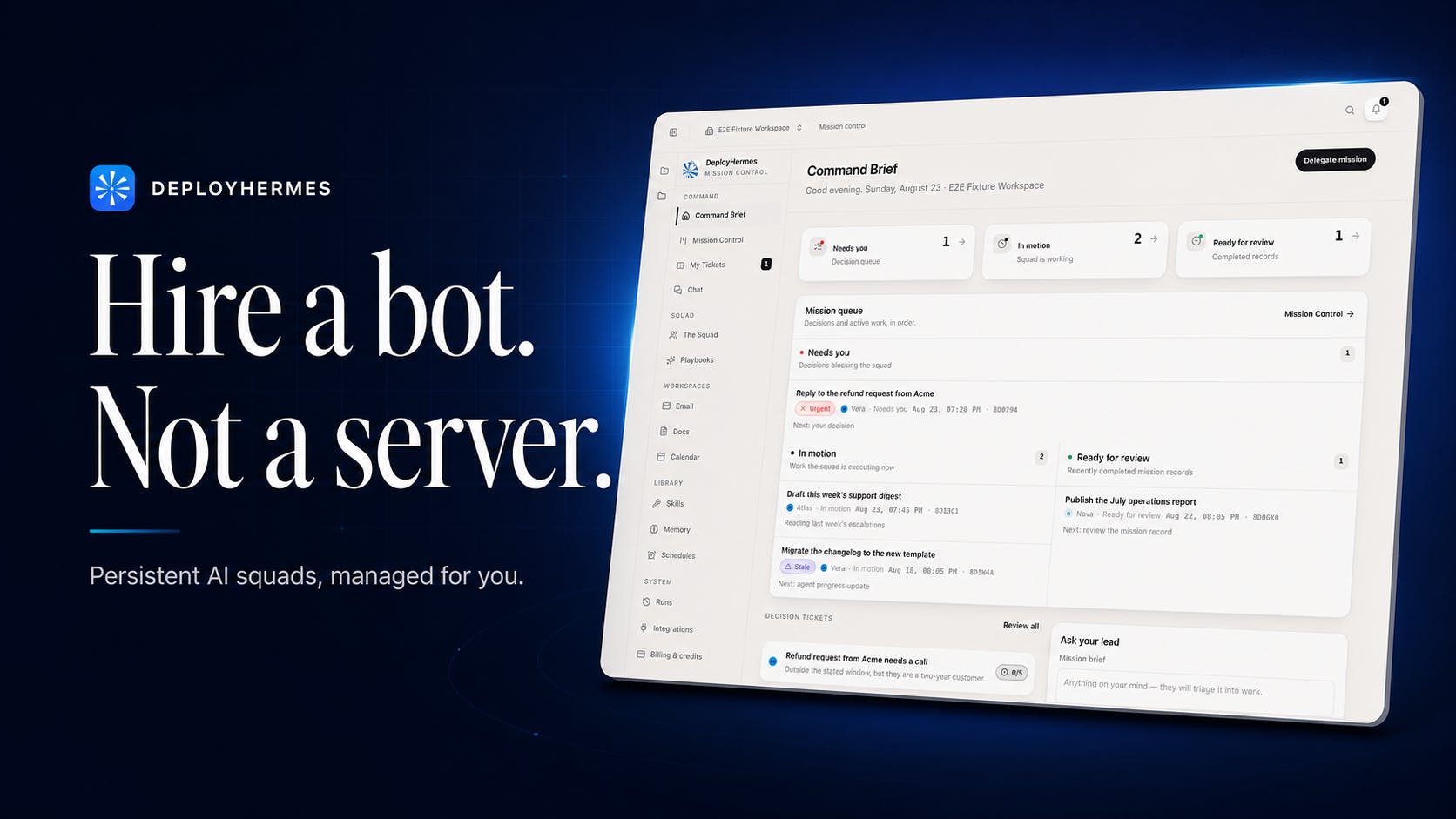
DeployHermes turns AI agents into persistent digital employees with memory, skills, and auditable runtimes.
DeployHermes is a persistent AI agent platform that lets users create agents with defined roles, models, memory, and skills. It offers one-click private runtime deployment, run receipts for auditability, and integration with Claude Code and Codex for multi-agent orchestration — shifting AI from disposable chat tools to manageable digital employees.
From "Disposable Conversations" to "Persistent Employees"
Most mainstream AI applications today are stuck in a "use-it-and-forget-it" conversation mode — once an interaction ends, the model doesn't remember who you are or where your last task left off. DeployHermes aims to break through this limitation with an ambitious positioning: "hiring" AI agents the way you'd hire real employees.
According to its Product Hunt listing, DeployHermes allows users to create persistent Hermes AI agents built on four key elements: role, model, memory, and skills. This means each agent is no longer a stateless temporary assistant, but rather a "digital employee" with a defined identity, continuous memory, and a dedicated set of capabilities. Since its launch, the product has received 75 upvotes, ranking 20th for the day, and is categorized under Productivity, SaaS, and Artificial Intelligence.
Core Capabilities: Private Runtimes and Run Receipts
One-Click Private Runtime Deployment
A key selling point of DeployHermes is its "one-click private runtime deployment." Users can assign an independent execution environment to their agents without complex infrastructure setup. Within this environment, agents can execute "missions," connect to various "integrations," and generate "receipts" after every run.
The "receipts on every run" concept is a design choice worth paying attention to. As enterprise AI applications increasingly emphasize auditability and traceability, maintaining complete records of every agent run serves both compliance requirements and trust-building. When AI begins autonomously executing tasks, "what it did, how it did it, and what the results were" must be verifiable and inspectable — not a black box.
Modular Composition of Memory and Skills
The biggest pain point of traditional AI assistants is the lack of long-term memory. DeployHermes treats "memory" as a native attribute of agents, meaning they can maintain contextual continuity across multiple tasks — remembering your preferences, historical decisions, and project progress.
The "skills" abstraction gives agents modular extensibility. You can configure different skill combinations for agents with different roles. For example, an agent responsible for data analysis and one handling customer communication would have entirely different skill stacks, yet share the same persistence framework.
Multi-Agent Collaboration with Claude Code and Codex
The product description specifically mentions that DeployHermes integrates with Claude Code, Codex, and other programming agent tools, enabling Hermes agents to "manage your bots, which in turn seamlessly manage your work."
This design philosophy points to a major trend in AI engineering today — multi-agent orchestration. While a single powerful model is certainly useful, truly complex workflows often require multiple specialized agents working together: one for planning, one for coding, one for testing, and one for deployment. DeployHermes aims to serve as the "manager" layer, making persistent Hermes agents the central hub that coordinates other tools.
For developers already using Claude Code or Codex for AI-assisted programming, this "agents managing agents" layered architecture could theoretically reduce the complexity of manual orchestration, delegating repetitive scheduling work to the agents themselves.
Positioning Analysis: The "HR-ification" of AI Agent Management
The product language makes it clear that DeployHermes deliberately employs HR management metaphors — "hire," "role," "persistent." This isn't just marketing speak; it reflects an evolutionary direction for AI agent products: the shift from tools to "digital employees."
When agents have stable identities, persistent memory, and clearly defined responsibilities, the user's relationship with them shifts from "using a tool" to "managing a team." This paradigm shift places new demands on productivity tool design — requiring considerations around permission management, task allocation, performance tracking (which may be the deeper purpose behind "receipts"), and an entire set of "organizational management" logic.
That said, a dose of realism is warranted. As a new product on Product Hunt, DeployHermes is currently more concept than proven solution. The actual effectiveness of its memory mechanisms, the stability of multi-agent collaboration, and the security boundaries of private runtimes all need validation in real-world scenarios. The 75 upvotes indicate it's touching on pain points the developer community cares about, but the gap between "an interesting idea" and "a reliable productivity tool" remains significant.
Conclusion: The Future of Persistent AI Agents
DeployHermes represents an exploratory direction in AI agent productization: endowing agents with persistent identities, memory, and skills while ensuring controllability and auditability through private runtimes and run receipts. If it can truly achieve deep integration with mainstream programming tools like Claude Code and Codex, the vision of "hiring an AI employee to manage your other AI tools" may arrive sooner than we think. For practitioners focused on AI engineering and multi-agent architectures, this is a product worth keeping a close eye on.
Related articles

Chain of Thought Isn't Just for AI: How Humans Can Use CoT to Improve Thinking Quality
Chain of Thought isn't just a prompt trick for large models. Starting from a Hacker News discussion, this article analyzes why CoT works for human thinking too, breaks down actionable ways to transfer it, and highlights the key differences between human CoT and machine CoT.
Cloudflare Teams Up with OpenAI: Closi…
Cloudflare Teams Up with OpenAI: Closing the Loop from Vulnerability Discovery to Defense with AI
Cloudflare uses OpenAI Daybreak to investigate security vulnerabilities and generate reviewable remediation plans, while developers use Codex to boost coding efficiency and quality.

Orca Multi-Agent Orchestration in Practice: A Guide to Parallel Collaboration with Claude and Codex
Orca is Stable AI's free open-source agent workbench supporting 34 agents like Claude Code and Codex in parallel. Learn its Git worktree isolation, multi-model orchestration, and mobile management.