Depth Pro 2: Monocular Depth Estimation with Sharpness and Temporal Consistency

Apple releases Depth Pro 2, using a single network to handle images and videos while balancing metric accuracy, sharpness, and temporal consistency.
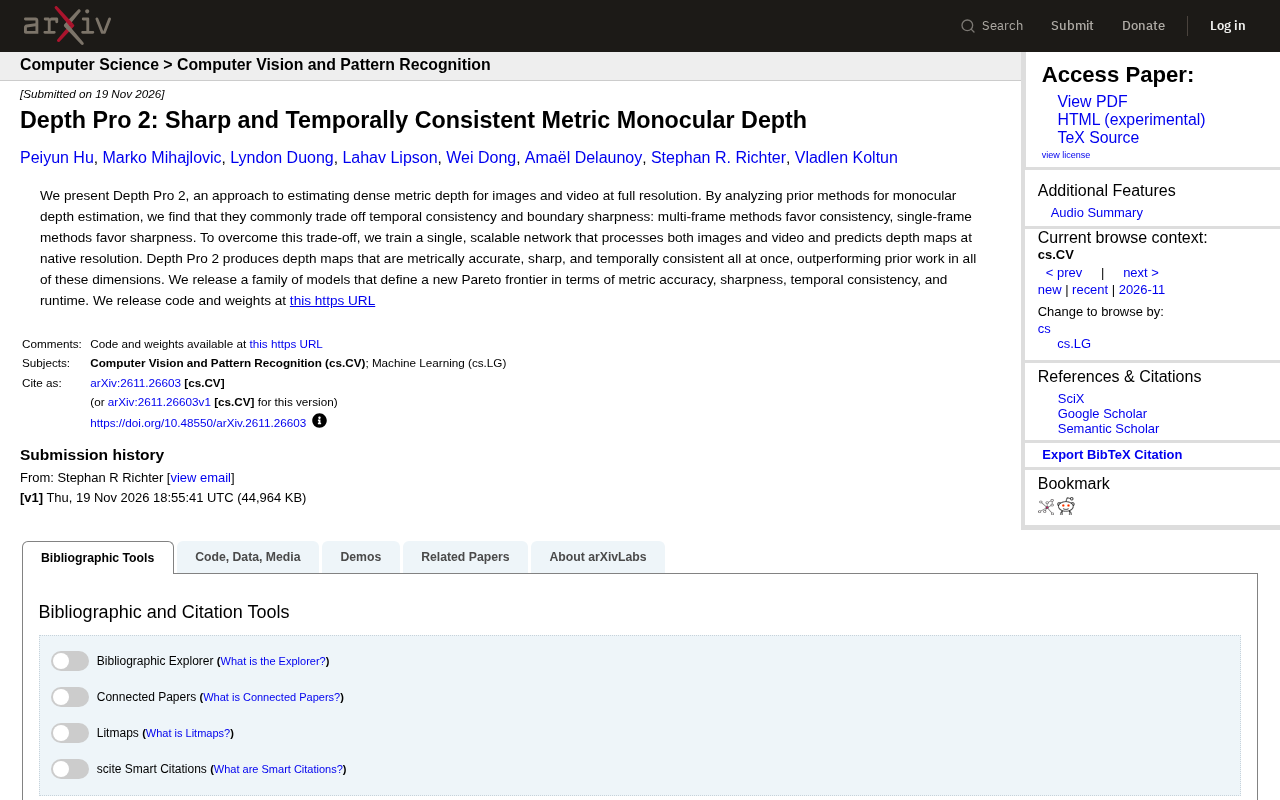
Apple's AI/ML research team has released Depth Pro 2, a method for dense metric depth estimation for images and videos at full resolution. The team found that existing multi-frame methods emphasize temporal consistency while single-frame methods emphasize boundary sharpness, and the two are hard to achieve together. Depth Pro 2 uses a single scalable network to unify image and video processing and predicts depth maps at native resolution, achieving metrically accurate, sharp, and temporally consistent depth estimation and outperforming prior work in all three dimensions. A family of models of different sizes defines a new Pareto frontier across metric accuracy, sharpness, temporal consistency, and runtime. Code and weights are open-sourced.
Apple's AI/ML research team has released Depth Pro 2, a method for estimating dense metric depth for both images and videos at full resolution. By analyzing existing monocular depth estimation methods, the work found that they typically trade off between temporal consistency and boundary sharpness: multi-frame methods tend toward consistency, while single-frame methods tend toward sharpness. To overcome this trade-off, the team trained a single scalable network that handles both images and videos and predicts depth maps at native resolution. Depth Pro 2 is able to produce depth maps that are simultaneously metrically accurate, sharp, and temporally consistent, outperforming prior work across all of these dimensions. The team also released a family of models that define a new Pareto frontier in metric accuracy, sharpness, temporal consistency, and runtime. Code and weights have been published on the project page.
The Inherent Contradiction of Monocular Depth Estimation: Consistency and Sharpness Are Hard to Achieve Together
Monocular depth estimation aims to recover dense depth information of a scene from a single image or video. For a long time, there has been a clear divergence in technical approaches in this field: video-based multi-frame methods can exploit temporal information to obtain smooth and consistent depth estimates, but often at the cost of boundary sharpness; single-frame image-based methods focus on extracting details from a single image and can generate sharp object boundaries, but struggle to ensure consistency across frames, leading to flickering or jitter in video depth results.
The Depth Pro 2 paper explicitly points out that this trade-off is common to prior methods. Multi-frame methods prioritize consistency, while single-frame methods prioritize sharpness, and it is difficult to achieve both. This observation constitutes the core problem that Depth Pro 2 aims to solve: can a single network be designed to simultaneously achieve metric accuracy, sharp boundaries, and temporal consistency?
Metric Depth and Relative Depth are two key distinctions in monocular depth estimation. Relative depth only requires that predicted values be consistent with true distances in ordering (larger values for near objects, smaller values for far objects) and does not require values to correspond to real physical scale; metric depth requires output in absolute distances such as meters or millimeters, which can be directly used for 3D reconstruction, ranging, and robot navigation. Moving from relative to metric typically requires camera intrinsics, calibration information, or large-scale training with ground-truth data. A signature characteristic of the Depth Pro series is precisely that it outputs metric depth, which gives it stronger downstream usability than models that only perform relative depth, but also imposes higher requirements on the quality of depth ground truth in training data.
Temporal Consistency means that depth predictions for the same static scene across consecutive video frames should not exhibit physically unjustified jumps. It is often measured by warping the previous frame's depth to the current frame using optical flow and then comparing the warped result with the current prediction; poor consistency manifests as flickering, edge crawling, or the "jelly effect," which is especially jarring in AR overlays and video post-production. It is worth noting that consistency metrics themselves can be fooled by "over-smoothing"—a model that predicts all frames as approximately constant has excellent consistency but is useless. Therefore, sharpness and metric accuracy must be evaluated jointly with consistency, which is precisely the deeper reason the paper emphasizes that all three must be satisfied simultaneously.
Unified Architecture: A Single Network Handles Both Images and Videos
To break the above trade-off, Depth Pro 2 adopts a single scalable network architecture that can handle both image and video inputs and directly predict depth maps at native resolution. This means the model does not need to switch modes for different input types; instead, through a unified training strategy, it learns how to exploit temporal cues in video while retaining the detail-capturing ability required for single images.
The key to this network lies in "scalable" and "native resolution." Scalability means that model capacity can be adjusted with data volume and computational resources, while native-resolution prediction avoids the blurring effect caused by post-processing upsampling of depth maps, thereby safeguarding boundary sharpness at the root.
Performance: Outperforming Prior Work Across the Board
Depth Pro 2 outperforms prior methods in all three dimensions: metric accuracy, sharpness, and temporal consistency. The paper emphasizes that the model can simultaneously produce metrically accurate depth maps (i.e., depth values with real-world scale), clear object boundaries, and stable video temporal results. This "have it all" performance directly challenges the trade-off previously considered inevitable.
The research team also released a series of models of different sizes that define a new Pareto frontier across four dimensions: metric accuracy, sharpness, temporal consistency, and runtime. The Pareto frontier means that under a given runtime constraint, this model family can provide the optimal combination of overall performance, offering flexible choices for different application scenarios (such as real-time processing on mobile devices or high-quality reconstruction in the cloud).
Pareto Front is a concept in multi-objective optimization: when several objectives (here, metric accuracy, sharpness, temporal consistency, and runtime) need to be optimized simultaneously, if one solution is no worse than another on all objectives and better on at least one, it is said to "dominate" the latter. The set of solutions not dominated by any other solution constitutes the Pareto frontier. When the paper says it "defines a new Pareto frontier," it means that under the same runtime, its model family's overall performance on the other three metrics is better than all existing methods, and models of different sizes within the family each correspond to the optimal trade-off under different compute budgets. For engineering selection, the Pareto frontier is more informative than a single best metric because it directly answers the question: "How good an accuracy can I get under my latency constraint?"
Open Source and Impact: Code and Weights Released Together
The Apple AI/ML research team has made the code and model weights of Depth Pro 2 publicly available on the project page (https://apple-aiml-research.github.io/ml-depth-pro-2/). This move continues the open-source tradition of the Depth Pro series and helps the research community reproduce results and build on them. For researchers and developers working in fields such as 3D reconstruction, augmented reality, and autonomous driving perception, a monocular depth estimation model that performs excellently in metric accuracy, sharpness, and temporal consistency has direct practical value.
The emergence of Depth Pro 2 marks an important step for monocular depth estimation toward unified image and video processing. It no longer requires users to choose between "clear single frames" and "stable video"; instead, through innovations in architecture and training strategy, it integrates both into a scalable framework.
Background Supplement
Native-Resolution Prediction is key to understanding the boundary sharpness advantage of Depth Pro 2. Many depth models perform inference at lower resolutions (such as 384×384 or 512×512) and then upsample back to the original image size using bilinear or guided filtering; upsampling is essentially interpolation and produces transition bands at object contours, causing foreground and background depth to blend slowly rather than change abruptly, resulting in "soft edges." Native-resolution prediction lets the network directly output per-pixel depth on high-resolution feature maps, avoiding this information loss and thus preserving sharp depth discontinuities in fine structures (such as thin poles, hair, and railings). The cost is that computation and memory grow quadratically with resolution, which is also the practical reason the series needs to offer multiple model sizes and trade off runtime on the Pareto frontier.
One-line Summary
Apple releases Depth Pro 2, using a single network to handle both images and videos while balancing metric accuracy, sharpness, and temporal consistency.
Paragraph Summary
Apple's AI/ML research team has released Depth Pro 2, a method for estimating dense metric depth for images and videos at full resolution. The team's analysis found that existing multi-frame methods emphasize temporal consistency while single-frame methods emphasize boundary sharpness, and the two are hard to achieve together. Depth Pro 2 uses a single scalable network to unify image and video processing and predicts depth maps at native resolution, thereby simultaneously achieving metrically accurate, sharp, and temporally consistent depth estimation, outperforming prior work in all three dimensions. The team also released a series of models of different sizes that define a new Pareto frontier in metric accuracy, sharpness, temporal consistency, and runtime, offering flexible choices for scenarios ranging from mobile to cloud. Code and weights have been open-sourced on the project page.
Related articles

Prompt Engineering for Beginners: From Writing Prompts to Engineering Thinking
Starting from the essence and four functions of prompts, this article systematically explains the six-step process, four success criteria, learning value, and practical limitations of prompt engineering to help you build a complete understanding.

Anthropic Launches Nasdaq IPO: AI Giant's Listing and Risk Disclosures
Anthropic officially launches its Nasdaq IPO under ticker ANT, with market valuation expected to potentially exceed SpaceX's record. The prospectus devotes nearly 100 pages to AI risks, while first-half revenue grew over 14x but net losses widened sharply, reigniting the AI bubble debate.

Rust cURL Clone Uses 4,832 unsafe Blocks—Is the Memory Safety Myth Broken?
A Rust cURL clone uses 4,832 unsafe keywords, challenging Rust's memory safety narrative. We analyze what unsafe really means, compare Fil-C, and examine rewrite motives.