Designing a Treehouse with ChatGPT: An AI Collaboration Story from a Family of Nine Kids

A dad of nine uses ChatGPT to plan a treehouse, turning kids' wild ideas into real builds.
Ben Kalkman, father of nine, used ChatGPT as an architectural consultant to build a family treehouse. The AI helped with structural design validation, materials procurement planning, and translating children's imaginative ideas into feasible construction plans. This real-world case demonstrates how generative AI can lower professional barriers in family DIY projects without replacing human connection—strengthening collaboration instead.
How a Screen-Free Sunday Became an AI Collaboration Session
For the Kalkman family with nine children, Sundays come with one iron-clad rule — no screens whatsoever. Behind this rule lies a challenge many families face: how do you get everyone to put down their phones and come together to do something truly meaningful?
Ben Kalkman's answer was a massive project the whole family could participate in: building a treehouse by hand. Interestingly, while Sundays are screen-free, Ben brought ChatGPT in as his "architectural consultant" during the planning phase.
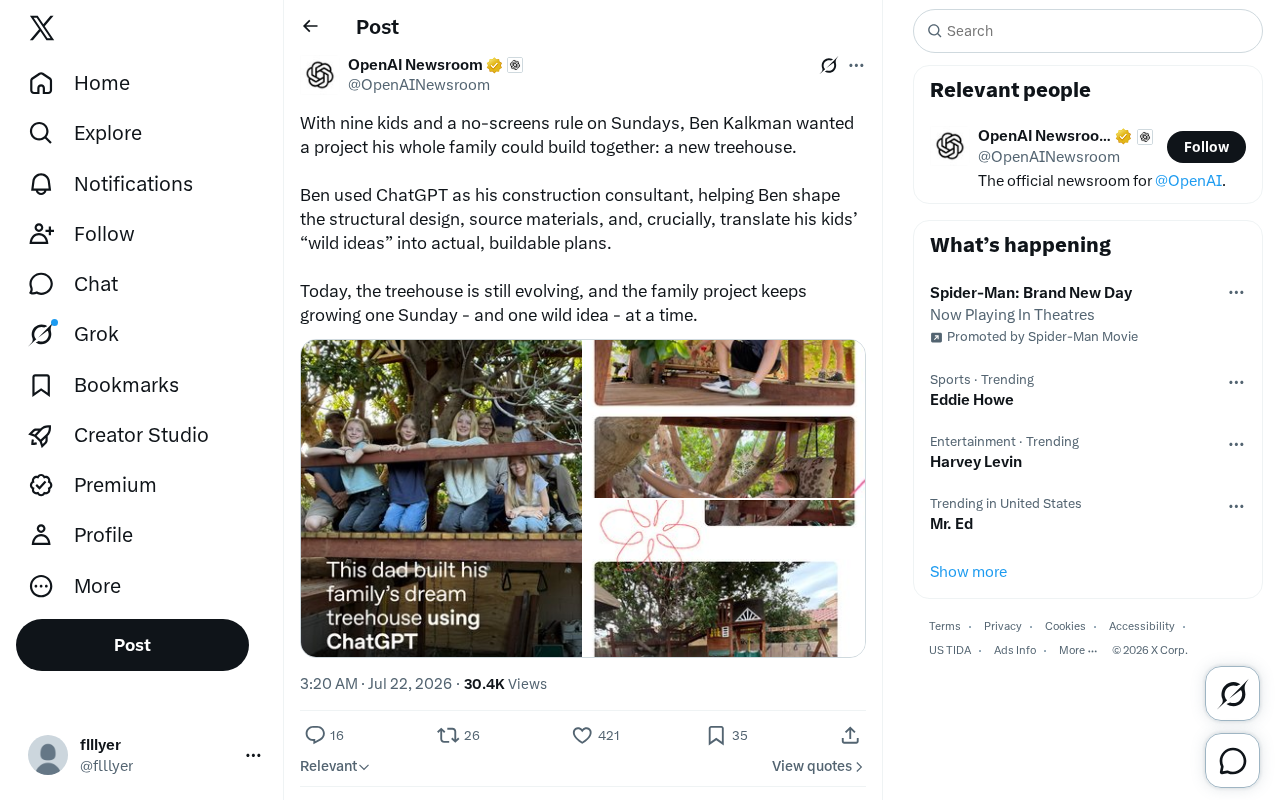
This seemingly contradictory combination — traditional family craftsmanship paired with cutting-edge AI tools — reveals exactly how generative AI is seeping into ordinary people's lives: it's not replacing human collaboration, but serving as the behind-the-scenes assistant that quietly offers suggestions and crunches numbers.
What Role Did ChatGPT Play in the Treehouse Project?
According to Ben, ChatGPT handled three key responsibilities throughout the treehouse project.
Structural Design Gatekeeper
A treehouse isn't something you can safely build by nailing a few boards together — not when it needs to support a group of children. Ben used ChatGPT to work through the structural design, evaluating support points, load-bearing methods, and the overall framework's soundness. For a father without a professional architecture background, AI served as an on-demand "engineering assistant," helping him transform vague ideas into structurally sound design concepts.
It's worth noting that when large language models like ChatGPT assist with structural design, they're essentially reasoning based on the vast amount of architectural and engineering knowledge in their training data. They can provide general structural principles — such as the stability advantages of triangular forms, how loads distribute along support points, and basic requirements for connection node design — but they lack the precise finite element analysis capabilities of professional structural engineering software like SAP2000 or ETABS. For small, non-commercial structures like treehouses, AI's directional guidance is typically sufficient for amateur builders to make reasonable decisions. However, for critical load-bearing nodes involving personal safety, it's still advisable to combine AI suggestions with practical experience or consult professionals for final confirmation. This represents the boundary of AI as an "advisor" rather than a "decision-maker."
Materials Procurement Planner
From lumber specifications to hardware selection, a real construction project involves massive amounts of tedious list-making. ChatGPT helped Ben organize the materials he needed to purchase, making preparation work more systematic. This type of "list-based" task is precisely where large language models excel — they can quickly break down a vague requirement into actionable procurement items.
This capability is closely related to LLMs' structured output mechanism. When a user describes "I want to build a treehouse about 3 meters tall that can hold 5 kids," the model can draw on construction knowledge from its training corpus to automatically derive the needed beam dimensions (such as 2x8 or 2x10 pressure-treated pine), bolt specifications (diameter and length of galvanized carriage bolts), and preservative treatment grades, among other specific procurement items. This transformation from vague requirements to structured checklists is known in engineering as a "Work Breakdown Structure" (WBS), traditionally requiring an experienced project manager or contractor. LLMs significantly lower this professional barrier, enabling ordinary families to prepare materials as methodically as professional teams.
Translator of Children's Imagination
The most touching aspect was how ChatGPT helped Ben translate his children's "wildly imaginative ideas" into actually buildable plans. Children's imagination is often unconstrained by reality, and AI played the role of a patient "translator" here: neither bluntly rejecting the kids' creativity nor leaving it as pure fantasy, but offering feasible implementation paths. This kept the family collaboration process playful while preventing it from becoming all talk and no action.
From a technical perspective, converting children's wild ideas into executable plans can be understood as a type of "Constraint Satisfaction Problem." A child might propose "I want a rotating balcony" or "the treehouse needs a secret slide to the ground," and ChatGPT needs to find the closest feasible solution to the original idea within multiple constraints — physics, budget limitations, material availability, and safety standards. For example, simplifying a "rotating balcony" into a viewing platform that can rotate slightly via a turntable mechanism, or converting a "secret passage" into a fire pole with a hidden entrance. This capability stems from LLMs' ability to weigh multiple dimensions simultaneously during reasoning, generating compromise solutions that preserve creative spirit while maintaining engineering feasibility. For parents, this avoids the dilemma between "saying no outright" and "promising something that can't be delivered."
Practical Takeaways: AI as a Family Project Collaborator
What makes this story noteworthy isn't its technical sophistication — it's how it demonstrates a natural way to use generative AI in family settings.
Previously, discussions about ChatGPT focused on "productivity" scenarios like writing code, creating content, or conducting research. Ben's case offers another perspective: AI can serve as an "advisor" for ordinary families tackling physical projects, dramatically lowering the barrier to specialized knowledge and transforming planning work that would typically require an engineer or carpenter into a family activity you can discuss around the dinner table.
This reflects a broader emerging trend — "AI-augmented DIY culture." According to multiple user behavior studies, home renovation, garden planning, and craft projects account for a significant share of ChatGPT's household use cases. These applications share a common characteristic: users have the willingness and ability to execute hands-on work but lack professional planning knowledge. AI fills the gap between "knowing what you want to do" and "knowing how to do it." Meanwhile, DIY tutorial communities on platforms like YouTube are forming a complementary ecosystem with AI tools — videos provide intuitive operational demonstrations showing "what this looks like," while AI provides personalized parameter calculations and customized plans, answering "given my specific tree, this budget, and these kids, what exactly should I do?" Together, they're ushering in an era of universal making with lower barriers but higher quality.
More importantly, AI didn't weaken human connections here — it strengthened them. The people actually sawing wood, driving screws, and climbing up and down were still this family of a dozen. ChatGPT simply removed backstage obstacles like "can this idea actually work" and "what materials should we buy," allowing family collaboration to proceed smoothly.
An Ever-Growing Project
According to Ben, the treehouse continues to evolve to this day — every Sunday, every new "crazy idea" helps it keep growing. This state of "never quite finished" is, in some ways, the very charm of family projects: their value lies not in reaching some finished endpoint, but in the process of working together, again and again.
For those interested in AI applications, real user stories like this are often more persuasive than any feature demo. It reminds us that the ultimate value of AI tools depends on how people embed them into their real-life contexts. When a father of nine can use ChatGPT to turn his children's imagination into an actual treehouse, AI has truly left the laboratory and become part of everyday life.
Conclusion
The Kalkman family's story doesn't feature flashy technical specifications, yet it vividly demonstrates how generative AI lands in family life: as an architectural consultant, a procurement assistant, and a bridge connecting adult practicality with children's imagination. On a Sunday originally meant to be screen-free, AI found an appropriate way to integrate itself, helping a family build memories that belong to them alone. This is perhaps technology at its best — not stealing the spotlight, but making human collaboration better.
Related articles
HydraNet-VSM Architecture Analysis: A New Approach to Reasoning Through Parallel Fusion of Mamba and Attention Mechanisms
Deep dive into the HydraNet-VSM hybrid architecture proposal: parallel fusion of Mamba SSM and Attention mechanisms, plus how Verified Step Memory tackles Chain-of-Thought unfaithfulness.

Claude Code Creator's Advice: For Big Changes, Align Before You Code
Claude Code creator Boris shares AI coding best practices: for big changes, read the repo first, confirm the plan, then code and verify immediately. Master this workflow to avoid costly rework.
Seed7 Programming Language: A Unique Design Achieving Memory Safety Without GC
Deep dive into how Seed7 achieves memory safety without GC, exploring its AOT compilation, extensible syntax, integer overflow checking, and comparisons with C++, Rust, and Java.