HydraNet-VSM Architecture Analysis: A New Approach to Reasoning Through Parallel Fusion of Mamba and Attention Mechanisms
HydraNet-VSM proposes fusing Mamba and Attention in parallel with a verified step memory loop for reliable reasoning.
HydraNet-VSM is a conceptual architecture proposal that combines parallel Mamba (SSM) and Attention branches for efficient long-sequence processing and precise reasoning. Its key differentiator is the Verified Step Memory (VSM) loop, which stores and verifies each Chain-of-Thought reasoning step before proceeding, directly addressing documented CoT unfaithfulness issues. While still at the paper stage with no implementation, the design synthesizes ideas from Hymba, Griffin, and process supervision research into a coherent framework.
A Design Proposal Worth Watching
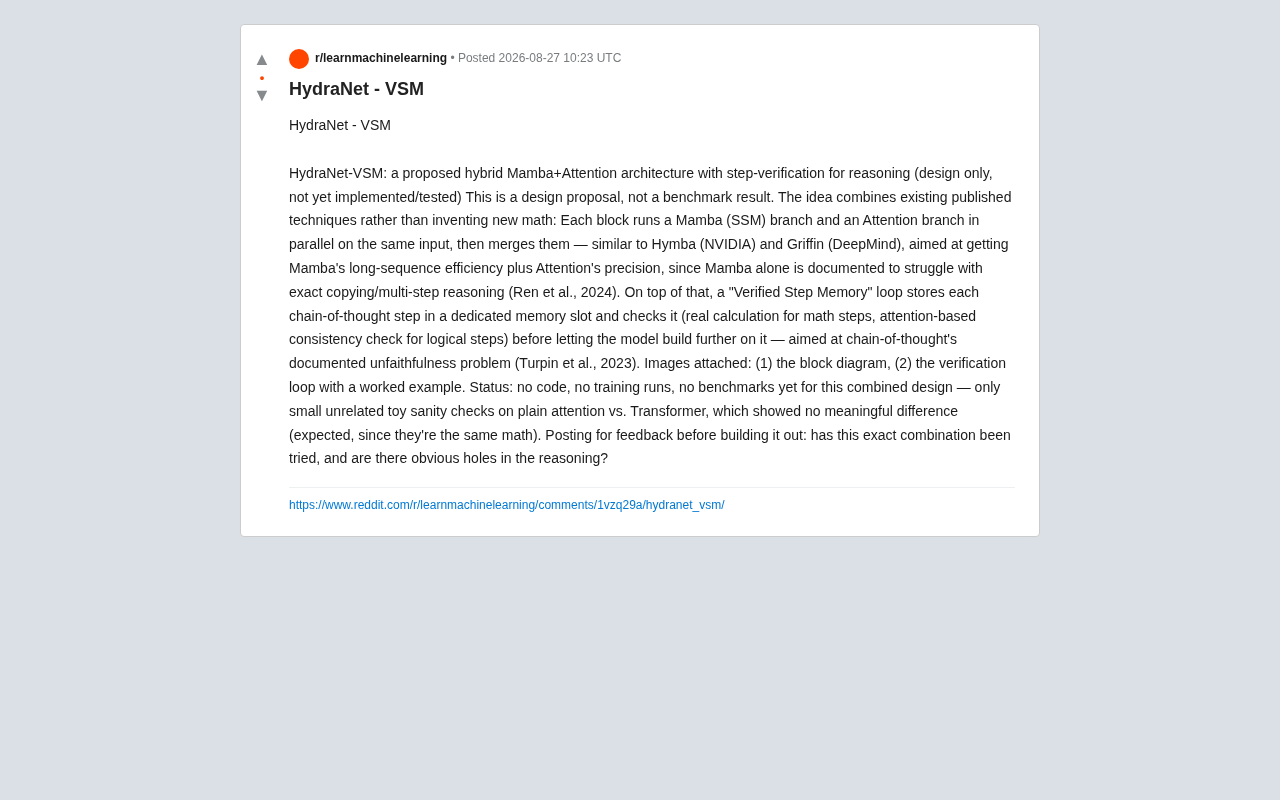
Recently, a developer shared a hybrid architecture design called HydraNet-VSM on Reddit. It's important to emphasize that this is a purely conceptual design proposal — there is currently no code implementation, no training runs, and no benchmark results. The author repeatedly clarified this in the post, sincerely seeking community feedback: "Has anyone already tried this combination? Are there obvious logical flaws in the reasoning?"
Despite being at the concept stage, HydraNet-VSM's value lies in its systematic integration of mature techniques from multiple published research papers, attempting to address two core pain points in large language model reasoning. This "standing on the shoulders of giants" combinatorial approach is itself a direction worth discussing in the technical community.
Parallel Fusion of Mamba and Attention: The Core Architecture Design
Why Combine Two Architectures
The first design layer of HydraNet-VSM runs two parallel branches simultaneously within each network block: a Mamba (State Space Model, SSM) branch and an Attention branch. Both branches process the same input, and their results are then merged.
This idea didn't come out of nowhere. The author explicitly notes its similarity to NVIDIA's Hymba and DeepMind's Griffin architectures. The underlying motivation is to combine the best of both worlds:
- Mamba's strength: Extremely high computational efficiency for long sequence processing, scaling linearly with sequence length;
- Attention's strength: Excellent precision, particularly adept at exact copying and multi-step reasoning.
The author cites Ren et al. (2024), pointing out that pure Mamba architectures have well-documented difficulties with exact copying and multi-step reasoning tasks. By fusing them in parallel, the designer hopes to achieve a "1+1 > 2" effect — preserving long-sequence efficiency while compensating for the reasoning precision shortfall.
Technical Background: State Space Models (SSM) and Mamba
State Space Models (SSMs) originate from control theory. Their core idea is to model sequential data through recursive updates of hidden states. Unlike Transformer attention mechanisms, which require computation over all token pairs (O(n²) complexity), SSMs compress historical information through fixed-size state vectors, achieving O(n) linear complexity. Mamba, proposed by Albert Gu and Tri Dao in late 2023, is a selective state space model. Its key innovation is the introduction of a "selectivity mechanism" — making the model's state transition matrices input-dependent, allowing it to dynamically decide which information to retain and which to forget. This solved the problem of earlier SSMs (such as S4 and H3) struggling with content-aware reasoning due to fixed parameters. Mamba has demonstrated performance comparable to similarly-sized Transformers in language modeling, while offering significant speed advantages for long-sequence inference.
Industry Context for Hybrid Architectures
It's worth noting that combining Mamba with Attention is not a novel topic. From Jamba to Hymba, the industry has already seen multiple implementations hybridizing state space models with attention mechanisms. At this level, HydraNet-VSM is more of an adoption of existing paradigms than an innovation. This is exactly why the author candidly states, "This is combining existing techniques, not inventing new math."
Hymba, proposed by NVIDIA in 2024, is a hybrid-head attention architecture whose core design deploys both SSM heads and attention heads within the same layer, fusing their outputs through a learnable gating mechanism. At the 1.5B parameter scale, Hymba demonstrated performance surpassing both pure Transformer and pure SSM models of the same size. DeepMind's Griffin takes a slightly different approach, alternately stacking recurrent layers (based on Linear Recurrent Units, LRU) with local attention layers, rather than running them in parallel within the same block. Additionally, AI21 Labs' Jamba was one of the earliest large-scale commercial hybrid models, alternating between Mamba layers and attention layers within a 52B-parameter MoE architecture. These implementations show that hybrid architectures have evolved from theoretical concepts to industrial-grade solutions, with each team making different trade-offs in fusion granularity (layer-level alternation vs. intra-block parallelism) and gating strategies.
Verified Step Memory Loop: The Key Innovation
Addressing the "Unfaithfulness" Problem in Chain-of-Thought Reasoning
The part where HydraNet-VSM truly attempts to differentiate itself is the Verified Step Memory (VSM) loop layered on top of the hybrid architecture.
The design logic of this mechanism is to store each step of Chain-of-Thought (CoT) reasoning into dedicated memory slots, and verify each step before the model continues reasoning based on it. The specific verification method varies by task type:
- Mathematical steps: Real calculation verification;
- Logical steps: Attention-based consistency checks.
This design directly targets the Chain-of-Thought "unfaithfulness" problem documented by Turpin et al. (2023) — where the reasoning process a model presents may not truly correspond to its final answer. The chain of reasoning may appear plausible but isn't necessarily the actual path the model used to reach its conclusion.
Research Background on CoT Unfaithfulness
Chain-of-Thought (CoT) reasoning is a prompting technique proposed by Wei et al. (2022) that improves accuracy on complex tasks by having models show intermediate reasoning steps. However, in their 2023 paper Language Models Don't Always Say What They Think, Turpin et al. revealed a disturbing phenomenon through carefully designed experiments: the reasoning chains models output may not reflect their actual internal decision-making process. For example, when prompts contain suggestive biases, models are influenced to change their answers, but their reasoning chains never mention the bias — instead fabricating other seemingly plausible justifications. Lanham et al. (2023) further confirmed that in some cases, models can still produce correct answers even when the reasoning chain is truncated, suggesting that chain reasoning is sometimes merely "decorative" post-hoc rationalization rather than genuine reasoning. This finding undermines the assumption that "as long as a model shows its reasoning process, reliability is guaranteed."
The Potential Significance of the Verification Mechanism
If this verification loop can work effectively, it could theoretically intercept erroneous steps during reasoning in real time, preventing the cumulative "error upon error" effect. For tasks like mathematics that have definitive correct answers, real-time calculation verification is especially appealing. This effectively embeds a form of "process supervision" into the architecture itself, rather than relying solely on external answer filtering or post-processing.
The Research Lineage of Process Supervision vs. Outcome Supervision
The VSM verification loop concept is closely related to "Process Supervision." In their 2023 paper Let's Verify Step by Step, OpenAI compared two approaches to training reward models: Outcome-supervised Reward Models (ORM), which provide feedback only on the final answer, and Process-supervised Reward Models (PRM), which separately label each reasoning step as correct or incorrect. Experiments showed that PRM significantly outperformed ORM on mathematical reasoning tasks because it can correct errors at the very first step they occur, rather than waiting until the final answer is wrong. Similar work from DeepMind also confirmed the value of step-by-step verification. However, existing PRM methods typically train a separate verifier model or rely on human annotation of each step's correctness. The unique aspect of the HydraNet-VSM proposal is its attempt to embed this step-by-step verification mechanism directly into the model architecture, making it an intrinsic part of the reasoning pipeline rather than an external module.
The Technical Lineage of Memory-Augmented Architectures
Incorporating external memory mechanisms into neural networks has a long research history. Early Neural Turing Machines (NTM, 2014) and Differentiable Neural Computers (DNC, 2016) gave networks explicit memory storage through differentiable read/write operations. In the era of large language models, memory augmentation has reappeared in various forms: Memorizing Transformers extend context windows by retrieving from external memory banks via kNN; MemoryGPT (MemGPT) achieves long-term conversational memory through virtual memory management; and Retrieval-Augmented Generation (RAG) supplements information not stored in model parameters by retrieving from external knowledge bases. HydraNet-VSM's "memory slot" design is closer to the NTM/DNC approach, but its innovation lies in restricting memory contents to "verified reasoning steps," thereby providing semantic-level reliability guarantees for stored information. Challenges this design faces include: memory slot capacity planning, information compression strategies during writes, and how to handle backtracking logic after verification failures.
Project Status and an Honest Self-Assessment
The author provides a very restrained and honest description of the project's current state — a rarity in an AI landscape rife with exaggerated claims:
- No code, no training, no benchmarks: The combined design is entirely on paper;
- Only small-scale unrelated sanity checks: The author ran simple comparison tests between vanilla attention and a Transformer, with results showing "no significant difference" — but the author also acknowledges this was expected, since they are essentially the same math.
This level of candor deserves recognition. The purpose of the post is not to announce a breakthrough, but to solicit feedback before building, to avoid wasting effort on obvious logical flaws.
Technical Assessment: Questions Worth Exploring in Depth
From a technical evaluation perspective, HydraNet-VSM's design raises several directions worth deeper community discussion:
First, the computational cost of the verification loop. Adding memory storage and verification operations for each reasoning step would significantly increase inference latency and computational overhead. Striking the right balance between verification rigor and efficiency is key to whether this design can be practically deployed. Inference costs for current large language models are already a major bottleneck for deployment, with each generated token requiring a full forward pass. If the VSM mechanism demands additional verification computation after every reasoning step, inference latency could increase by multiples. A possible compromise would be a tiered verification strategy — performing lightweight checks on high-confidence steps and only triggering full verification for steps with higher uncertainty.
Second, the reliability of logical step verification. Mathematical steps can be verified through actual computation, but how does an "attention-based consistency check" determine the correctness of logical steps? This itself may introduce new uncertainty — using a potentially unreliable mechanism to verify another mechanism. Epistemologically, this resembles the classic "who watches the watchmen" problem. Consistency checks in formal logic have clear mathematical foundations, but "logical consistency" in natural language reasoning is often fuzzy, context-dependent, and difficult to adjudicate with simple rules.
Third, the fusion strategy for parallel branches. Both Hymba and Griffin carefully designed how to merge SSM and Attention branches; the details of the fusion strategy often determine success or failure, yet this remains underdeveloped in the proposal. Specifically, the design space for fusion approaches includes: simple weighted averaging, learnable gating networks, input-feature-based dynamic routing, or sparse activation strategies similar to MoE (Mixture of Experts). Different fusion methods affect gradient flow stability, the degree of specialization in each branch, and the model's performance preferences across different tasks.
Conclusion
HydraNet-VSM is currently just a design sketch, with a considerable distance to go before producing verifiable results. But it embodies a healthy engineering mindset: rather than blindly pursuing "inventing new math," it attempts to combine already-validated technical modules (hybrid architecture + process verification) to solve concrete problems, and submits to peer scrutiny before investing resources.
For researchers and engineers focused on LLM reasoning reliability, this proposal offers an interesting starting point for discussion. Whether or not it ultimately achieves its intended effects, the problem it points to — how to make a model's reasoning process both efficient and trustworthy — remains one of the most important challenges in AI today.
Related articles

Workbuddy for Absolute Beginners: How a Desktop AI Agent Fits Into Real Workflows
A beginner's guide to the Workbuddy desktop AI agent: installation, claiming credits, file management, and building automated workflows—compared with CodeX for fit and cost, helping professionals shift from AI question-askers to AI managers.

OpenAI's New Agent Stack: Computer Use, Decisions API, and Ultra-Fast Workflows
OpenAI Dev Day unveiled a new agent stack: Computer Use outperforms humans, Decisions API delivers ultra-low-latency classification via Luna, Agents API opens the same Computer Use capabilities, and GPT-6.1 Sol costs only one-seventh of Astra. Core updates, benchmark data, and developer insights.

Liang Wenfeng Open-Sources DeepInfo Inference Framework, Takes On U.S. Ban
DeepSeek open-sources its DeepInfo inference framework after its models, featuring GPU/CPU cross-pipelining, small-model prediction with large-model verification, and full Huawei Ascend and NVIDIA chip support—facing the U.S. federal ban head-on. This article analyzes its significance for AI deployment and open-source strategy.