Deus Ex: Mankind Divided — A Deep Dive into Prague's Level Design
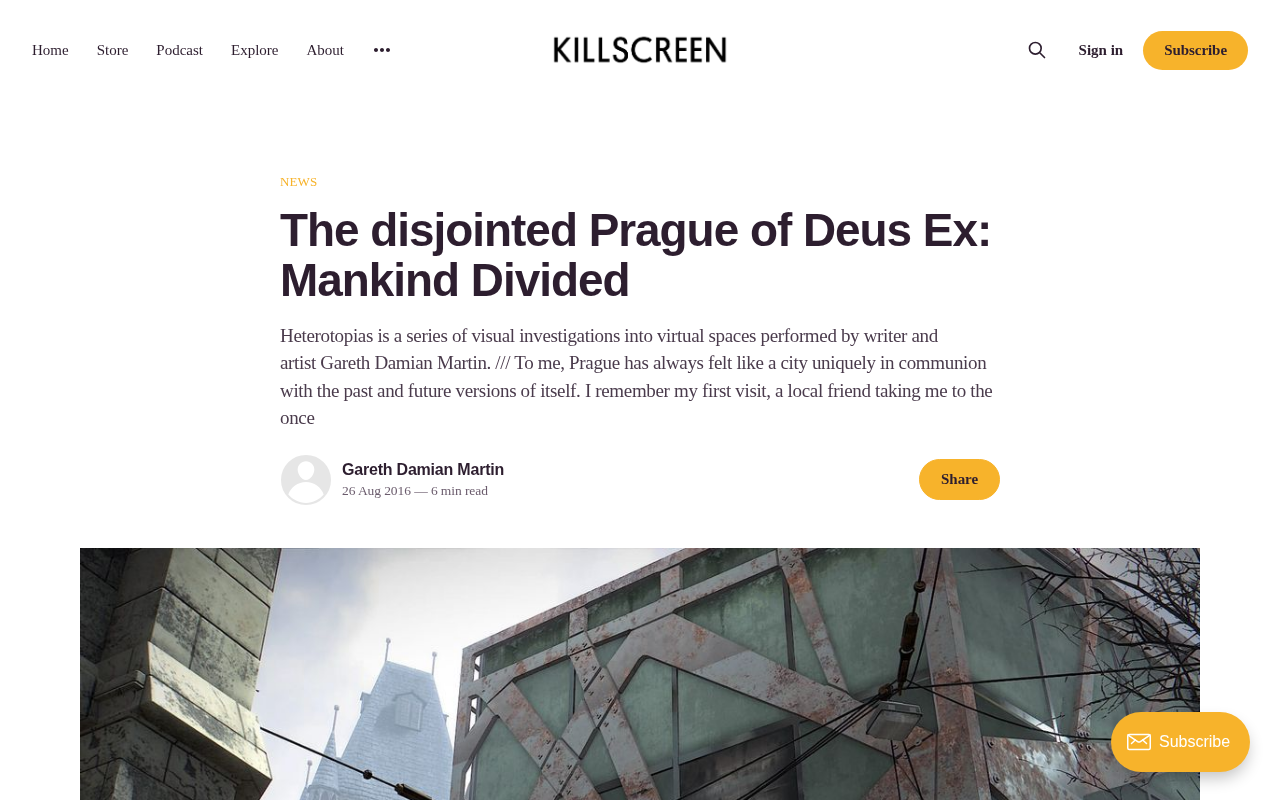
How Mankind Divided's Prague hub became a masterclass in dense, vertical, multi-path level design.
This article dissects the spatial design of Prague in Deus Ex: Mankind Divided, examining how its compact density, vertical layering, multi-path level philosophy, and environmental storytelling create a cyberpunk city that rewards exploration. Rooted in the Immersive Sim tradition, Prague proves that depth and density matter far more than map size.
Introduction: A Cyberpunk City Worth Revisiting Again and Again
Among the many games that tout open or semi-open worlds, the Prague hub of Deus Ex: Mankind Divided has long been regarded by players and game design researchers alike as a textbook example of exceptional spatial design. Rather than pursuing vast, sprawling maps, it achieves its brilliance through meticulous density, vertical layering, and a highly interconnected structure — creating a near-future city brimming with reasons to explore.
The game's fictional Prague is set in 2029, at a time when human society is gripped by fierce tensions between mechanically augmented people (Augs) and the unaugmented population. This setting is deeply rooted in the Cyberpunk literary tradition — a genre that emerged in the 1980s, exemplified by William Gibson's Neuromancer (1984) and the works of Philip K. Dick. Its central concern is the entanglement of technological progress and social inequality. High technology hasn't ushered in utopia; instead, it has deepened class divisions and identity crises. The Deus Ex series makes this premise tangible through the ethical debate of whether humans should transcend their natural limitations through mechanical means. Mankind Divided takes place after the "Aug Incident" — a global catastrophe in which augmented people lost control — sparking widespread fear and hostility toward the augmented community. This serves as a metaphor for real-world issues like racial segregation and immigrant discrimination. This fusion of science fiction with social critique is precisely what gives the cyberpunk genre its enduring vitality.
The city itself is far more than a container for levels; it serves the integrated functions of narrative, atmosphere, and gameplay. This article examines why this city has become an endlessly discussed classic, analyzing it across three dimensions: spatial structure, level design philosophy, and narrative integration.
It's worth noting that Mankind Divided belongs to the Immersive Sim genre, which has a deep historical lineage. This design school can be traced back to the 1990s, with foundational titles including Ultima Underworld (1992) and System Shock (1994), both developed by Looking Glass Studios. The core philosophy is to grant players a high degree of freedom within a simulated world, allowing game systems to produce emergent interactions. The original Deus Ex (2000), led by Warren Spector, is widely considered a milestone of the Immersive Sim — it was the first to deeply integrate parallel paths of combat, stealth, social interaction, and hacking within a first-person action RPG framework. This design tradition was later carried forward and evolved by titles like Prey and the Dishonored series. Understanding this lineage is essential to appreciating Prague's design in the context of genre history.
A Compact Yet Profound Spatial Structure
Density Over Scale
Unlike many open-world games that chase ever-larger map sizes, Mankind Divided's Prague deliberately takes the "small but dense" approach. The total explorable area is relatively compact, yet every building, every alleyway, and every ventilation shaft is imbued with real function and purpose for exploration.
Behind this design philosophy lies a relentless pursuit of "effective space" — a concept used in game design research to measure the proportion of a map that genuinely carries gameplay significance. In the mid-to-late 2010s, large open-world games — particularly those from Ubisoft — frequently drew criticism for "map bloat." Titles like the Assassin's Creed series and Ghost Recon offered enormous explorable areas, but vast stretches of space were used merely to pad repetitive side activities or serve as pure visual decoration, leading to what players call "check-list fatigue." By contrast, Prague's footprint might equal just a single neighborhood in some open-world maps, yet its information density and gameplay density per square meter far exceeds those larger worlds. This approach aligns with the Japanese game design tradition of "hakoniwa" (miniature garden) — Nintendo's Shigeru Miyamoto has repeatedly emphasized that what matters isn't how big a space is, but what you can do within it.
Players never waste time in empty, content-barren expanses. Instead, nearly every few steps reveal a new path, a hidden item, or a narrative clue. This high-density information delivery keeps exploration in a constant state of positive feedback, and it's a key factor that distinguishes immersive simulation games from traditional open worlds.
Full Utilization of the Vertical Dimension
One of Prague's most lauded design achievements is its thorough use of vertical space. The city isn't a flat two-dimensional plane laid out before you — instead, it links together multiple elevation layers through sewers, subway tunnels, apartment floors, rooftops, and balconies, forming a three-dimensional exploration network.
Full utilization of vertical space is widely recognized as one of the most challenging aspects of level design. From a technical standpoint, vertical space means more complex pathfinding systems, higher collision detection precision requirements, and greater occlusion culling computational overhead — the engine must simultaneously handle rendering and logic for ground level, underground, and rooftop layers. From a design standpoint, the readability of vertical space is far lower than that of horizontal space: players naturally tend to understand maps on a two-dimensional plane, and upward or downward paths are easily overlooked. Mankind Divided addresses this through visual guidance (such as lighting around pipe openings and yellow markings on rooftop edges) and ability-unlock mechanics, turning vertical exploration into a skill that can be learned and mastered.
Protagonist Adam Jensen's mechanical augmentations — such as the Icarus Landing System that prevents fall damage and reinforced arms that can punch through walls — are designed precisely around this vertical structure. Once the Icarus Landing System is unlocked, elevated routes become safe and viable. This means space and gameplay form a tight coupling: unlocking abilities doesn't just expand your combat options — it opens up entirely new ways to traverse space. This design ensures that player progression is felt not just in numerical stats, but viscerally in the expansion of physically reachable areas.
The Multi-Path Level Design Philosophy
One Problem, Multiple Solutions
One of the core design tenets of the Deus Ex series is respect for player agency. Nearly every area and mission node in Prague offers multiple approaches:
- Frontal assault: Engage enemies directly in combat — ideal for action-oriented players
- Stealth infiltration: Use cover, disguises, and non-lethal methods to slip through undetected
- Hacking route: Compromise door locks, cameras, and turrets to break through with technical prowess
- Environmental exploration: Find ventilation ducts, hidden passages, or elevated entry points
This multi-path design not only enhances replay value but also allows every player to find the approach that best suits their character build. The urban space thus becomes a "puzzle box" rather than a mere combat arena. This design philosophy directly inherits the legacy of the original Deus Ex and has been evolved in different directions by Arkane Studios with the Dishonored series and the team behind Prey — the former emphasizing creative combinations of supernatural abilities and physics systems, the latter focusing on the depth of resource management and systemic interaction within a space station environment. Mankind Divided builds on this foundation by further emphasizing the city space itself as a "gameplay canvas," extending multi-path choice beyond individual mission levels into every corner of free urban exploration.
Interconnected Zones and the Immersion They Create
Prague's various districts don't exist in isolation — they're linked through a complex web of internal passages. A seemingly ordinary sewer might lead to the interior of a building several blocks away; an apartment window might be the key entrance that bypasses a heavily guarded front door.
This highly interconnected structure allows players to gradually build a spatial understanding of the entire city in their minds — a process known in game design research as "cognitive map" construction. Once you've familiarized yourself with these hidden routes, exploration evolves from "fumbling around" to "mastery." That feeling of navigating the city with the ease of a local resident is a charm unique to the Immersive Sim genre. This is also why many players find even deeper satisfaction on their second or third playthrough than on their first — because intimate knowledge of the space is itself a reward. It grants a sense of "mastery" that doesn't rely solely on new content to sustain engagement.
Space as Narrative: The Power of Environmental Storytelling
The Divided Society Made Physical
Prague's spatial design also serves a crucial narrative function. In the game, mechanically augmented people suffer systemic discrimination and segregation, and this social tension is skillfully woven into the city's physical fabric — checkpoints, segregation zones, and aug-specific security facilities appear everywhere.
As players traverse the city, they don't need a single cutscene to understand what's happening. Environmental details alone convey the world's oppression and injustice. This is the brilliance of Environmental Storytelling: letting the space itself become the narrator, allowing players to grasp the worldbuilding through firsthand experience.
The term "Environmental Storytelling" was popularized in the early 2000s by game designer Harvey Smith and Valve, the development team behind Half-Life 2. Its core methodology can be broken down into several layers: the first is "set dressing" — using object placement to imply events, such as a chair toppled beside a pool of blood telling the story of a struggle; the second is "discoverable documents" — emails, diaries, and audio logs that provide specific character backgrounds and plot threads; the third is "spatial grammar" — using architectural forms, zone divisions, and access restrictions themselves to convey social structures and power dynamics. Mankind Divided's Prague excels particularly at this third layer — checkpoints, segregation fences, and aug-specific pathways aren't just gameplay obstacles but physical symbols of systemic discrimination. This technique transforms narrative from something "told" to something "perceived" — a unique advantage of interactive media over traditional storytelling forms.
A Believable World Built from Accumulated Detail
From personal belongings scattered in apartments, emails and computer logs, to propaganda posters and graffiti on the streets, Prague is filled with background details waiting to be uncovered. This content is never mandatory reading — it exists as optional depth, rewarding players who take the time to observe closely.
It's precisely this design approach of "rewarding curiosity" that makes Prague feel remarkably alive and believable. It isn't a backdrop for players to pass through; it's a real place with its own internal logic and traces of daily life. Every corner stands up to scrutiny, and every piece of text enriches the world's depth. In game design, this method of building world credibility through the accumulation of countless small details is sometimes called "narrative archaeology" — players, like archaeologists, piece together a complete story from fragmented information. In Mankind Divided, you might read an email about an augmented person being fired on a computer in an ordinary apartment, discover an expired Neuropozyne prescription in the trash can of the next room, and notice an eviction notice posted by the landlord on the door — three independent environmental details that, taken together, silently tell a complete personal tragedy. The power of this storytelling approach lies in its non-coercive nature: the process of discovery is itself the reward.
Conclusion: Big Wisdom in a Small Map
Deus Ex: Mankind Divided's Prague proves through practice that the value of a game world lies not in its size, but in the depth and density of its design. It weaves compact spaces, vertical layers, diverse pathways, and rich environmental storytelling into a unified whole, creating an urban space that serves simultaneously as a gameplay stage and a narrative vessel.
In an industry trend where open worlds have become increasingly ubiquitous and maps grow ever larger yet ever more hollow, Prague's design philosophy remains highly relevant: rather than spreading out a wilderness no one cares to explore, invest in meticulously crafting a city that's worth revisiting again and again. In recent years, we can see more and more developers reconsidering this "density-first" design philosophy — From Software's Elden Ring, despite its vast open world, is most praised for its carefully designed traditional levels full of vertical layers and hidden paths; Arkane Studios' Deathloop directly replaced the traditional large map with four high-density small open zones. These trends all point to the same conclusion: what players truly crave isn't a bigger world, but a world more worth exploring.
This is perhaps the fundamental reason why Prague continues to be enthusiastically discussed by players and developers years later — it isn't just an excellent map in an excellent game, but a powerful statement of a design philosophy.
Related articles

Tutorial: Locally Deploying Qwen Models with llama.cpp — GPU Compatibility & Parameter Tuning in Practice
Complete guide to locally deploying Qwen models with llama.cpp, covering NVIDIA/AMD/Intel GPU compatibility, GGUF model selection, KV cache quantization, context length optimization, and OpenAI-compatible API integration.

Burning Through 11.7 Billion Tokens: Which Is the Strongest Cybersecurity AI Model?
A massive experiment burning 11.7 billion tokens systematically evaluated leading LLMs on cybersecurity capabilities. Learn why generic benchmarks fall short and why vertical evaluations matter.

Oppora AI Review: End-to-End Automated Outbound Sales System for B2B
In-depth analysis of how Oppora AI turns ICPs into self-running outbound workflows, integrating lead discovery, personalized outreach, deliverability protection, and CRM sync for B2B sales teams.