dev-crew: An Out-of-the-Box AI Agent Software Development Team Orchestration Framework
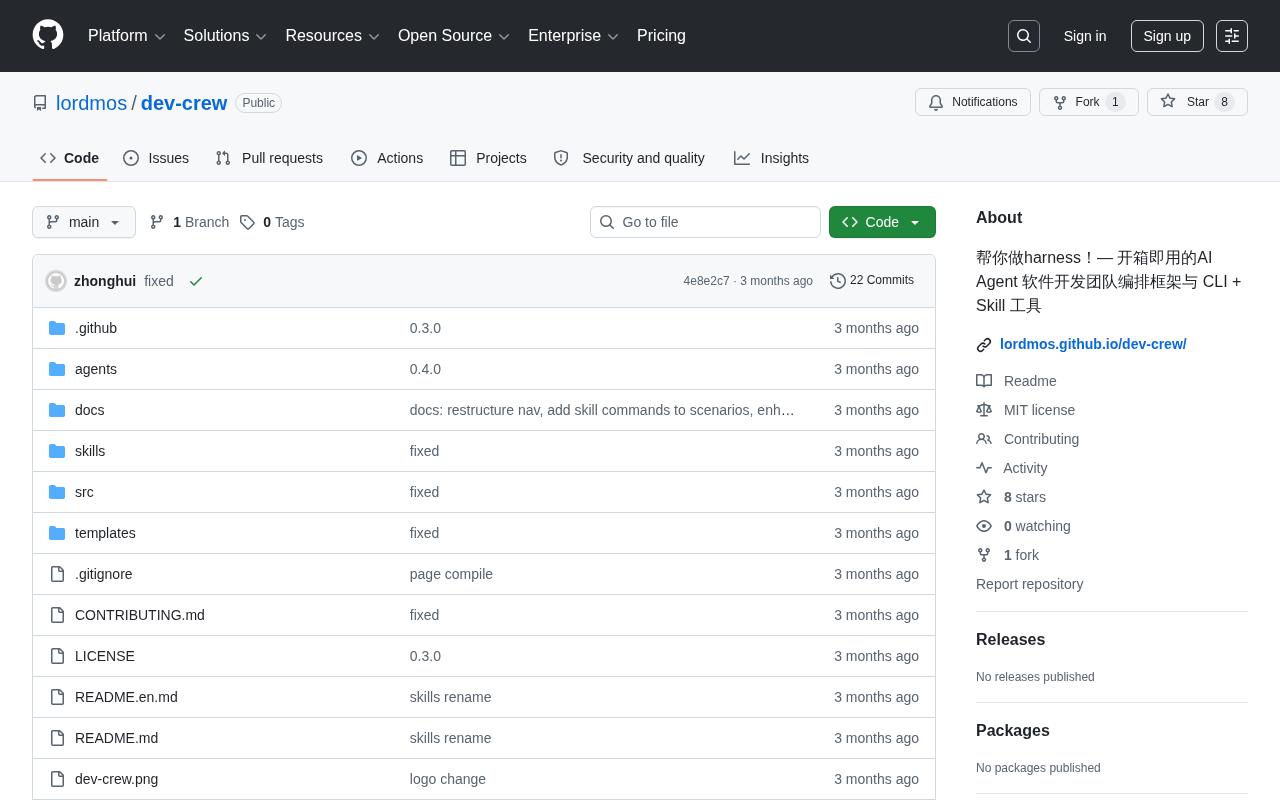
dev-crew orchestrates multiple AI Agents as a dev team using TypeScript, CLI, and modular Skills.
dev-crew is an early-stage open-source project that standardizes the AI Agent "harness" — the scaffolding for prompt management, tool calling, and execution environments. It uses a multi-agent team approach with role-based division of labor, a CLI-first interface, and reusable "Skill" modules. Built in TypeScript for easy integration with Node and full-stack workflows, the project currently has just 6 stars and lacks production validation, but its design direction aligns with the trend of AI coding tools evolving from single LLM calls toward collaborative, engineered workflows.
Project Overview
The open-source project lordmos/dev-crew on GitHub puts forward an ambitious idea: organize AI Agents into a "software development team" and let them collaborate on development tasks through a unified orchestration framework and CLI tool. The project's tagline is straightforward — "Help you build the harness!" — aimed at solving one of the trickiest challenges in deploying AI coding tools today: how to wrap individual LLM calls into a controllable, reusable, and collaborative engineering workflow.
Based on the repository's current state, this is an early-stage project (6 Stars, 1 Fork, primary language TypeScript). Small in scale, but it targets a real pain point in AI Agent engineering — and that makes it worth paying attention to.
What Is a "Harness" and Why Does It Matter
In the AI Agent world, a "harness" refers to the runtime scaffolding built around a model — it manages prompts, tool calls, context, execution environments, and result validation, transforming a model that "can talk" into an execution unit that "can actually work." A bare model can only generate text; the harness is the critical middleware that makes a model useful within a real software development workflow.
dev-crew's core positioning is precisely "help you build the harness" — standardizing and templatizing the scaffolding that developers would otherwise have to construct from scratch. For teams looking to quickly experiment with Agent collaboration without reinventing the wheel, this kind of framework can significantly lower the barrier to entry.
Team Orchestration and the CLI + Skill Model
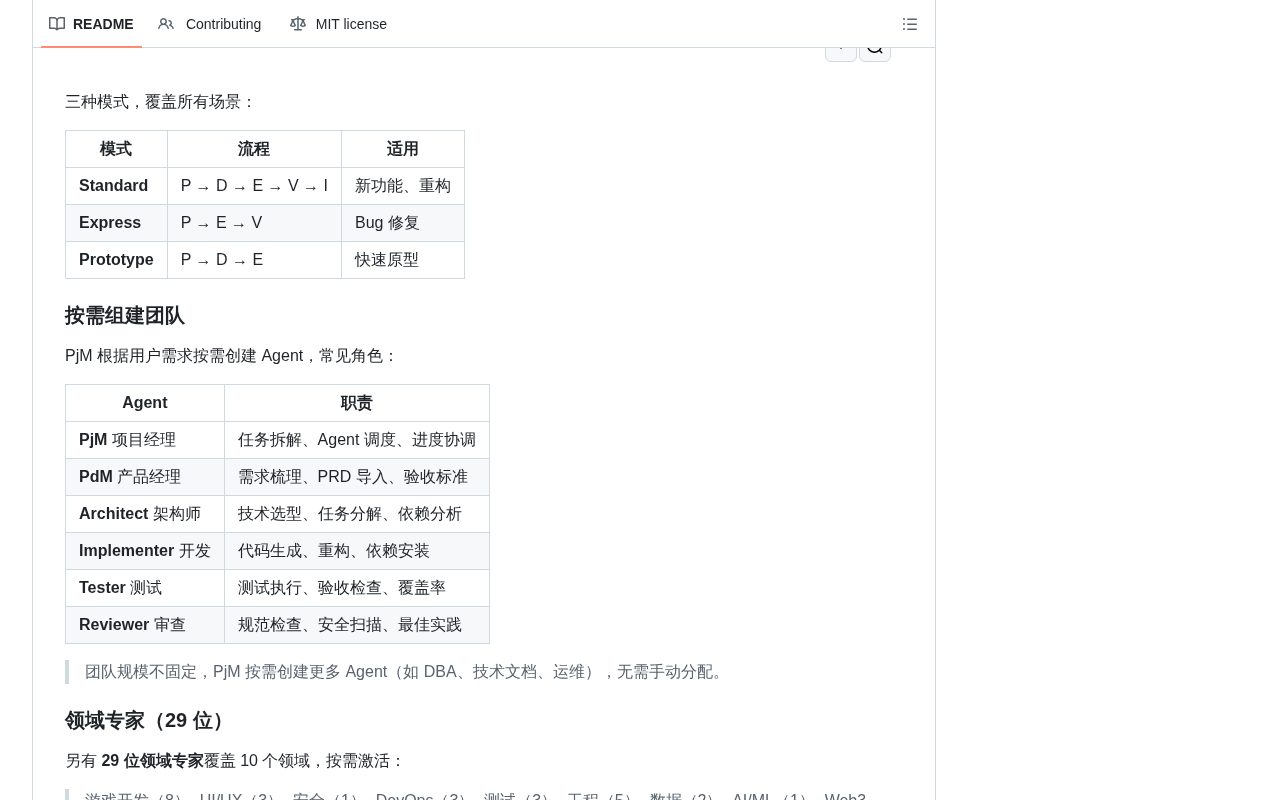
The word "crew" (team) in the project name signals its design philosophy: not a single Agent working in isolation, but multiple Agents with distinct responsibilities forming a development team and collaborating together. This aligns with the mainstream multi-agent orchestration thinking in recent years — using role-based division of labor (e.g., planning, coding, testing, reviewing) to improve the quality of complex task completion.
CLI-First Workflow
dev-crew provides a CLI (command-line tool) as its primary interaction interface. A CLI-first design is developer-friendly, easy to integrate into existing engineering pipelines, scripts, and CI environments, and aligns with the developer mindset of "managing everything from the terminal."
Skills as Capability Units
The project introduces the concept of "Skills," which can be understood as callable capability modules or toolsets available to Agents. By encapsulating specific capabilities as Skills, the framework enables the same tool logic to be reused across different tasks, while also allowing the Agent team's capabilities to be extended and combined on demand. This modular design is key to making Agent frameworks maintainable and scalable.
Multi-agent orchestration frameworks are not unique to dev-crew — several comparable projects have emerged in recent years. AutoGen (Microsoft) allows multiple LLM Agents to collaborate on problems through conversation loops; CrewAI similarly centers on a "role-based team" abstraction, supporting the definition of Agent roles, goals, and tools; LangGraph models Agent workflows as directed graphs, suited for complex tasks requiring explicit control flow. Most of these projects are Python-centric, whereas dev-crew's choice of TypeScript positions it closer to the engineering workflows of frontend and full-stack developers — carving out a degree of differentiation. Understanding this competitive landscape helps assess whether dev-crew fits your own tech stack.
The "Skill" abstraction corresponds, in Agent framework design, to a higher-level wrapper over the Tool / Function Calling mechanism. OpenAI Function Calling allows models to declaratively invoke external functions, but the raw interface is fairly low-level — developers must manually manage tool registration, parameter validation, and error retries. Combining related tools into semantically meaningful "Skill" modules is a common pattern at the framework layer — similar to packaging scattered APIs into a business capability bundle. The practical benefit of this design: Agents reason over high-level semantic units rather than low-level function signatures, reducing the complexity of prompt engineering while making capability versioning and access control easier to implement.
Tech Stack and Use Cases
The project is written in TypeScript, a common and reasonable choice in the Agent tooling ecosystem: the type system helps constrain complex tool-call interfaces, while enabling easy integration with the Node ecosystem and frontend engineering pipelines. For teams primarily working in JavaScript/TypeScript, the onboarding cost is lower.
In terms of use cases, dev-crew targets developers and small teams who want AI Agents to collaboratively complete software development subtasks — for example, automatically generating code skeletons, executing repetitive development workflows, or having multiple Agents divide and conquer a feature module in a controlled environment. It feels more like a "scaffolding + orchestration ruleset" than a plug-and-play black-box product.
Honest Assessment: Opportunities and Risks of an Early-Stage Project
It's important to be upfront: dev-crew is still a very early-stage project. A community of 6 Stars and 1 Fork means it hasn't been validated at production scale, and there's genuine uncertainty around documentation, stability, and ecosystem maturity. If you're considering using it, it's advisable to first evaluate in an experimental environment whether its orchestration capabilities and Skill extension mechanism actually fit your needs.
That said, from a design direction standpoint, it has identified the trend of AI coding tools moving from "single-point calls" toward "team-based collaborative engineering." Harness construction, multi-agent orchestration, and modular Skills are precisely the core propositions of Agent engineering in practice today. For developers tracking the evolution of AI Agent development paradigms, small and focused open-source experiments like this are worth observing in their own right.
Summary
dev-crew captures its value proposition in a single phrase — "help you build the harness" — standardizing the unglamorous work of building Agent runtime scaffolding, and providing a multi-Agent software development team orchestration solution through CLI and Skills. It's small and not yet mature, but its design philosophy aligns with industry trends. For developers willing to experiment — especially those working primarily in TypeScript — it's worth forking and exploring.
Related articles
Altman: Taking OpenAI Public This Year Would Be 'Ill-Advised'
OpenAI CEO Sam Altman says going public this year would be 'ill-advised,' even as the company has confidentially filed IPO paperwork. Here's what it means for AI.
An Open Letter to Dario: If AI Safety Is Real, Open the Model Weights
Developer Jacob's open letter to Anthropic CEO Dario Amodei went viral on Hacker News, challenging the contradiction between AI safety rhetoric and closed-source models: if safety truly matters, why not open the weights?
Ludwig: Building Custom LLMs and Neural Networks with Declarative Low-Code Configuration
Ludwig is an open-source low-code ML framework that builds custom LLMs and neural networks via declarative YAML config — no boilerplate training code required.