DevDay Live: Developers Build Complete Startup Projects in a Single Day

AI coding tools make one-day startup prototypes a reality, shifting competition to judgment and insight.
Using DevDay as a starting point, the article observes a deep shift in the developer ecosystem: the rapid collapse of the building barrier. AI coding tools compress prototype development from weeks of teamwork into one person's afternoon, with intense "builder energy" on-site as a vivid footnote. The author notes that when implementation is no longer scarce, competition shifts to problem judgment, user insight, and iteration stamina — while cautioning that a day yields a prototype, not a company.
DevDay Live: From Zero to a Startup Project in One Day
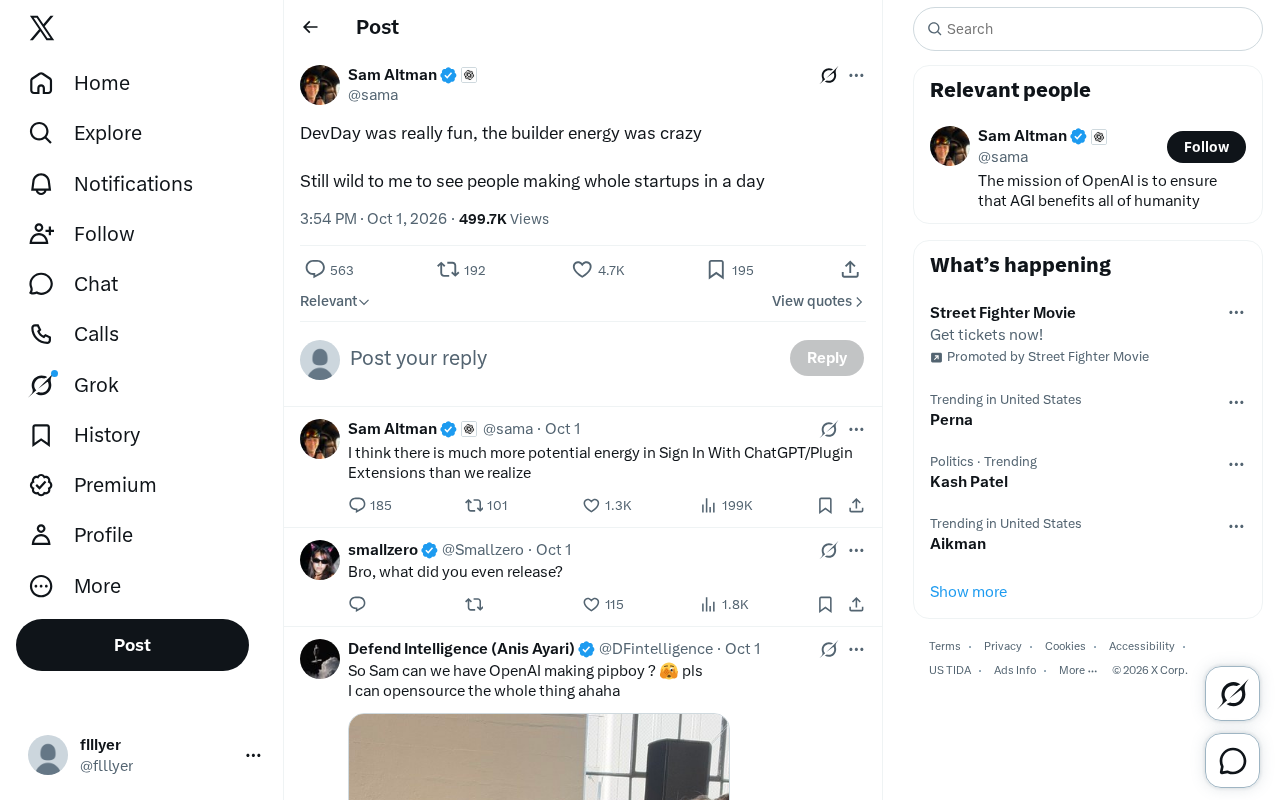
DevDay has just wrapped up, and the atmosphere on-site, in the words of one attendee, was simply — "builder energy was crazy." What struck him even more was this: "Seeing people build complete startups in a day still feels a little surreal."
This brief share actually reflects a deeper shift happening in the developer ecosystem right now: the barrier to building a product is collapsing at a visible pace.
Why "building a startup in a day" is no longer an exaggeration
A few years ago, this statement would have sounded like marketing talk. A usable product required at least frontend, backend, database, deployment, and payment integration — just scaffolding it would take weeks.
Now, AI coding tools have compressed this chain to the extreme. From code completion to whole-file generation, from automated debugging to one-click deployment, the developer's role is shifting from "writing every line of code" to "clearly describing what needs to be done." Events like DevDay are exactly the showcase for this transformation — participants aren't just listening, they're building on-site, turning ideas directly into runnable things.
What's truly surprising isn't the tools themselves, but the pace: a prototype that once required a team collaborating for weeks can now be brought to life by one person in an afternoon.
The "AI coding tools" mentioned here currently fall into roughly three main categories. The first is code completion tools, such as GitHub Copilot, which predict the next line of code within the editor based on context. The second is conversational programming assistants, such as Cursor and Claude Code, which allow you to describe requirements in natural language and have the model directly generate or modify multi-file code. The third is application generation platforms, such as v0, Bolt, and Lovable, where users describe a product in one sentence and the platform directly produces a deployable frontend-backend application. The common technical foundation for all three is large language models with long context windows and massive code training data. The so-called "prototype in an hour" essentially means using these tools to replace the most time-consuming work of boilerplate coding, API integration, and deployment configuration, letting developers focus on product logic and user experience itself.
Builder energy: an underrated driving force
The term "builder energy" deserves special mention. It's not just a description of atmosphere — it's a genuine source of productivity.
When a group of people gather in the same space, building things simultaneously, each other's progress creates a kind of positive pressure. When you see the person next to you has already gotten a feature working, you unconsciously pick up your own pace. This energy is hard to replicate in online collaboration, but in offline settings like DevDay, it's amplified to the extreme.
The "whole startups in a day" that participants specifically mentioned is precisely the product of this energy. It doesn't necessarily mean every project will grow into a real company, but it proves one thing: the distance from idea to demonstrable product has shrunk to something measurable in hours.
"Builder energy" is not a new term in the developer community. It first gained popularity in hackathons and startup acceleration settings like Y Combinator, referring to a state of excitement driven by high-density hands-on practice and immediate feedback. Its psychological basis is close to the "social facilitation effect": when individuals perform tasks in the presence of others or in a peer-competitive environment, their performance tends to improve. The cleverness of events like DevDay is that they stack the "instant deliverability" brought by large models on top of a high-density offline crowd — every piece of usable code the model outputs immediately reinforces the participant's positive feedback loop, further accelerating the pace. This is why many attendees later describe not technical details, but a state of "can't stop."
Practical implications for developers and founders
If you can build a runnable startup prototype in a day, then the focus of competition shifts.
In the past, technical implementation capability itself was the barrier. Now, implementation itself is becoming cheaper and cheaper. What's truly scarce is: judgment about the problem, insight into users, and the stamina for continuous iteration. The value of those "startups built in a day" at DevDay isn't in the lines of code, but in the fact that they validated whether an idea is worth continued investment.
For individual developers, this means the cost of trial and error drops dramatically — you can spend a day testing a direction, and if it doesn't work, move to the next one. For teams, this means the prototype validation cycle can be compressed to a fraction of the traditional process.
It's important to understand what "lower trial-and-error cost" really means. In traditional software development, the sunk cost of a prototype includes human time, server costs, and opportunity costs — often high enough that teams tend to "get it right the first time," which lengthens decision cycles. AI tools dramatically compress the implementation cost, making "parallel exploration of multiple directions" feasible. This is especially important for individual developers: in the past, one person's time could only be bet on one project. Now you can validate three or four ideas within days, then concentrate resources on the most promising one. But note: what's being trialed is "implementation," not "judgment" — if the problem itself is wrong, building a prototype quickly only wastes attention faster. Therefore, the ability truly amplified at this stage is the ability to quickly identify from user feedback whether a direction is worth continuing.
What deserves a calmer look
Of course, the claim "build a startup in a day" needs some discounting. What you can build in a day is a prototype, not a company. Real startups also involve user acquisition, retention, business models, compliance, and a whole series of issues that no tool can solve for you.
But even speaking only of prototypes, this speed alone is already enough to change the rules of the game. It turns "let's build it first and see" from a slogan into an action you can casually execute.
The signal DevDay sends is clear: the barrier to building is lowering, and more and more people will take action. As for who can turn a one-day prototype into a year-long commitment — that's still a different game.
The gap between a prototype and a company is usually called the absence of "product-market fit" in startup research. A demo that runs through the main flow only proves technical feasibility; it has not yet validated demand authenticity, willingness to pay, or a repeatable customer acquisition path. Take SaaS as an example: a formal launch also involves account systems, billing and subscriptions, data compliance (such as GDPR and personal information protection laws), SLA guarantees, and customer service systems — these often account for most of the work across a product's full lifecycle. In addition, AI-generated code still carries risks in security, maintainability, and license compliance, and putting it directly into production requires additional review. So the more accurate statement is: AI has compressed the "visible part of going from 0 to 1" to the hour level, but the hidden engineering work from 1 to 100 has not decreased proportionally.
One-line Summary
AI coding tools make building a startup prototype in a day a reality, and the competitive focus shifts to judgment and insight.
Paragraph Summary
Using DevDay as an entry point, the article observes a deep shift in the developer ecosystem: the rapid collapse of the barrier to building. AI coding tools have compressed prototype development that once took a team weeks into one person's afternoon, and the intense "builder energy" on-site serves as a vivid footnote to this acceleration. The author points out that when technical implementation itself is no longer scarce, the competitive focus shifts from writing code to judgment about the problem, insight into users, and the stamina for continuous iteration. The dramatic reduction in trial-and-error costs gives both individuals and teams a faster validation rhythm. But the article also reminds readers to stay calm: what you build in a day is a prototype, not a company. User acquisition, retention, business models, and compliance remain unavoidable steps. What AI compresses is the visible 0 to 1, not the hidden 1 to 100.
Related articles

Chain of Thought Isn't Just for AI: How Humans Can Use CoT to Improve Thinking Quality
Chain of Thought isn't just a prompt trick for large models. Starting from a Hacker News discussion, this article analyzes why CoT works for human thinking too, breaks down actionable ways to transfer it, and highlights the key differences between human CoT and machine CoT.
Cloudflare Teams Up with OpenAI: Closi…
Cloudflare Teams Up with OpenAI: Closing the Loop from Vulnerability Discovery to Defense with AI
Cloudflare uses OpenAI Daybreak to investigate security vulnerabilities and generate reviewable remediation plans, while developers use Codex to boost coding efficiency and quality.

Orca Multi-Agent Orchestration in Practice: A Guide to Parallel Collaboration with Claude and Codex
Orca is Stable AI's free open-source agent workbench supporting 34 agents like Claude Code and Codex in parallel. Learn its Git worktree isolation, multi-model orchestration, and mobile management.