DevDay Livestream Countdown: What to Expect from the Developer Conference

DevDay livestream countdown: official teaser "great stuff for you" hints at a developer-focused release blitz.
OpenAI DevDay's livestream is in its final countdown, with the official account posting a minimalist teaser — "We built some great stuff for you" — without revealing any product names or feature details. The article argues the tweet's core purpose is to build suspense and drive viewership, and that the "for you" framing targets developers specifically, suggesting announcements will likely cover model and API updates, toolchain improvements, and platform integrations. A livestream format rather than recorded video hints at features that can be demoed live and run directly. The article also cautions that all speculation is community guesswork before the stream begins, and advises watching with specific questions while tracking changelogs and pricing adjustments.
DevDay Livestream Is About to Begin: A Preview of the Conference's Big Reveals
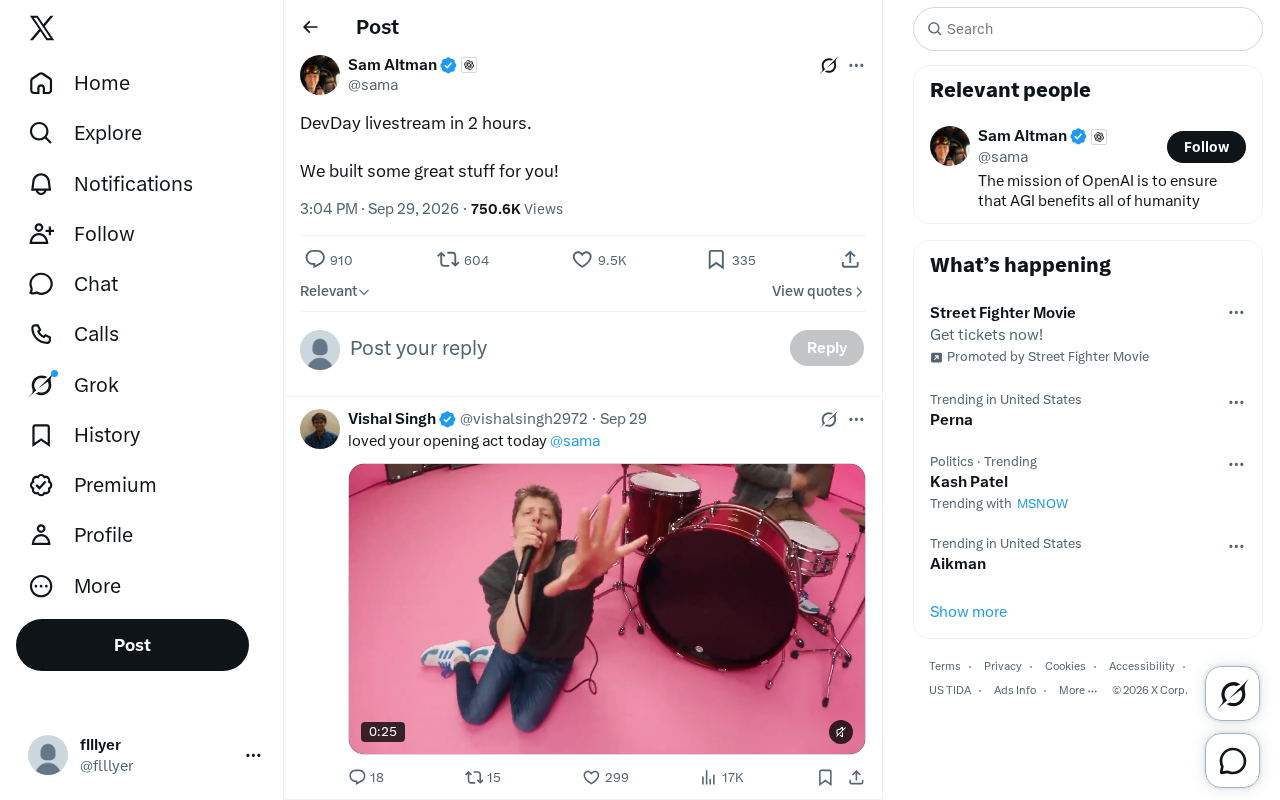
The DevDay developer conference livestream is in its final countdown. The official account posted a brief message on social media: "DevDay livestream in 2 hours. We built some great stuff for you!" — two hours until the stream begins, and the team has prepared some "great stuff" for developers.
A single sentence offers limited information, yet it's enough to stir up a round of speculation in the developer community. For those who follow AI toolchains and development platform trends, DevDay has long served as an important window into the technical direction of leading vendors.
Why a One-Line Teaser Is Worth Paying Attention To
The team chose a minimalist approach to send its signal — no product names, no feature lists, just the vague yet explicitly promising phrase "great stuff." This style of communication is not uncommon for developer conferences: build suspense first, concentrate attention on the livestream itself, then let the keynote reveal everything one by one.
From a timing perspective, tweeting two hours in advance is a calculated move. It's short enough to create a sense of urgency that "it's about to start," yet long enough for developers to arrange their viewing. Combined with the exact wording in the screenshot, the core function of this teaser is to drive viewership, not to convey specific technical details.
What truly deserves attention is the "for you" framing. It explicitly targets developers rather than general consumers. This means the upcoming announcements will most likely revolve around APIs, developer tools, model capabilities, or platform integrations.
DevDay is an annual developer conference OpenAI has held since 2023. The inaugural event launched products including GPT-4 Turbo, the Assistants API, and custom GPTs, directly shaping the tooling baseline for AI application development over the following year. Because of this, DevDay is regarded in the developer community as a bellwether for the priorities of leading model vendors — what it announces and what it doesn't often hints at shifts in resource allocation. This article focuses on the teaser phase before such events begin: information is minimal, but the timing, wording, and choice of medium all carry signals.
What Developers Can Expect from DevDay
Based on the historical positioning of events like DevDay, several possible directions can be reasonably inferred.
Model and API updates. Developers care most about model capability boundaries and calling costs. New model versions, context length adjustments, and pricing strategy changes all directly impact product architecture decisions. If "great stuff" points to this layer, the impact will be the broadest.
Toolchain and developer experience. From SDKs and debugging tools to deployment workflows, improvements at any link in the chain lower the barrier to development. In recent years, leading platforms have increasingly focused on the complete path "from idea to launch" rather than isolated capabilities.
Platform ecosystem and integrations. Plugins, connectors, and third-party service integrations — these ecosystem-level moves determine whether developers can embed model capabilities into real business scenarios.
It should be noted that the above represents reasonable speculation based on the event's positioning; the official team has not yet disclosed specific details. Before the livestream officially begins, any feature list can only be treated as community speculation.
Developer attention to model and API updates typically concentrates on several quantifiable dimensions: context window size determines the scale of documents or code that can be processed in a single call; calling pricing translates directly into a product's marginal cost; the stability of function calling and structured output affects engineering implementation complexity; and rate limits determine whether a service can withstand real traffic. Any change to these parameters may force teams to reassess their architecture choices. Therefore, the real impact of model-layer announcements often lies not in how much capability has improved, but in how the cost curve and reliability boundaries have shifted.
The Product Rhythm Behind the Livestream Teaser
Placing this tweet in a broader timeline, its significance goes beyond "there's another launch event coming."
DevDay's rhythm is typically tied to product iteration cycles. The shorter the teaser, the more concentrated the announcements tend to be — the team wants to save attention for the main stage rather than dispersing it into fragmented social media discussion beforehand. For developers, this is a signal to set aside time in advance: the real information density will be released in a concentrated burst over the course of a few dozen minutes during the livestream.
Another detail is the livestream format itself. Compared to recorded video or blog posts, a livestream carries an unedited, live feel and makes it easier to arrange real-time demos and Q&A. Choosing a livestream suggests the team has some confidence in the demo — such content typically involves features that can be run directly, not purely strategic presentations.
The choice of "livestream over recorded video" carries specific meaning in developer events. Recorded video can be edited repeatedly and avoids demo mishaps, at the cost of losing the persuasiveness of live Q&A and on-the-spot debugging. A livestream means the team is willing to bear the boundary issues that may surface during a demo, which usually indicates the features to be announced have been internally validated and can run in a real environment. Additionally, livestreams make it easier to arrange hands-on segments — writing code live, calling APIs, showing real-time output — content that is more valuable to developers than strategic narratives.
How to Efficiently Follow This Livestream
High-density launch events can easily overwhelm viewers. A few practical tips:
- Clarify in advance what you care about — model capabilities, pricing, or toolchain — and watch with specific questions for greater efficiency.
- Pay attention to official documentation and API changelogs; verbal introductions at launch events often differ from documented details.
- During demos, focus on whether the results can be reproduced — there may be a gap between the live demonstration and actual calling experience.
- Watch for pricing and quota changes, which are often key variables affecting deployment decisions.
For the developer community, DevDay's value lies not only in what is announced that day, but in how these capabilities are actually put to use in the weeks that follow. The "great stuff" in the teaser will ultimately be verified by code.
The livestream is about to begin — answers will be revealed soon.
There is often an information gap between verbal introductions at launch events and API documentation: capabilities emphasized in a keynote may have scope limitations or prerequisites, and quota, concurrency, or version compatibility issues only surface during actual calls. API changelogs and deprecation schedules are key documents for assessing upgrade costs, especially when existing products depend on older interfaces. It's advisable to compare documentation diffs immediately after the livestream ends, rather than making technical decisions based solely on demo impressions.
One-line Summary
DevDay livestream countdown: the official teaser "great stuff for you" signals a concentrated release aimed at developers.
Paragraph Summary
The OpenAI DevDay livestream is in its final countdown, with the official account posting a minimalist teaser — "We built some great stuff for you" — without disclosing any product names or feature details. The article notes that the tweet's core function is to build suspense and drive viewership, while the "for you" framing explicitly targets the developer community, suggesting the content will likely center on model and API updates, toolchain improvements, and platform ecosystem integrations. Choosing a livestream format over recorded video or blog posts hints that announcements may include features that can be demoed live and run directly, indicating the team has some confidence in the demo. The article also reminds readers that all directional speculation is merely community guesswork before the livestream begins, and recommends developers watch with specific questions while tracking official document changelogs and pricing/quota adjustments, since gaps may exist between verbal introductions and actual calling experience.
Related articles

Chain of Thought Isn't Just for AI: How Humans Can Use CoT to Improve Thinking Quality
Chain of Thought isn't just a prompt trick for large models. Starting from a Hacker News discussion, this article analyzes why CoT works for human thinking too, breaks down actionable ways to transfer it, and highlights the key differences between human CoT and machine CoT.
Cloudflare Teams Up with OpenAI: Closi…
Cloudflare Teams Up with OpenAI: Closing the Loop from Vulnerability Discovery to Defense with AI
Cloudflare uses OpenAI Daybreak to investigate security vulnerabilities and generate reviewable remediation plans, while developers use Codex to boost coding efficiency and quality.

Orca Multi-Agent Orchestration in Practice: A Guide to Parallel Collaboration with Claude and Codex
Orca is Stable AI's free open-source agent workbench supporting 34 agents like Claude Code and Codex in parallel. Learn its Git worktree isolation, multi-model orchestration, and mobile management.