Developer Builds AI Opinion Tracker to Chronicle How Industry Leaders' Stances Evolve

Developer builds tool to track AI leaders' video statements and visualize how their views evolve.
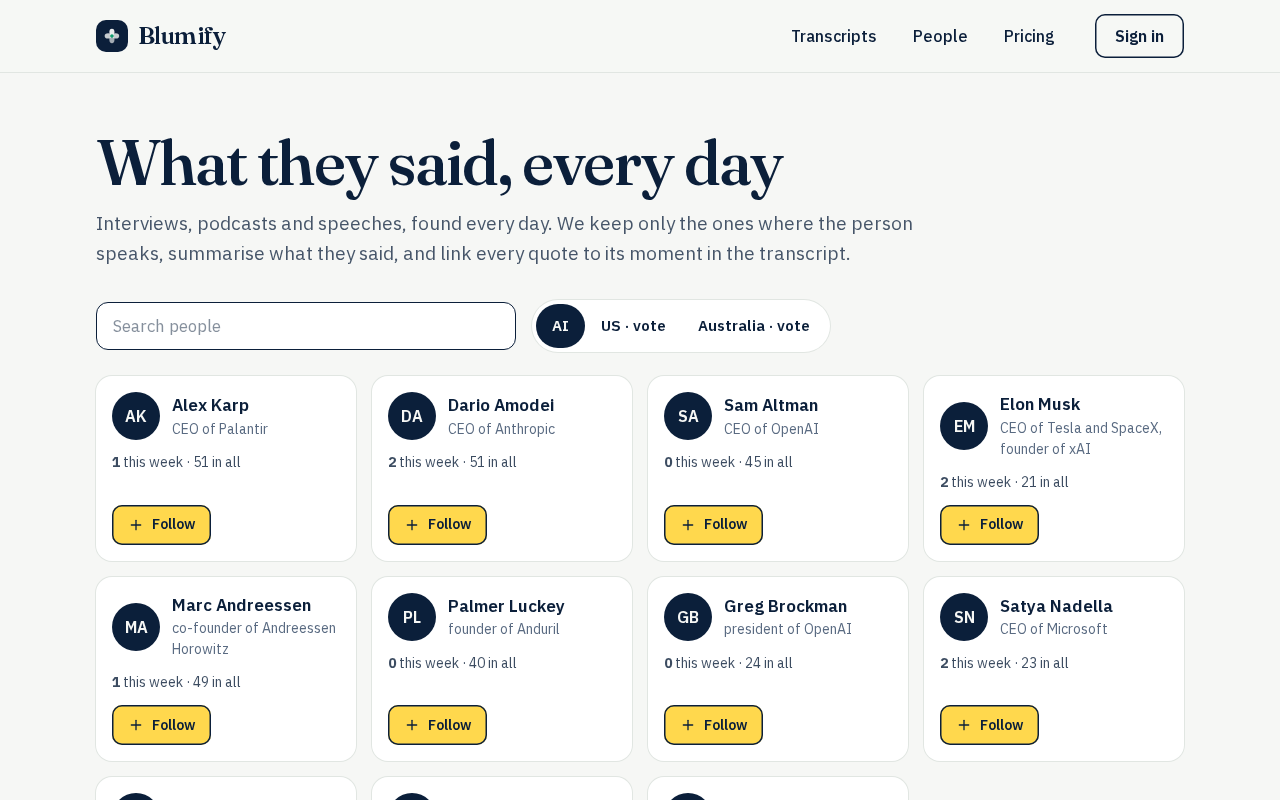
A developer shared a tool on Hacker News that tackles the fragmentation of AI leaders' statements. It fetches videos from YouTube, transcribes them with Whisper, extracts core opinions via NLP, and organizes them by person and timeline to visualize view evolution. Community feedback focused on multilingual support, extraction accuracy, and side-by-side comparison features.
Public statements by AI industry leaders are often treated as bellwethers for where the technology is heading, but those views are scattered across interviews, podcasts, and keynote videos. Systematically tracking how a given leader's position shifts over time is anything but easy. A developer on Hacker News shared a tool built specifically to solve this problem — automatically tracking what AI leaders say in videos and visualizing how their views evolve over time.
Why Tracking AI Leaders' Shifting Views Matters
The AI field moves faster than most technology sectors. A leading figure's judgment today about the AGI timeline may be completely overturned six months later after a leap in model capabilities. Sam Altman of OpenAI, Dario Amodei of Anthropic, Demis Hassabis of DeepMind, and academic representatives like Yann LeCun and Geoffrey Hinton — their statements on different occasions form an important reference point for how the industry understands itself.
The problem is that these statements are highly fragmented. In a two-hour podcast interview, the key insight might occupy only five minutes; in the Q&A portion of an academic conference, a speaker may reveal more genuine judgment than in the formal talk. Manually organizing this material is time-consuming and hard to keep updated. This is precisely the pain point the developer's tool targets: transcribing speech from videos into text, extracting core viewpoints, and organizing them by person and timeline, so that "who said what, and when" becomes immediately clear.
Technical Approach Behind the Tool
Based on the Hacker News discussion, the tool's core workflow breaks down into several stages.
From Video to Searchable Text
The first step is handling video sources. The tool needs to fetch video content from platforms like YouTube and perform speech-to-text processing. The choice of technology here is critical — open-source models like Whisper already deliver fairly accurate transcription, but for multi-person conversations and AI discussions full of technical terminology, some post-processing is still needed to ensure quality.
Whisper is an open-source automatic speech recognition (ASR) model released by OpenAI in 2022. It supports multilingual transcription and translation and maintains relatively high accuracy even in noisy environments and with accent variation. Its core strength lies in large-scale weakly supervised training, using 680,000 hours of multilingual audio data. For content like AI leader interviews, Whisper handles technical terminology and multi-person dialogue reasonably well, but it still has limitations: when speakers talk too fast, overlap, or use newly coined terms (such as new model names), the transcription error rate rises. As a result, practical tools often need to combine custom vocabulary lists or post-processing corrections. In addition, video platform subtitle files (such as YouTube auto-generated captions) can serve as an alternative or supplementary source, though their quality varies widely. The developer chose open-source options like Whisper primarily to balance cost, privacy, and customizability, rather than relying on commercial APIs.
Opinion Extraction and Structuring
Once transcription is complete, the next step is extracting substantive opinions from large blocks of text. This involves understanding and classifying content — which parts are factual statements, which are predictive judgments, and which are expressions of position. The tool needs to store this content in a structured way to support later comparison and retrieval.
Extracting and structuring opinions from text typically involves information extraction and text classification techniques in natural language processing. Specifically, the tool needs to identify opinion sentences (such as "I think AGI will be achieved within five years"), determine their type (prediction, evaluation, factual claim), extract topic tags (such as "AGI timeline" or "AI regulation"), and associate them with the speaker and timestamp. This can be done with few-shot prompting of large language models (such as GPT-4), or with traditional methods like rule-based pattern matching or fine-tuned BERT-style models. The difficulty lies in distinguishing fact from opinion, handling irony and vague expressions, and avoiding quoting out of context. Structured storage often uses graph databases or time-series databases to support multi-dimensional queries by person, topic, and time range. The accuracy concerns raised in community discussions stem precisely from the cumulative errors across these steps.
Timeline and View Evolution
The most valuable feature is the visualization of how views evolve. Has the same person's judgment on the same topic changed? At what point in time did the change occur? Is it related to a particular technical breakthrough or industry event? This kind of longitudinal comparison is something static text organization simply cannot provide.
Visualizing opinion evolution typically combines timelines with semantic similarity computation. The tool needs to sort multiple statements by the same person on the same topic chronologically and calculate the semantic shift between opinions (for example, from "possible" to "impossible"). This can be achieved through sentence embeddings (such as Sentence-BERT) and cosine similarity, but simple similarity cannot distinguish a "position reversal" from a "wording adjustment." More refined methods include sentiment analysis, stance detection, and aspect-based sentiment analysis (ABSA). In addition, timelines are often aligned with external events (such as new model releases or regulatory policies) to analyze causal relationships. This longitudinal comparison capability is indeed more insightful than static text organization, but one must be wary of data sparsity — a given leader may only address a specific topic on a few occasions.
Key Concerns in Community Discussion
The project sparked discussion on Hacker News, with community feedback centering on several areas. Some people asked about the tool's coverage — whether it only supports English content or can be extended to interviews with AI leaders in Chinese, Japanese, and other languages. Others raised concerns about data accuracy: could automatically extracted opinions be taken out of context, and how can the original meaning be preserved?
Other developers suggested adding comparison features, such as displaying different AI leaders' answers to the same question side by side to intuitively show divisions within the industry. Such features would have considerable practical value for researchers studying consensus and disagreement in the AI community.
Implications for How We Consume AI Information
The significance of this tool goes beyond a personal project. It reflects a broader trend: the volume of information in the AI industry is growing exponentially, and traditional manual tracking methods can no longer keep up. Whether researchers, investors, or practitioners, everyone needs more efficient tools for filtering and comparing information.
From a longer-term perspective, if the capabilities of such tools could be extended to a wider range of information sources — not just videos, but also papers, blogs, and social media — it would be possible to build a relatively complete map of the "AI marketplace of ideas." Whose views were validated or overturned under what conditions, and which judgments recur repeatedly but never materialize — this data itself has research value.
At present, the tool is still in its early stages, and based on community feedback, the author is considering iterating on the suggestions. For anyone following developments in the AI industry, this is a direction worth watching: not passively consuming information, but actively tracking and comparing where information comes from and how it evolves.
One-line Summary
A developer built a tool that automatically tracks AI leaders' video statements and visualizes how their views evolve, sparking community discussion on multilingual support, accuracy, and comparison features.
Paragraph Summary
A developer shared a tool on Hacker News aimed at solving the fragmentation of AI industry leaders' statements and the difficulty of tracking them systematically. The tool fetches videos from platforms like YouTube, uses models such as Whisper for speech transcription, then applies natural language processing to extract core opinions and organize them by person and timeline, enabling visualization of how views evolve. Community discussion focused on multilingual support, the accuracy of automatic extraction (avoiding out-of-context quotes), and adding side-by-side comparison of different leaders' views. The article argues this reflects a shift in AI information consumption from passive reception toward active tracking and comparison, and that extending it to more sources like papers and blogs could eventually build a more complete "AI marketplace of ideas."
Related articles

MCP Protocol in 60 Seconds: A Real Session, Message by Message
Dissecting a real MCP session message by message: how an Agent dynamically discovers tools, forwards call requests, and has an MCP server execute them — all in just 9 JSON messages, with the model and reasoning loop untouched.

n8n 40-Minute Masterclass: Build Your First AI Automation Workflow from Scratch
Distilled from a 40-minute n8n masterclass: the core differences between automation, AI, and AI Agents, a comparison of n8n's four deployment methods, and a complete guide from dashboard to your first workflow.

Why Does a 35GB Quantized Model Blow Up an 80GB GPU? The Truth About KV Cache VRAM
Why does a 35GB 4-bit quantized LLM still blow up an 80GB GPU? This article breaks down the four components of inference VRAM, provides precise KV Cache formulas, compares GQA vs DeepSeek MLA memory, and offers production-grade OOM prevention like FP8 KV Cache.