Developer Portfolio Launch: An AI Student's Hands-On Project Showcase

An AI student showcases his growth trajectory through a portfolio and will shift toward generative AI and agent development.
An AI and data science student has launched a personal developer portfolio. The original intent wasn't to list programming languages and frameworks, but to present his growth trajectory as an AI learner, the projects he's building, and future directions. The portfolio itself is seen as an experiment—using a more polished, intentional web experience to showcase technical work, serving as a vehicle for personal branding and project storytelling. The author emphasizes that the portfolio will continue to evolve with new projects, and the next step will focus on generative AI, LLM-driven applications, and AI agents, turning ideas into actual projects.
Why Do You Need a Portfolio?
An AI and data science student recently launched his personal developer portfolio. He admits that the original intent wasn't to create yet another page listing programming languages and frameworks, but rather to have a space that showcases his growth trajectory as an AI learner—the projects he's building, the technical directions he's exploring, and the areas he wants to deepen in the future.
This portfolio is also an experiment: presenting technical work through a more polished, intentional web experience. For many student developers, a portfolio is often a supplement to a resume, but this author sees it as a vehicle for personal branding and project storytelling.
What's in the Portfolio?
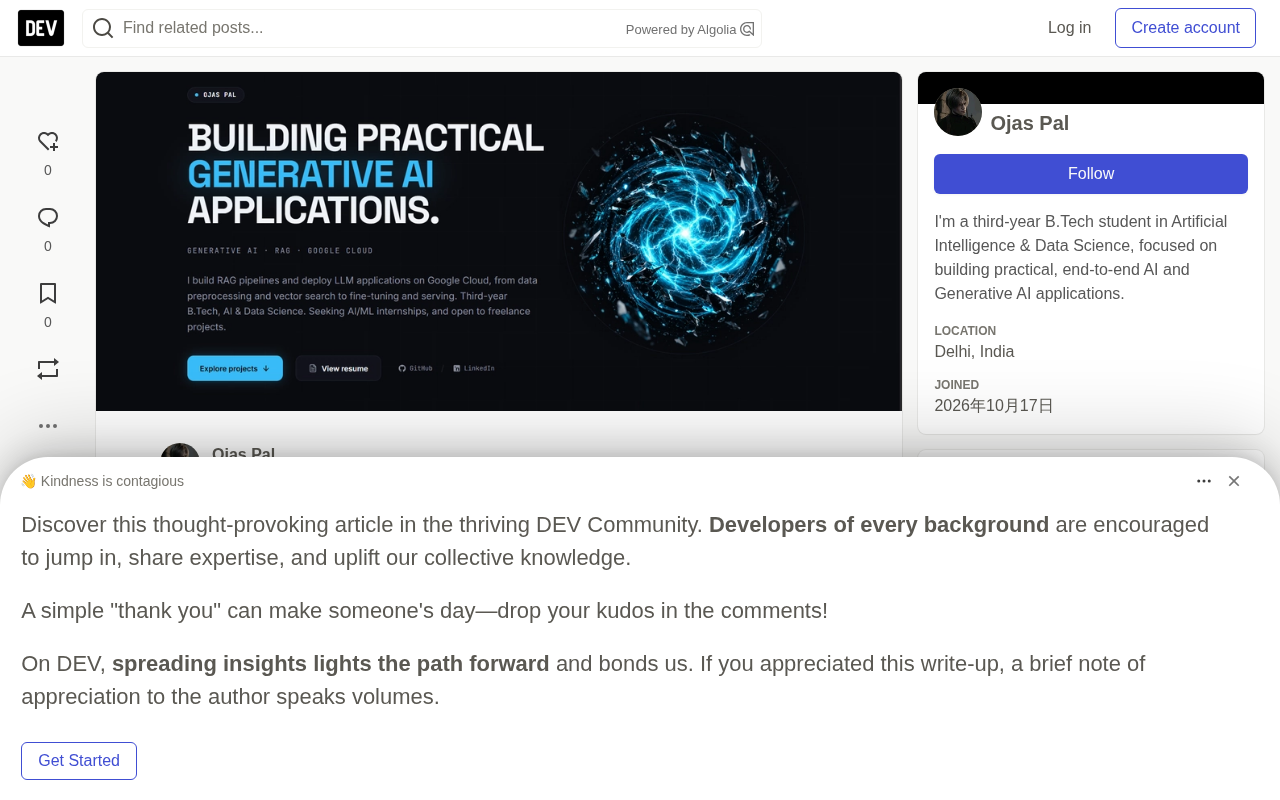
The portfolio is now live and accessible via a public link. Although the original article doesn't list specific projects in detail, based on the description, it covers the author's practice in AI application development and software engineering. The portfolio itself is also a project—demonstrating comprehensive skills in front-end design, information architecture, and content organization.
For students in the AI field, being able to showcase a combination of models, data processing, and product thinking is more convincing than simply listing skills. The author emphasizes that the portfolio will continue to evolve as he learns new projects and technologies.
Information architecture refers to the methodology of organizing, categorizing, and designing navigation for content, determining whether visitors can find key information in the shortest time possible. For a portfolio, information architecture typically includes: how the homepage summarizes identity positioning, how projects are grouped by theme or tech stack, and what elements each project page presents (problem background, technical approach, outcomes and reflections). Good information architecture lets readers naturally browse along the path of "who you are—what you've done—what you can do," rather than facing a scattered collection of links. This is also why treating the portfolio itself as a project makes sense—it tests precisely the ability to structure and express complex information.
Next Step: Focusing on Generative AI and Agents
The author explicitly states that he will continue exploring generative AI, LLM-driven applications, and AI agents, with a focus on turning ideas into actual projects. This reflects a current trend in the AI engineering field: moving from calling APIs to building end-to-end intelligent applications.
LLM applications and Agent development are becoming hot directions in the developer community. For students, showcasing these hands-on experiences through a portfolio can effectively enhance competitiveness in the job market. The author also hopes to connect with more developers building AI projects through the portfolio.
LLM-driven applications typically refer to software products built with large language models (such as GPT, Claude, etc.) as the core reasoning engine. Unlike traditional rule-based systems or small models, these applications often combine the model's general language capabilities with external data and tools through techniques like Prompt engineering, Retrieval-Augmented Generation (RAG), and Function Calling, to accomplish tasks such as question answering, writing, code generation, and information extraction. The engineering challenges lie not in training the model itself, but in context management, output reliability, cost and latency control, and how to evaluate the quality of non-deterministic outputs.
AI agents are a concept that goes further beyond LLM applications: the model not only passively answers questions but can also autonomously plan tasks, call tools, observe results, and iterate actions until the goal is achieved. Typical architectures include planning modules, memory modules, and tool-use modules, with common implementation patterns such as ReAct (alternating reasoning and acting) and multi-agent collaboration. Compared to single API calls, Agent development requires handling systemic issues like loop control, error recovery, and permission and security boundaries, thus better reflecting a developer's understanding of end-to-end engineering.
Insights for the Developer Community
The release of this portfolio reflects the new generation of developers' emphasis on personal presentation. Rather than waiting for perfection, it's better to launch first and iterate—the portfolio itself is a continuously evolving product. If you're also exploring AI engineering, why not start by putting together a portfolio and turning your learning process into visible outcomes.
The author is active on GitHub and welcomes community exchange. For developers currently building projects, this is a lightweight starting point worth referencing.
One-line Summary
An AI student showcases his growth trajectory through a portfolio and will shift toward generative AI and agent development.
Paragraph Summary
An AI and data science student has launched a personal developer portfolio. The original intent wasn't to list programming languages and frameworks, but to present his growth trajectory as an AI learner, the projects he's building, and future directions. The portfolio itself is seen as an experiment—using a more polished, intentional web experience to showcase technical work, serving as a vehicle for personal branding and project storytelling. The author emphasizes that the portfolio will continue to evolve with new projects, and the next step will focus on generative AI, LLM-driven applications, and AI agents, turning ideas into actual projects. The article suggests this reflects an industry trend of moving from calling APIs to building end-to-end intelligent applications, and encourages developers to launch first and iterate.
Related articles

Chain of Thought Isn't Just for AI: How Humans Can Use CoT to Improve Thinking Quality
Chain of Thought isn't just a prompt trick for large models. Starting from a Hacker News discussion, this article analyzes why CoT works for human thinking too, breaks down actionable ways to transfer it, and highlights the key differences between human CoT and machine CoT.
Cloudflare Teams Up with OpenAI: Closi…
Cloudflare Teams Up with OpenAI: Closing the Loop from Vulnerability Discovery to Defense with AI
Cloudflare uses OpenAI Daybreak to investigate security vulnerabilities and generate reviewable remediation plans, while developers use Codex to boost coding efficiency and quality.

Orca Multi-Agent Orchestration in Practice: A Guide to Parallel Collaboration with Claude and Codex
Orca is Stable AI's free open-source agent workbench supporting 34 agents like Claude Code and Codex in parallel. Learn its Git worktree isolation, multi-model orchestration, and mobile management.