Developers Share Monetization Ideas for $15,000 in OpenAI Credits Expiring in 14 Days

How to turn $15K in compute credits expiring in 14 days into a sustainable asset rather than one-time consumption.
A developer holding $15,000 in OpenAI credits expiring in 14 days asked the community how to use them. The article reviews the main suggested paths: batch-generating structured domain-specific content, building reusable synthetic datasets and benchmarks, and distilling small specialized models. It analyzes the viability of "front-load compute, sell later," noting that the key constraint is content shelf life—data and factual content depreciate slowly, while technical docs and prompt templates depreciate fast. It also reminds readers to confirm platform terms before reselling batch-generated content.
A Compute Asset About to Hit Zero
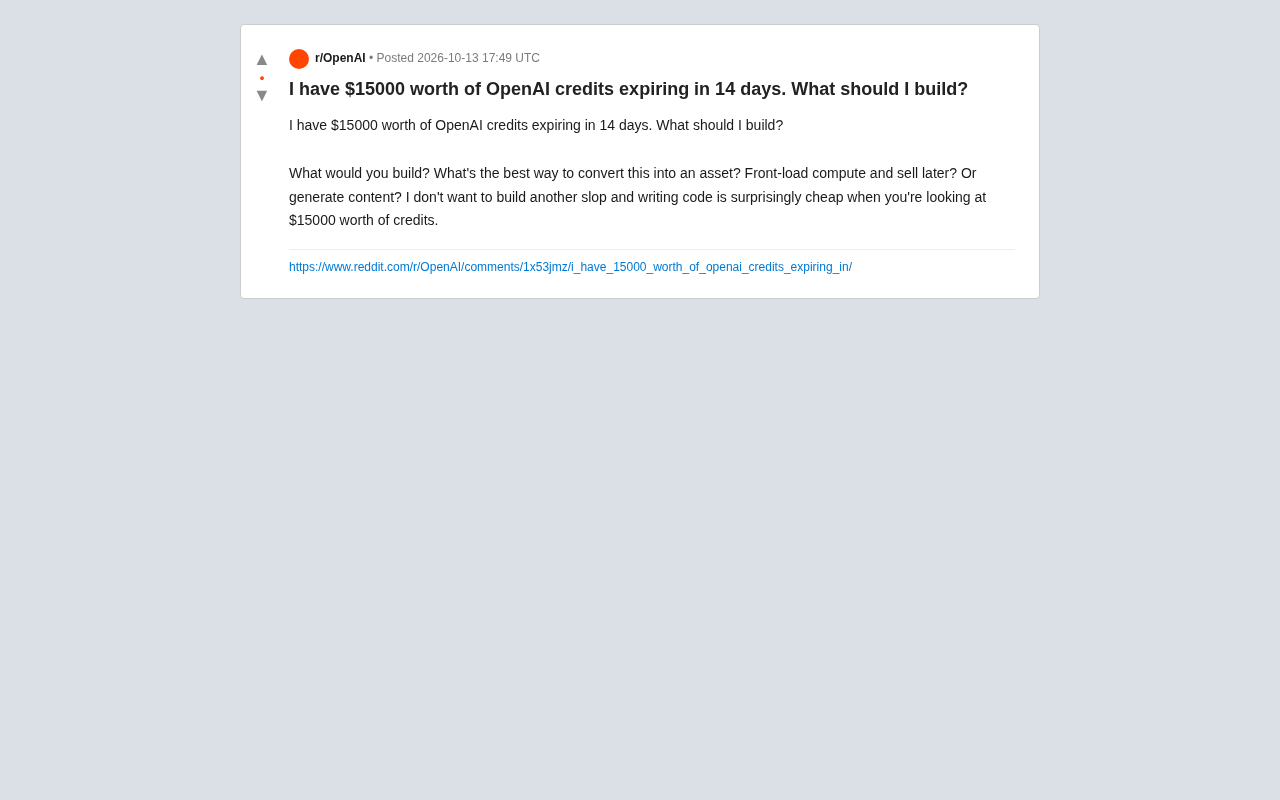
In the AI developer community on Reddit, a post sparked a large discussion: a user holding $15,000 worth of OpenAI credits, set to expire in 14 days, asked the community what to build with them. His core question was clear—"how do I turn these credits into an asset?"—and he proposed two paths: front-load compute and sell later, or batch-generate content. He also emphasized a fact many overlook: with a large pool of credits, the marginal cost of writing code is surprisingly low, so he didn't want to create yet another "AI slop" product.
The essence of this question is how to turn an expiring option into a sustainable asset. Compute credits aren't like cash that can sit in a bank—they only create value when consumed, and the direction of consumption determines the final return.
The Main Paths Suggested by the Community
Batch-generate content—but the kind with a "moat"
The most concentrated advice in the comments was to avoid wasting credits on generic content—which is exactly the "slop" trap the poster worried about. A more viable direction is generating structured, searchable, domain-specific content: for example, a product database for a vertical industry, structured analysis of regulatory clauses, or a collection of technical docs for a specific developer audience. What these have in common is that model capability is only the starting point; the real value comes from the work of data curation and information architecture.
"Store" compute in datasets and benchmarks
Another developer's idea was to run a batch of high-value synthetic datasets or evaluation sets before the credits expire. Model-generated data can be stored long-term, resold repeatedly, or used to train your own small models. Compared to generating an article, a high-quality dataset is a one-time investment with long-term reuse—closer to the definition of an asset.
Train or distill a small model
Some users suggested using the credits to generate large amounts of labeled data and then distill a small, specialized model. While $15,000 may not be enough to train a large model, it's enough to generate tens of thousands to hundreds of thousands of distillation samples, producing a lightweight model that can run locally. This path has a higher technical barrier, but the resulting asset is also stronger.
Knowledge Distillation is a model compression technique: first, a powerful "teacher model" (in this case, OpenAI's large model) generates outputs for a large number of inputs. These outputs (especially soft labels with probability distributions) are then used as training data to guide a much smaller "student model" in learning. The student model doesn't need to understand the task from scratch—it only needs to mimic the teacher's output distribution, so it can approach the teacher's performance on a specific task with far less compute and data. The product of distillation is a specialized model that can be deployed locally with extremely low inference cost, often used for tasks with clear boundaries such as classification, extraction, and intent recognition. Its limitation is that the student model's performance ceiling is constrained by the teacher's performance on that task, and it struggles to generalize to new tasks outside the training distribution.
Synthetic Dataset refers to training or evaluation data that is not manually labeled but batch-generated by a model. Its value lies in bypassing the expensive manual labeling process to quickly construct data that is large-scale, uniformly formatted, and covers long-tail scenarios. Quality control is key to synthetic data: you need to design clear generation constraints, perform deduplication and fact-checking, and retain a portion for manual spot checks. High-quality synthetic datasets can be resold repeatedly, used to fine-tune your own models, or serve as evaluation benchmarks—making them closer to an "asset" than one-off generated articles.
Is "Front-Load Compute, Sell Later" Actually Viable?
The poster's suggestion to "front-load compute and sell later" deserves separate discussion. In theory, you could generate as much content as possible before the credits expire and store it, then sell it gradually over time. But there's a key constraint here: the shelf life of content.
Technical content related to large models, prompt templates, and code snippets depreciate extremely fast—what you generate today may be outdated in six months. By contrast, raw data, verified factual content, and executable workflows depreciate more slowly. So whether the front-loading strategy works depends on what kind of asset you're generating.
Additionally, credits usually come with terms of use, and batch-generating content for resale may violate platform policy—this needs to be confirmed before you start.
"Front-load compute and sell later" is conceptually close to inventory speculation: stockpiling capacity before the cost window closes, betting that demand will still exist in the future. But it differs fundamentally from physical inventory in one respect—the value of model-generated content decays over time rather than holding steady. You can think of this decay as a content half-life: prompt templates and code snippets that depend on a specific model version, API form, or current best practices may have a half-life of only a few months; whereas verified factual data, domain ontologies, and executable workflows can have half-lives lasting years. Therefore, judging whether front-loading is worthwhile essentially comes down to estimating whether the half-life of the content you generate is longer than the time you plan to hold it. Also note that credits are billed by token—the larger the generation scale, the higher the later costs of filtering, cleaning, and storage. This "hidden cost" is often overlooked.
When the Cost of Code Approaches Zero, Where's the Opportunity?
The poster mentioned that "writing code is surprisingly cheap," which actually points to a real shift in AI development today: when compute is abundant, the time cost of writing code is greatly compressed, and the bottleneck shifts from "can it be built" to "what's worth building."
This also explains why building tool-type products alone no longer offers an advantage—the barrier is too low. What's truly scarce is distribution channels, domain knowledge, and user trust. Whether $15,000 in credits can be monetized isn't about who makes the most model calls—it's about who can turn compute into assets others can't easily replicate.
Advice for Developers Holding Expiring Credits
If you're facing a similar situation, a few practical directions are worth considering: prioritize investing credits in outputs that are accumulable and reusable, rather than one-time consumables; choose areas where you have genuine domain expertise to avoid the red ocean of generic content; and figure out your distribution path before batch-generating—content production without a channel equals zero.
Credits expiring isn't a loss, provided that before they hit zero, you've turned them into something that can stay.
FAQ
Can OpenAI credits be restored after they expire? Usually not. Trial or gifted credits issued by the platform typically have a clear expiration date and automatically become invalid after expiry—extensions or cash redemption are not supported.
Is it compliant to batch-generate content for resale using credits? You need to check the platform's commercial use terms. Most platforms allow generated content to be used for commercial purposes, but prohibit reselling API access itself. The boundaries of batch-generating content for resale should be confirmed before you start.
Roughly how many tasks can $15,000 in credits run? It depends on the model used and task complexity. For medium-scale text generation tasks, it can support tens of thousands to hundreds of thousands of calls. The specific number needs to be calculated based on model pricing and token consumption.
One-line Summary
How to turn $15,000 in compute credits expiring in 14 days into a sustainable asset rather than a one-time consumption.
Paragraph Summary
A developer holding $15,000 in OpenAI credits expiring in 14 days posted on a community forum asking how to use them. This article reviews the main paths suggested by the community: batch-generating structured content with domain moats, building reusable synthetic datasets and benchmarks, and distilling small specialized models. The article focuses on analyzing the viability of the "front-load compute, sell later" approach, pointing out that its key constraint is the shelf life of content—data and factual content depreciate slowly, while technical docs and prompt templates depreciate extremely fast. The article further notes that when the marginal cost of writing code approaches zero, the truly scarce resources shift from "can it be built" to distribution channels, domain knowledge, and user trust, and reminds readers to confirm platform terms before batch-generating content for resale.
Related articles

JobRunner MCP Server: AI Agents Can Now Fix Failed Java Jobs
JobRunner launches an open-source MCP server enabling AI agents to view cluster status, diagnose failures, and recover Java jobs—incident response from any cloud coding environment or existing agent.

MLAI Digital Launches 9 Security Agents: MCP Server Safeguards the Full Lifecycle of Agentic AI
MLAI Digital launches Security MCP Server with nine built-in specialized security agents covering vulnerability discovery, attack simulation, prompt injection detection, API and infrastructure assessment, and accelerated remediation—embedding security validation across the full Agentic AI lifecycle from development to production.

Running Isaac Lab on H100 GPUs: Exploring Better Approaches
Exploring optimization methods for running Isaac Lab on NVIDIA H100 GPUs, including MIG configuration, mixed precision, TensorRT acceleration, and community experience to improve robotics simulation and reinforcement learning efficiency.