Devin Launches Teams Plan: Desktop + Free SWE-2 Sessions

Devin Teams plan adds desktop for all users, free SWE-2 sessions, SSO, cost controls, and a standard BAA—shifting toward selling team workflows.
Devin's official blog announced a major Teams plan update: every user gets Devin Desktop, the plan includes free sessions powered by the SWE-2 model, and adds SSO single sign-on and cost controls, plus a standard BAA for Teams customers. The article breaks the update into four areas, noting the core isn't a leap in model capability but lower enterprise adoption barriers—SSO addresses identity integration, cost controls address unpredictable usage, and BAA opens doors to regulated industries like healthcare. It sees this as Devin shifting from "selling seats" to "selling team workflows" and reminds buyers to confirm SSO compatibility, free session boundaries, cost control granularity, and BAA scope before integrating.
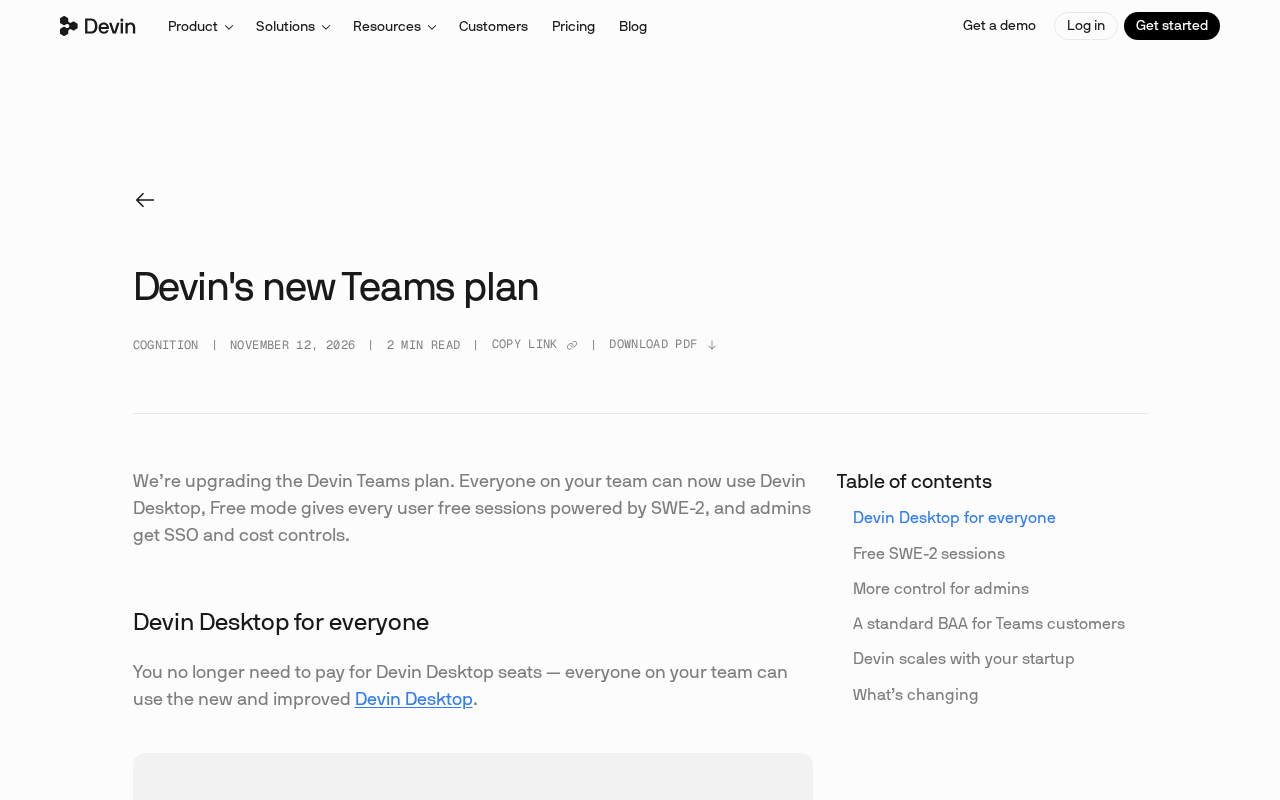
Devin is moving its AI coding agent from a "personal experiment" toward a "team productivity tool." According to the official blog, Devin's Teams plan is getting a major update: every user gets access to Devin Desktop, free sessions powered by the SWE-2 model, SSO single sign-on, cost controls, and a standard BAA (Business Associate Agreement) for Teams customers.
Breaking down the plan: more than just "bigger quotas"
According to Devin's official announcement, the Teams plan's new capabilities fall into four areas.
Devin Desktop for every user. Previously, the desktop experience may have been limited to certain seats or specific scenarios; now every user under the Teams plan gets Devin Desktop. This further reduces the friction of switching between local dev environments and the cloud agent, embedding the AI agent more naturally into daily coding workflows.
Free sessions powered by SWE-2. The announcement mentions that the Teams plan includes free sessions backed by the SWE-2 model. SWE-2 is Devin's model family for software engineering tasks, and free sessions lower the barrier for teams to trial and for lightweight daily use—members can validate workflows first without extra billing.
SSO and cost controls. For enterprise customers, these are hard requirements in purchasing decisions. SSO lets admins connect Devin to existing identity systems for unified account lifecycle management; cost controls address the common concern that AI agent usage is "unpredictable," letting team leads set boundaries and monitor consumption.
Standard BAA. A BAA is the Business Associate Agreement under US HIPAA compliance. Teams customers can obtain a standard BAA, signaling that Devin is actively covering regulated industries like healthcare, where customers have rigid requirements around data processing agreements.
What kind of model is SWE-2? SWE-2 is the software-engineering-specific model family behind Devin. The "SWE" in the name typically stands for Software Engineering, indicating the model has been specifically trained and tuned for code understanding, bug fixing, and repo-level task execution rather than general conversation. Such models are often evaluated on benchmarks like SWE-bench, which use real GitHub issues as tasks. The announcement does not disclose SWE-2's parameter scale, context length, or whether it supports multi-model routing, so whether free sessions offer full capability or a limited version needs to be confirmed against official documentation.
SSO and its relationship to IdPs. SSO (single sign-on) lets users log into Devin through their company's existing identity provider. Common protocols include SAML 2.0 and OIDC, and mainstream IdPs such as Okta, Azure AD (Entra ID), and Google Workspace can all integrate. For enterprises, the value of SSO isn't just passwordless login—it's centralized account provisioning and deprovisioning: when an employee leaves, disabling the account on the IdP side revokes downstream application access. In practice, you also need to confirm whether SCIM auto-sync is supported and whether multiple IdPs or subdomain isolation are supported—details that determine operational cost at scale.
BAA and HIPAA compliance. A BAA (Business Associate Agreement) is a legal document under the US HIPAA framework. HIPAA governs "covered entities" (such as hospitals and insurers) and their "business associates"—third-party service providers that may come into contact with protected health information (PHI) during processing. Under the HIPAA Privacy Rule, covered entities must sign a BAA with a third party before handing over PHI, specifying data usage scope, security obligations, and breach notification responsibilities. So a vendor offering a standard BAA means it is willing to assume these obligations at the contract level—a prerequisite for healthcare customers procuring SaaS tools.
What this update signals
From a product cadence perspective, Devin's moves point in a clear direction: shifting from "selling seats" to "selling team workflows."
Early adopters of AI coding agents tend to be individual developers or small teams who care about whether the agent can complete a task independently. But once a tool enters enterprise procurement lists, decision-makers care about identity integration, cost visibility, and compliance agreements. SSO, cost controls, and BAA map precisely to these three demands—a classic "enterprise-ready" feature set.
The full rollout of Devin Desktop is also worth noting. Combining a cloud agent with a local desktop means Devin wants to cover the full loop from task assignment to code landing, rather than only remote asynchronous execution. For teams, this reduces the disconnect of "the agent runs in the cloud while people edit locally."
Free sessions powered by SWE-2 can be understood as a habit-building mechanism. A team plan's value depends on whether members actually use it; free quota gets more members to take the first step, gradually converting to paid usage.
What to evaluate before team procurement
If you're considering bringing Devin to your team, this update offers several clear evaluation entry points.
First, confirm SSO compatibility with your existing identity provider (IdP). The announcement doesn't detail specific protocols, so you'll need to confirm with the vendor before integrating.
Second, understand the boundaries of "free sessions." The announcement doesn't specify how free quota is measured or its usage limits, so teams should estimate real costs based on their size rather than treating free sessions as unlimited supply.
Third, the granularity of cost controls. What level of budgets or alerts admins can set directly affects financial controllability.
Fourth, the scope of the BAA. A standard BAA typically corresponds to specific data processing terms; teams in regulated industries should have compliance colleagues review the actual text.
Technical details worth probing during evaluation. Beyond the four items listed in the announcement, teams can also look at: whether free and paid sessions differ in model version, concurrency, or task duration; whether cost controls support per-project and per-member accounting with hard caps; whether Devin Desktop data is stored locally and whether code is uploaded to the cloud; and how code commits produced by the agent integrate with existing code review, CI/CD, and permission systems. Announcements typically don't disclose all of this, so it's advisable to request documentation directly from the vendor during the POC phase.
Summary
The core of Devin's Teams plan update isn't a leap in model capability but a lowering of enterprise adoption barriers: desktop access for everyone, free sessions reducing trial costs, SSO and cost controls addressing management needs, and BAA opening the door to regulated industries. For teams evaluating AI coding agents, this is a change worth revisiting the procurement checklist for.
Related articles

Prompt Engineering for Beginners: From Writing Prompts to Engineering Thinking
Starting from the essence and four functions of prompts, this article systematically explains the six-step process, four success criteria, learning value, and practical limitations of prompt engineering to help you build a complete understanding.

Anthropic Launches Nasdaq IPO: AI Giant's Listing and Risk Disclosures
Anthropic officially launches its Nasdaq IPO under ticker ANT, with market valuation expected to potentially exceed SpaceX's record. The prospectus devotes nearly 100 pages to AI risks, while first-half revenue grew over 14x but net losses widened sharply, reigniting the AI bubble debate.

Rust cURL Clone Uses 4,832 unsafe Blocks—Is the Memory Safety Myth Broken?
A Rust cURL clone uses 4,832 unsafe keywords, challenging Rust's memory safety narrative. We analyze what unsafe really means, compare Fil-C, and examine rewrite motives.