Devin Slashes Costs by Up to 70%: AI Coding Agent Gets a Major Efficiency Upgrade

Devin cuts usage costs by up to 70%, making AI-powered code review and autonomous coding far more commercially viable.
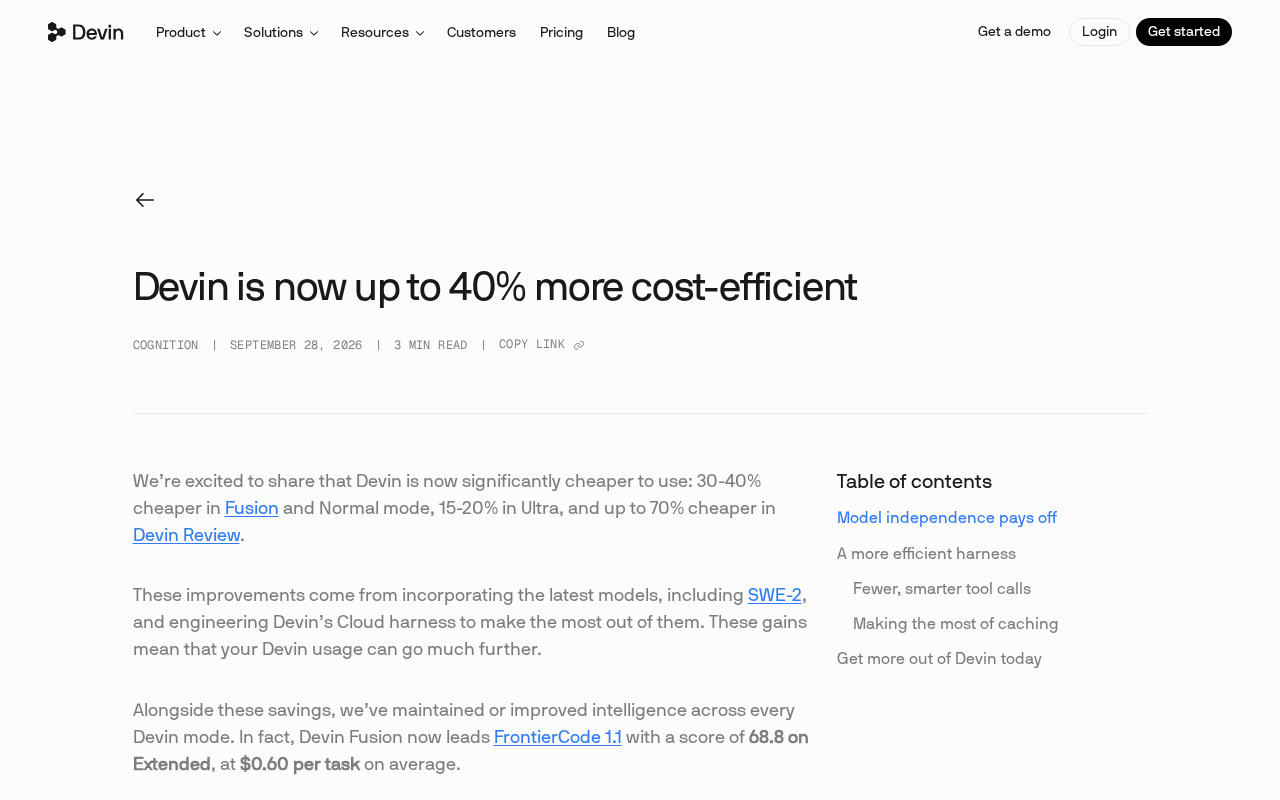
AI coding agent Devin has announced across-the-board price cuts: Fusion and Normal modes are down 30–40%, compute-intensive Ultra mode is down 15–20%, and the Devin Review feature drops by up to 70%. The reductions stem from two factors — lower inference costs in newer foundation models and an optimized execution harness that reduces redundant calls and context overhead. Code review benefits most due to its predictable, structured nature. The cuts significantly lower the barrier to integrating AI agents into standard dev pipelines, potentially making AI code review a default workflow rather than an optional add-on.
Devin Announces Major Cost Reductions — Up to 70% Savings
AI coding agent Devin recently announced an update that developers will find hard to ignore: through the adoption of newer models and a more efficient execution harness, Devin's operational costs have dropped significantly across the board. The change spans virtually all of Devin's running modes and further lowers the commercial barrier to entry for autonomous coding agents.
According to official figures, cost reductions vary by mode: Fusion and Normal modes are down 30%–40%, Ultra mode is down 15%–20%, and Devin Review — the dedicated code review feature — sees the steepest drop at up to 70%. These aren't marginal tweaks; they represent a substantive improvement to the overall economic model.
Two Key Drivers Behind the Cost Cuts
Devin's cost reduction is primarily attributed to two factors: more advanced underlying models and a more efficient execution harness.
Updated Underlying Models
As large language models continue to iterate rapidly, newer generations tend to deliver equal or greater capability at lower inference costs. As an application layer product built on top of foundation models, Devin benefits directly from this trend. Greater model efficiency means fewer tokens consumed to complete the same coding task, which translates to a lower per-task cost.
A More Efficient Execution Harness
Beyond the model itself, Devin's "harness" — the orchestration and execution system that coordinates multi-step task completion — has also been optimized. For autonomous coding agents, harness efficiency is critical. A smarter scheduling framework can reduce unnecessary repeated calls, wasteful inference, and redundant context passing, directly cutting operational overhead. This kind of optimization reflects Devin's own engineering capabilities and is a key moat that distinguishes it from products that simply wrap a model API.
In the AI agent space, "harness" typically refers to the task orchestration layer built around a base language model. It's responsible for decomposing a complex goal into sub-steps and managing tool calls (such as code execution, file I/O, and terminal operations), context window management, error retries, and state tracking across multi-turn interactions. For autonomous coding agents like Devin, the harness design directly determines how many model calls are needed to complete a task and how many tokens of context each call carries. An inefficient harness might accumulate the full conversation history with each turn, causing context bloat and exponential token consumption. An optimized harness, by contrast, can dramatically reduce per-inference costs through techniques like summarizing history, pruning irrelevant context, and batching tool calls. This explains why harness optimization can sometimes deliver greater cost savings than simply switching to a cheaper underlying model.
Breaking It Down by Mode: Who Benefits Most?
The variation in cost reductions across modes reflects the distinct task characteristics of each.
Fusion and Normal modes serve as the primary workhorses for everyday development. A 30%–40% reduction covers the vast majority of routine development tasks, and for teams using Devin frequently, the long-term savings are substantial.
Ultra mode sees a more modest reduction of 15%–20%. This mode typically handles more complex, compute-intensive tasks where fixed high-intensity computation makes up a larger share of the cost structure, leaving less room for optimization.
The most striking figure is Devin Review's 70% cost reduction. Code review tasks tend to follow predictable patterns with a well-defined context scope. This higher degree of structural consistency makes them the most amenable to gains from harness optimization and improved model efficiency. For teams looking to integrate AI into their code review workflows, this change dramatically improves the return on investment.
What This Means for the AI Coding Ecosystem
Cost has consistently been one of the central obstacles preventing autonomous coding agents from achieving widespread adoption. Many teams have been cautiously watching products like Devin from the sidelines, largely because per-task or usage-based pricing can accumulate quickly at scale.
This round of cost cuts — especially the 70% reduction for the Review feature — directly lowers the barrier to integrating AI agents into standard development pipelines. When AI code review becomes cheap enough, it can shift from a "nice-to-have" to a "default-on" part of the routine workflow.
More broadly, this update reinforces the industry trend of continuously declining costs at the AI application layer. As model capabilities improve and inference costs fall in tandem, products built on top of models can repeatedly refine their economic model without sacrificing quality. For developers and enterprises, this means the opportunity cost of trying and adopting AI coding tools is falling fast.
Autonomous coding agents typically bill based on task complexity, using models such as ACU (Agent Compute Unit) billing, time-based billing, or billing derived from underlying token consumption. Devin uses an ACU-like consumption model where users purchase a quota that gets drawn down as tasks are completed. This approach is transparent and controllable, but in high-frequency scenarios — such as automatically triggering a code review on every PR — cumulative costs can place real pressure on smaller teams. With Review costs dropping 70%, a team processing dozens of PRs daily could see their monthly AI review spend shrink from the hundreds of dollars to double digits. In business terms, that's the threshold that separates a "pilot project" from "core infrastructure."
Closing Thoughts
Devin's latest cost optimization isn't an isolated event — it's a signal that AI coding agents are beginning to take commercial viability as seriously as raw capability. Autonomous coding agents only become true candidates for mainstream development workflows when they can complete real tasks and do so at a reasonable cost. For teams currently evaluating AI coding tools, now may be the right time to take a fresh look at Devin's value proposition.
Related articles

Felix Rieseberg Personal Homepage
Felix Rieseberg's personal homepage sparks attention on Hacker News. This article covers the Slack engineer's technical background, the rise and fall of nativefier, and the value of a developer homepage as a tech calling card.

@ai-sdk/vue 3.0.306 Patch Release Syncs with [email protected] Update
@ai-sdk/vue 3.0.306 released, synced with [email protected]. A routine patch release for the Vercel AI SDK ecosystem with no public API changes; the Vue adapter layer stays version-aligned with the core package.

Gemini 4 Argon API Launches: The Era of Million-Token Output Begins
Google launches Gemini 4 Argon with sparse MoE architecture, up to 1M output tokens, and a 68.90% Vals Index score, available across API, AI Studio, and the Gemini app.