Devin Voice Launches: Delegate Coding Tasks with Your Voice

Devin Voice lets developers delegate coding tasks by speaking, with separate models handling conversation and code execution.
Cognition's Devin Voice upgrades the AI programming interface from text to speech. The core innovation isn't transcription — it's voice delegation: developers describe goals out loud, and Devin autonomously explores the codebase, writes code, and runs tests. Architecturally, the product decouples a real-time voice conversation model from a specialized SWE coding model. Interaction supports interruption and redirection at any time, with full conversation history preserved. Notably, voice mode does not bypass code review — human approval before merging remains in place, reflecting a product philosophy that balances efficiency with engineering oversight.
Cognition's Devin Voice shifts AI-assisted programming from typing to speaking. This isn't a simple voice-to-text feature — it lets you collaborate with AI the way you'd make a phone call: describe what you need, talk through ideas, and hand off the actual coding work. For developers who've spent years glued to a keyboard, this represents a genuinely new way of working.
From Voice Transcription to Voice Delegation
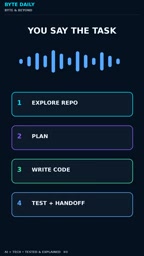
The most fundamental shift in Devin Voice is the concept of delegation, not transcription. Most voice coding tools stop at converting speech to text. Devin takes a completely different approach: you describe the outcome you want, and Devin autonomously explores the codebase, plans the steps, writes the code, runs the tests, and delivers the results.
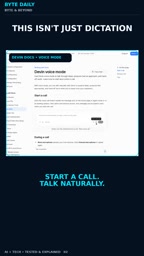
In other words, the developer's role shifts from "issuing line-by-line instructions" to "clearly stating the goal." This means you can talk through an idea with Devin during a call, stress-test a technical approach, and then naturally hand off the implementation — more like assigning work to a teammate than operating a tool.
Delegation carries a specific meaning in the AI Agent space: a human hands a high-level goal to an agent, which then autonomously breaks down the task, invokes tools, and iterates toward completion — rather than waiting for step-by-step human instructions. This contrasts with traditional "command execution" modes, which are more like operating a tool than managing an independent collaborator. Since its launch in 2024, Devin has positioned itself as a "fully autonomous software engineer," capable of completing end-to-end development tasks within a codebase — including cloning repos, reading documentation, modifying code, running tests, and submitting PRs. Devin Voice wraps these capabilities in a voice interface, extending delegation from keyboard input to spoken expression and lowering the cognitive overhead of kicking off a complex task.
Under the Hood: A Conversation Layer on Top of a Coding Model
According to Cognition, Devin Voice uses a GPT-based voice model for the real-time conversation layer, powered underneath by their newly released SWE coding model. The two work in tandem — one handles natural, fluid real-time communication, the other handles the actual software engineering work.
This architectural separation reflects a growing trend in agent-based products: decoupling the conversational experience from execution capability, with each handled by the most suitable model. The conversation model ensures low latency and naturalness; the coding model ensures code quality and engineering reliability.
SWE coding models (Software Engineering Models) are large language models specifically trained for software engineering tasks. Compared to general-purpose models, they are more deeply optimized for code generation, repository comprehension, and test execution. The standard benchmark for evaluating these models is SWE-bench — a test set built from real GitHub issues and their corresponding patches, requiring the model to localize bugs and generate code changes that pass tests within a complete repository. Devin previously used SWE-bench scores as a core marketing metric, so the naming of its new SWE coding model continues that tradition, signaling specialized capability for engineering-grade tasks.
The GPT-based real-time voice model refers to capabilities similar to OpenAI GPT-4o's multimodal real-time voice — optimized for low-latency speech understanding and generation, achieving near-human conversational fluency. Keeping the two model types specialized and separate, rather than forcing a single general model to handle both natural dialogue and complex code generation, is becoming established best practice in agent architecture design.
Interruptible and Redirectable by Design
Devin Voice is built for genuine back-and-forth interaction. You can interrupt it while it's working, cut in while it's talking, clarify requirements, or redirect the task at any point.
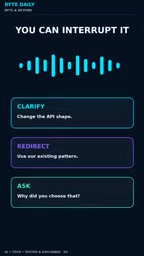
What's particularly interesting is that you can navigate freely within the Devin interface while the call stays connected, and the entire conversation is saved to session history. This design reduces friction in human-AI collaboration — you don't have to wait for the AI to finish a whole task before stepping in. You can interject and course-correct the way you would with a real colleague. This matters a lot in real development scenarios, where requirements often become clearer through the process of discussion.
Voice Doesn't Mean Skipping Code Review
To be clear: voice mode does not eliminate code review.

While the agent can write the code, you still need to inspect those changes and decide what actually gets merged into the codebase. AI handles production; humans handle oversight — that boundary remains intact. This is actually a sensible product stance: voice delegation increases output velocity without surrendering control over engineering quality. For serious production environments, human review remains an indispensable safety mechanism.
The Bigger Shift: From Typing to Speaking Work Into Existence
What makes Devin Voice genuinely worth paying attention to is the shift in working style it represents — from "typing commands" to "delegating software work by voice." If this model holds up, it could redefine the relationship between developers and AI tools.
That said, whether voice-first programming truly works for everyone and every scenario remains to be seen. Complex logic, precise variable naming, fine-grained debugging — whether these are well-suited to verbal expression is still an open question. But as an exploratory direction, Devin Voice offers a new approach worth trying: freeing developers from the keyboard, making it more natural to express intent and delegate execution.
Would you want to write code this way?
Related articles

WorkBuddy Full Guide: How an AI Coworker Takes Over Workplace Automation
What is WorkBuddy? This article analyzes the core capabilities of this full-scenario AI agent: autonomous execution with deliverable results, local file processing, multi-agent parallelism, and workplace automation workflows, helping you judge its essential difference from ordinary AI chat tools.

The Truth About AI Agents: A Hundred Lines of Code + an LLM, Deconstructing the Agent's Underlying Logic
AI agents aren't a new AI species—just a language model plus tools, a loop, and a goal. Here's the underlying logic: how 100 lines of Python hit a 75% fix rate, why the harness beats the model, and Gartner's "agent washing."

AI Agent Deployment: Three Things Developers Should Do
AI Agent deployment doesn't require rushing into multi-agent systems. This article outlines an actionable deployment path and engineering acceptance thresholds for developers, covering human baselines, bounded single-agent scope, and a controlled code-modification loop.