devpit: A Local-First Control Center Built for Claude Code Agents

devpit is a local-first, open-source control room desktop app for managing multiple Claude Code agents at scale.
As AI coding agents like Claude Code penetrate deeper into development workflows, managing multiple agents simultaneously has become a real engineering pain point. devpit positions itself as a "local-first control room," integrating a unified terminal, executable kanban, per-call cost labeling, and a global project orchestrator into a single open-source desktop app. Its key design insight: moving a kanban card directly triggers agent task execution, seamlessly binding project management to the execution layer. The local-first architecture protects code and call data privacy, while open source lowers the trust barrier. Currently tied to the Claude Code ecosystem, it earned 91 upvotes on Product Hunt and represents an early infrastructure exploration for scaling AI coding from single-agent assistance to multi-agent orchestration.
When You Have So Many AI Coding Agents You Need a Control Room
As AI coding agents like Claude Code become a regular part of developer workflows, a new challenge is emerging: when you're running multiple agents across multiple projects simultaneously, how do you effectively monitor, manage, and control them? Terminal windows keep multiplying, and each agent's progress, cost, and status are scattered everywhere — developers quickly lose their grip on the big picture.
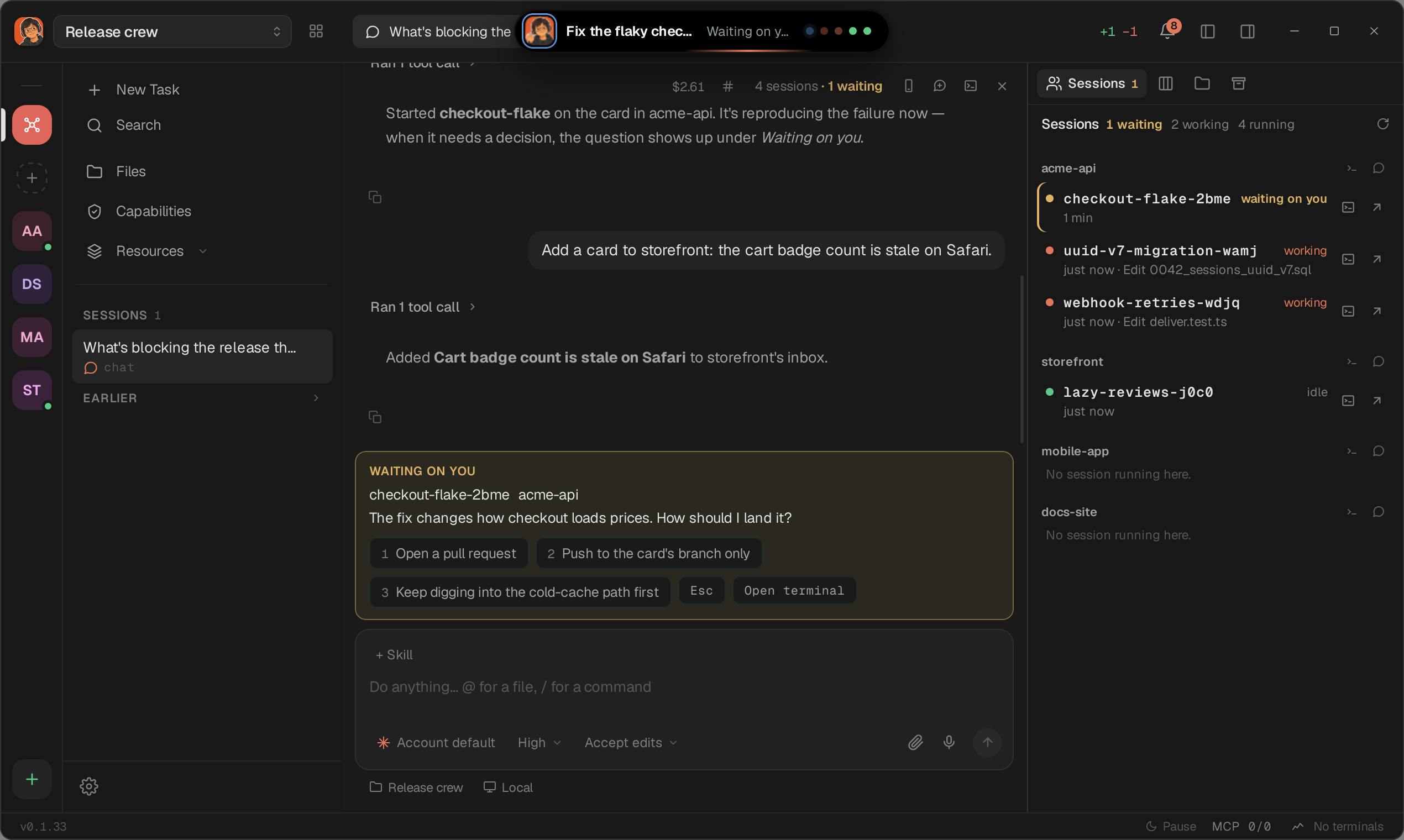
devpit was built specifically for this pain point. It's a native desktop application positioned as a "native control room" for Claude Code agents, aiming to consolidate fragmented agent processes into a single interface that's visual, controllable, and trackable. On Product Hunt, the product earned 91 upvotes and ranked 8th on the day's leaderboard, spanning categories including open source, developer tools, and artificial intelligence.
What devpit Actually Offers
According to the developers, devpit is built around several core capabilities, each addressing real-world scenarios in multi-agent collaboration:
One Terminal You Actually Watch
"One terminal you actually watch" — this tagline captures the absurdity of the current situation. When multiple agents each occupy their own terminal, no one can really follow what's happening in each window. devpit consolidates execution into a single terminal view, letting developers track agent activity in real time instead of jumping between a dozen tabs.
The Board Is the Execution: Moving a Card Starts Real Work
devpit introduces a task board — but it's not just a display-only to-do list. What makes it special is that moving a card triggers actual task execution. This design directly binds the visual interface of project management to the real-time operation of agents, making task orchestration intuitive: what you do on the board maps directly to what the agent does.
This design philosophy is known in software engineering as an "Executable Kanban" — an extension of traditional Kanban methodology. Traditional Kanban originated in the Toyota Production System and was popularized in software development by tools like Trello and Jira as a means of visual task management. But cards have always been information carriers, not action triggers. devpit links card state changes directly to agent task scheduling, essentially breaking down the boundary between the "project management layer" and the "execution layer." This pattern is similar to the "drag to trigger" logic in low-code/RPA (Robotic Process Automation) tools — except the execution actor has shifted from predefined scripts to AI agents with language understanding capabilities. For teams accustomed to visual workflows, this significantly reduces the cognitive overhead of task orchestration — no need to maintain a separate agent scheduling configuration alongside your board.
A Cost Label on Every Agent Call
API calls from AI agents cost real money, yet that cost is often a black box. devpit labels the cost on every agent call, so developers always know what they're spending. For teams running large volumes of agent tasks frequently, this cost transparency is an essential tool for budget control.
Global Orchestrator: See All Projects at a Glance
devpit includes an orchestrator that lets you see the runtime status of all your projects simultaneously. When you have multiple projects running different agents in parallel, this global view prevents you from losing track of any of them and enables higher-level scheduling decisions.
Local-First and Open Source: Two Defining Positions
devpit emphasizes that it is "local-first, open source" — and in today's developer tooling ecosystem, both labels carry real weight.
Local-first means data and execution happen primarily on the developer's own machine. This matters especially for teams concerned about code privacy and unwilling to have sensitive project information leave their environment. Compared to handing everything off to a cloud service, a local-first approach offers clear advantages in data sovereignty and response speed.
Open source lowers the trust barrier and reduces the cost of adoption. Developers can audit the code, customize it to their needs, and even contribute back. For a tool that embeds deeply into development workflows and directly touches code and cost data, the transparency that comes with open source is foundational to building trust.
"Local-First" is a clearly articulated design philosophy that gained traction in recent years, systematically described by the Ink & Switch research team in a 2019 paper. Its core thesis: user data should be stored and processed on local devices first, with network sync as an optional complement rather than a prerequisite. This stands in direct contrast to the traditional SaaS architecture of "cloud as primary, local as cache." In the context of AI coding tools, local-first carries additional practical significance: sensitive information like code, prompts, API keys, and call logs never passes through third-party servers, reducing supply chain security risks and data compliance pressure. For development teams in regulated industries like finance or healthcare, or for commercial projects working with unpublished codebases, this characteristic is often a prerequisite for tool adoption — not a nice-to-have.
It Solves a Real Problem in "Scaled Agent" Workflows
The value of devpit lies in its role as the infrastructure needed to move AI coding from "a single agent helping write code" to "multiple agents collaborating in parallel." A single Claude Code session is manageable. But as agent count grows and projects run simultaneously, monitoring, orchestration, and cost control become unavoidable engineering problems.
The emergence of tools like this reflects a broader trend: AI coding is graduating from a toy into a genuine productivity tool. Developers are no longer satisfied with having AI write a few lines of code — they want to manage agents as scalable "digital labor" that can be scheduled at scale. And managing labor requires a control room.
It's worth noting that devpit is currently tightly coupled to the Claude Code ecosystem. Whether it will support other agent frameworks, and how stable it proves in real-world use, remains to be validated by broader user feedback. But the problem direction it addresses — observability and controllability for agents running at scale — will undoubtedly be one of the most important topics in developer tooling going forward.
"Observability" is a core concept in modern distributed systems engineering, typically encompassing three dimensions: Logs, Metrics, and Traces — used to determine whether a system's internal state can be inferred from external outputs. The rise of AI agents brings this concept into a new layer of complexity: unlike traditional microservices, agent execution paths are non-deterministic — the same prompt can trigger entirely different tool-call chains depending on context. This makes it difficult to apply traditional APM (Application Performance Monitoring) tools directly, and developers need observability layers designed specifically for agent behavior. devpit's approach to cost labeling and unified terminal output is essentially building the most foundational layer of agent observability infrastructure. This space already has dedicated tools like LangSmith, Langfuse, and Helicone, and multi-agent management dashboards are among the fastest-growing sub-categories within it.
Summary
Using the metaphor of a "control room," devpit integrates four capabilities — unified terminal, executable kanban, cost labeling, and global orchestration — into a local-first, open-source desktop application that directly confronts the management chaos of running multiple Claude Code agents in parallel. For developers who have already incorporated AI agents into their daily workflows and are starting to feel overwhelmed by the growing number of agents, this is a product direction well worth watching.
Related articles

Felix Rieseberg Personal Homepage
Felix Rieseberg's personal homepage sparks attention on Hacker News. This article covers the Slack engineer's technical background, the rise and fall of nativefier, and the value of a developer homepage as a tech calling card.

@ai-sdk/vue 3.0.306 Patch Release Syncs with [email protected] Update
@ai-sdk/vue 3.0.306 released, synced with [email protected]. A routine patch release for the Vercel AI SDK ecosystem with no public API changes; the Vue adapter layer stays version-aligned with the core package.

Gemini 4 Argon API Launches: The Era of Million-Token Output Begins
Google launches Gemini 4 Argon with sparse MoE architecture, up to 1M output tokens, and a 68.90% Vals Index score, available across API, AI Studio, and the Gemini app.