dhAIBench: Redefining LLM Evaluation for Linguistic Annotation with 293 Experiments

Charles University launches dhAIBench, arguing LLM annotation should be evaluated by specific linguistic tasks, not general rankings.
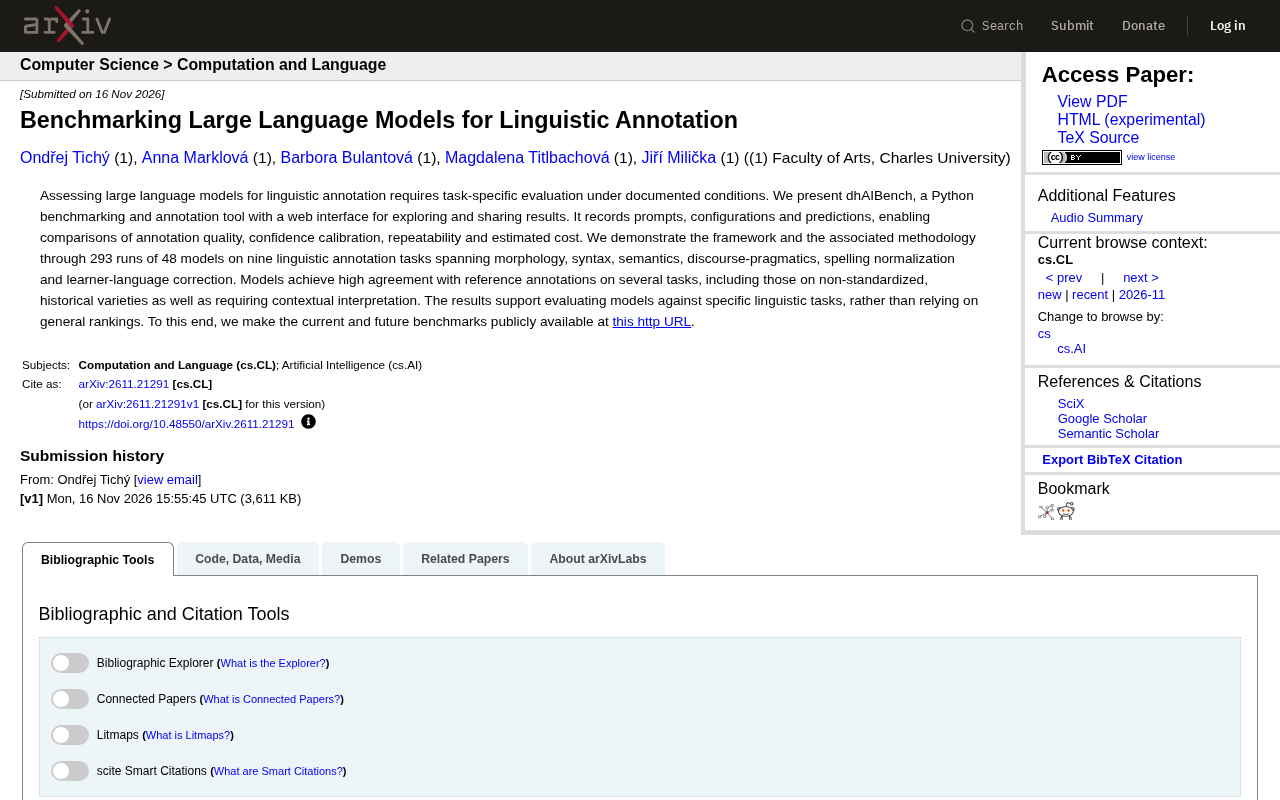
A Charles University team developed dhAIBench, a framework arguing LLMs should be evaluated on specific linguistic annotation tasks rather than general leaderboards. It is a Python benchmarking and annotation tool that records prompts, configurations, and predictions, with a web interface supporting comparison across annotation quality, confidence calibration, reproducibility, and cost. The team ran 293 experiments with 48 models across nine tasks covering morphology, syntax, semantics, discourse pragmatics, spelling normalization, and learner language correction. Models achieved high agreement on non-standardized and historical texts, but performance varied widely across tasks, proving task-level evaluation is essential. The authors recommend reproducible small-scale comparisons on target tasks and treating prompts and configurations as part of the experimental record.
How well do large language models perform on linguistic annotation tasks? Does a high score on a general leaderboard mean a model can handle lemmatization, syntactic parsing, or semantic annotation? A research team from Charles University says no—their dhAIBench framework, through task-level systematic evaluation, reveals the complex relationship between model capabilities and specific linguistic tasks.
Why general rankings aren't enough
Traditional LLM evaluation often relies on comprehensive benchmarks or single-metric rankings, but linguistic annotation is a highly fragmented field. Morphology, syntax, semantics, discourse pragmatics, and other tasks place fundamentally different demands on a model's underlying capabilities. A model that excels at general question answering may not accurately annotate non-standard spellings in historical texts, nor handle discourse relations that require contextual reasoning.
This is where dhAIBench's core argument comes in: models must be evaluated on specific linguistic tasks under recordable conditions. The paper explicitly states that the results "support evaluating models for specific linguistic tasks rather than relying on general rankings." This conclusion has direct reference value for linguists, annotation tool developers, and AI product selection.
Linguistic annotation tasks in NLP are typically divided by linguistic level: morphology deals with word-internal structure (e.g., lemmatization requires converting "running" to "run"), syntactic parsing focuses on structural relationships between words (e.g., dependency syntax), semantic annotation involves word sense disambiguation and semantic role labeling, and discourse pragmatics handles cross-sentence coreference, coherence, and speech acts. These tasks place significantly different demands on model capabilities—morphology relies on character-level pattern memory, syntax requires structured output capabilities, and discourse reasoning demands long-context modeling. Traditional NLP pipelines train a dedicated model for each task, whereas the unified interface of large language models allows the same model to attempt multiple tasks, though capabilities are uneven. dhAIBench designs its task set based on this layered framework, enabling it to pinpoint a model's strengths and weaknesses in specific linguistic subfields rather than producing an average score that masks differences.
What dhAIBench is: reproducible evaluation infrastructure
dhAIBench is essentially a Python benchmarking and annotation tool with a web interface for browsing and sharing results. Its key design feature is traceability—the system records prompts, configurations, and predictions, enabling comparison across four dimensions:
- Annotation quality: how closely model outputs match reference annotations
- Confidence calibration: whether a model's confidence matches its actual accuracy
- Reproducibility: whether results are stable under identical configurations
- Estimated cost: the resource overhead of running annotation tasks
These four dimensions form a far more three-dimensional evaluation profile than "accuracy" alone. Confidence calibration and reproducibility are particularly noteworthy, as they directly determine whether a model can be trusted in real annotation pipelines.
What 293 experiments reveal
The research team ran 293 experiments with 48 models across nine linguistic annotation tasks, covering morphology, syntax, semantics, discourse pragmatics, spelling normalization, and learner language correction. Several key findings deserve close attention:
- Models achieved high agreement with reference annotations on multiple tasks, including non-standardized text, historical language variants, and tasks requiring contextual interpretation. This shows that LLM linguistic capabilities have extended into areas traditional NLP tools struggle to cover.
- High agreement does not mean all tasks are equally easy. Performance differences across tasks precisely demonstrate the necessity of task-level evaluation.
- The evaluation framework itself is public, and current and future benchmark results are available at dhaibench.silent3.ff.cuni.cz.
Confidence calibration is a key metric for assessing model reliability, measuring the gap between a model's self-reported confidence and its actual accuracy. A well-calibrated model is indeed likely to be correct when it claims high confidence, while a poorly calibrated model may frequently err at high confidence levels. For linguistic annotation pipelines, calibration matters more than raw accuracy: if a model can reliably flag low-confidence samples, human review can focus on these difficult cases, greatly reducing annotation costs. By listing confidence calibration as an independent comparison dimension, dhAIBench cares not only about whether a model is "right" but also whether it "knows it might be wrong"—which directly determines whether model outputs can be trusted and embedded in human-in-the-loop annotation workflows.
Practical implications for linguistic annotation workflows
For teams considering bringing LLMs into their annotation processes, dhAIBench's methodology offers two practical recommendations. First, don't use general leaderboards for model selection decisions; instead, run a reproducible comparison on a small sample of the target task. Second, treat prompts and configurations as part of the experimental record, because annotation quality is highly sensitive to prompt design, and experimental results without records cannot be reproduced or compared.
dhAIBench's web interface makes browsing and sharing results accessible, which is especially useful for cross-institutional collaborative annotation projects—team members can compare different model configurations based on the same set of records without maintaining scattered evaluation scripts individually.
Prompt sensitivity refers to the performance fluctuations a model exhibits under minor changes in prompt wording, example selection, output format constraints, and other factors. In linguistic annotation tasks, this sensitivity is particularly pronounced: changing how the label taxonomy is phrased, adjusting the order or number of few-shot examples, or even just modifying a verb in the instructions can significantly change annotation agreement. dhAIBench incorporates prompts and configurations into the experimental record precisely to control this variable. Without fully recorded prompt designs, experimental results can be neither reproduced nor fairly compared across models, and team collaboration will produce incomparable data due to different prompts. Treating prompts as part of the experimental record is the prerequisite for moving LLM annotation from "results obtained by trial and error" to an accumulative, auditable engineering practice.
Limitations and outlook
The combination of nine tasks and 48 models is already substantial, but the diversity of linguistic annotation extends far beyond this. The framework's public hosting means the community can continuously add new tasks and models, gradually building a "task-model" capability map with more information than any static leaderboard. For linguistic research, this fine-grained evaluation data is itself valuable material for understanding model linguistic capabilities.
Related articles

Prompt Engineering for Beginners: From Writing Prompts to Engineering Thinking
Starting from the essence and four functions of prompts, this article systematically explains the six-step process, four success criteria, learning value, and practical limitations of prompt engineering to help you build a complete understanding.

Anthropic Launches Nasdaq IPO: AI Giant's Listing and Risk Disclosures
Anthropic officially launches its Nasdaq IPO under ticker ANT, with market valuation expected to potentially exceed SpaceX's record. The prospectus devotes nearly 100 pages to AI risks, while first-half revenue grew over 14x but net losses widened sharply, reigniting the AI bubble debate.

Rust cURL Clone Uses 4,832 unsafe Blocks—Is the Memory Safety Myth Broken?
A Rust cURL clone uses 4,832 unsafe keywords, challenging Rust's memory safety narrative. We analyze what unsafe really means, compare Fil-C, and examine rewrite motives.