DHH to Share Fresh Perspectives on AI-Assisted Coding at Fireworks Forge

DHH will share his independent take on AI coding and developer autonomy at Fireworks Forge on November 3rd.
Ruby on Rails creator David Heinemeier Hansson (DHH) will appear at the Fireworks Forge fireside chat on November 3rd in San Francisco to discuss controlling the AI stack and building specialized AI for small teams. Known for his strong stance on technical sovereignty — Basecamp famously migrated away from cloud infrastructure — DHH's perspective on AI tools is likely to diverge from mainstream optimism. The conversation is expected to focus on why developers should own and understand the AI capabilities they rely on, rather than accepting black-box services, offering practical insights for small teams evaluating how to integrate AI into their workflows.
DHH Joins the Fireworks Forge Fireside Chat
David Heinemeier Hansson (@dhh) — creator of Ruby on Rails and co-founder of Basecamp and HEY — has confirmed he will appear at the Fireworks Forge event to share his latest thinking on AI-assisted coding. The fireside chat is scheduled for November 3rd in San Francisco, with the conversation centered on "controlling the AI stack" and what that means for small teams building specialized intelligence.
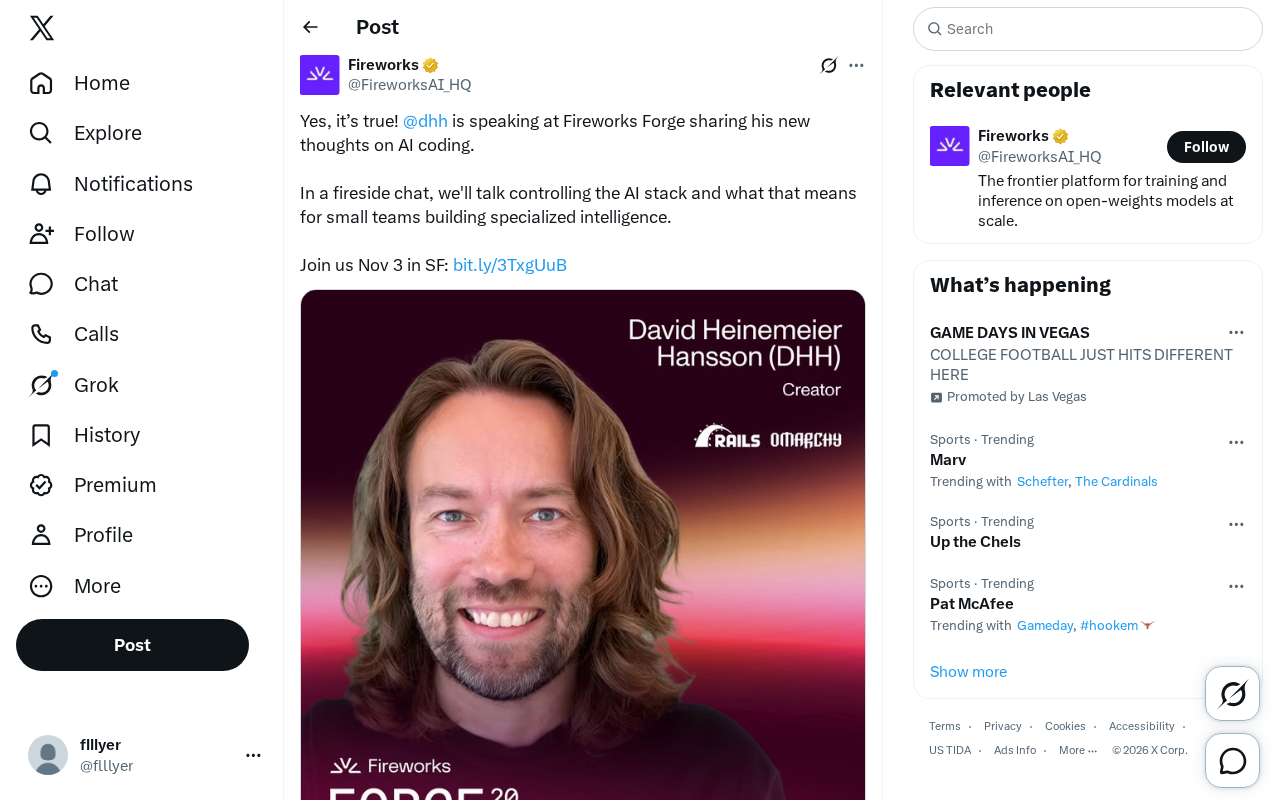
For anyone who has followed developer tooling and software engineering culture closely, DHH's participation in a discussion about AI coding is itself a noteworthy signal. As the creator of the Rails framework, he has always been known for taking bold technical stances and offering independent critiques of mainstream trends — which means his views on AI coding will almost certainly not be the standard optimistic narrative.
Fireworks AI is a platform focused on AI inference acceleration and model deployment, built to help developers run open-source and custom fine-tuned models while maintaining low latency. It's one of the defining products in today's "AI inference-as-a-service" space. Fireworks Forge is the company's developer-community event series, designed to bring AI practitioners and engineering professionals together for in-depth exchange. Compared to large tech conferences, the fireside chat format is deliberately less structured — a moderator guides guests through a focused conversation, creating an atmosphere closer to a clash of ideas than a keynote presentation. That format tends to surface more candid, unfiltered opinions.
The Core Topic: Controlling the AI Stack
The event preview explicitly highlights two key themes: "controlling the AI stack" and "small teams building specialized intelligence." Together, they reveal the angle this conversation is likely to take.
The dominant AI coding experience today relies heavily on cloud-hosted large model APIs. While developers gain productivity, they also hand over core capabilities in their stack to a handful of major providers. DHH has previously spoken out against over-reliance on cloud services, and Basecamp famously executed its own "de-cloud" migration, moving workloads back to self-owned infrastructure. His take on "controlling the AI stack" will likely extend that same commitment to technical sovereignty — the idea that teams should own, understand, and be able to control the AI capabilities they depend on, rather than passively consuming black-box services.
Specialized Intelligence for Small Teams
The framing of "small teams building specialized intelligence" echoes an important conversation happening across the industry right now: not every team needs a general-purpose large model. AI built for a specific domain or workflow can often deliver better results at lower cost and with greater control. For resource-constrained small teams, this is both an opportunity and a practical reality.
The trade-off between specialized AI and general-purpose LLMs is one of the central engineering decisions in AI deployment today. General-purpose models like GPT-4 or Claude cover a wide range of tasks, but come with high inference costs, greater latency, and limited adaptability to private data. By contrast, models fine-tuned for a specific domain or built with retrieval-augmented generation (RAG) can achieve equal or better performance within a given workflow — at a smaller parameter scale and lower inference cost. For small teams with high call volumes and clearly defined use cases, this approach reduces dependence on top-tier API providers while leaving more room for data privacy and compliance control. Fireworks' own product positioning serves exactly these teams: those who want to deploy or customize their own models.
Why This Conversation Is Worth Watching
There's an interesting tension in Fireworks — a platform focused on AI inference and model services — inviting DHH, a developer leader known for pragmatism and swimming against the current. The real draw of this event may lie precisely in that dynamic: what happens when someone who has consistently championed developer autonomy engages with the fast-moving wave of AI-assisted coding? Where will he draw the line between "worth using" and "worth being cautious about"?
Unlike many voices that uncritically hype AI as a replacement for programmers, DHH's participation is likely to bring a more grounded perspective — one focused on the fundamentals of engineering practice. For teams actively evaluating how to integrate AI into their development workflows, that kind of thinking from a seasoned practitioner tends to be far more useful than marketing copy.
The event takes place in person in San Francisco on November 3rd. Interested developers can check official channels for registration details.
Note: This article is based on an event announcement. DHH's specific views should be taken from the event itself once it occurs.
Related articles

Chain of Thought Isn't Just for AI: How Humans Can Use CoT to Improve Thinking Quality
Chain of Thought isn't just a prompt trick for large models. Starting from a Hacker News discussion, this article analyzes why CoT works for human thinking too, breaks down actionable ways to transfer it, and highlights the key differences between human CoT and machine CoT.
Cloudflare Teams Up with OpenAI: Closi…
Cloudflare Teams Up with OpenAI: Closing the Loop from Vulnerability Discovery to Defense with AI
Cloudflare uses OpenAI Daybreak to investigate security vulnerabilities and generate reviewable remediation plans, while developers use Codex to boost coding efficiency and quality.

Orca Multi-Agent Orchestration in Practice: A Guide to Parallel Collaboration with Claude and Codex
Orca is Stable AI's free open-source agent workbench supporting 34 agents like Claude Code and Codex in parallel. Learn its Git worktree isolation, multi-model orchestration, and mobile management.