Did AI Crack a 370-Year-Old Cipher? The Controversial Claude Fable 5.1 Claim
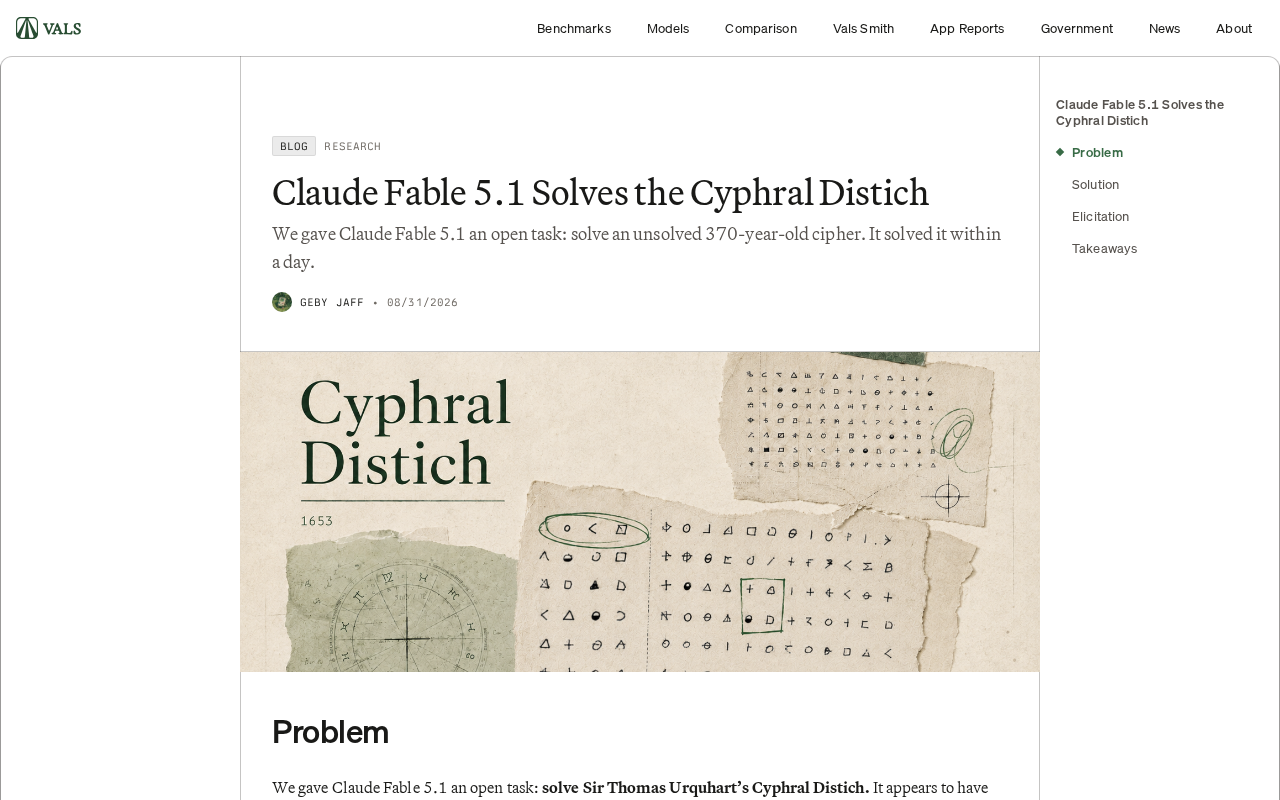
An AI model reportedly cracked a 370-year-old cipher, but key technical details are missing and the claim remains unverified.
A Hacker News post claims Claude Fable 5.1 deciphered the "Cyphral Distich," a cipher allegedly unsolved for 370 years, sparking debate in the tech community. While LLMs do offer real advantages in text pattern recognition and semantic evaluation that can accelerate classical cryptanalysis, their tendency to "hallucinate" plausible-but-wrong answers is a serious concern. The article argues that the true value of any decryption claim lies in reproducibility and independent verification — not textual coherence alone. Given the model's non-standard name and the absence of public technical details, this announcement is better treated as a discussion prompt than a validated scientific breakthrough.
A claim that an AI model called Claude Fable 5.1 successfully deciphered the "Cyphral Distich" — a cipher reportedly unsolved for around 370 years — recently sparked discussion on Hacker News. The post received 77 upvotes and several comments, reflecting the tech community's ongoing fascination with the intersection of AI and cryptanalysis.
Given the limited information available from the original source, this article presents the event as accurately as possible while drawing on general knowledge of cryptanalysis and large language model capabilities to offer a balanced look at the key dimensions worth considering.
What Happened
According to the Hacker News post title, Claude Fable 5.1 cracked a cipher known as the "Cyphral Distich." In literary terms, a distich refers to a couplet — two lines of verse — suggesting the cipher may encode its message in poetic or rhyming form, a technique historically common in steganography and encryption. The claim of a 370-year history adds a dramatic flair to the alleged breakthrough.
It's worth noting that "Claude Fable 5.1" is not a name commonly found in mainstream model naming conventions. It could refer to a specific project, a fine-tuned variant, or a community nickname. Without further technical details — such as the decryption method, verification process, or the original ciphertext — readers should approach claims of "AI solving a centuries-old puzzle" with appropriate skepticism.
Why AI-Assisted Cipher Breaking Matters
Deciphering historical ciphers has long relied on human experts with deep linguistic knowledge, pattern recognition skills, and extensive trial and error. In recent years, large language models have shown promise in text pattern recognition, multilingual processing, and assisting with frequency analysis — making them a new tool for cryptography researchers.
The strength of LLMs lies in their ability to rapidly evaluate the semantic plausibility of vast numbers of candidate plaintexts, identify statistical features of natural language, and leverage historical text corpora to infer encoding schemes. For classical cipher types like substitution and transposition ciphers, AI assistance can meaningfully accelerate the decryption process.
The real challenge, however, lies in verification. Whether a "deciphered" plaintext is actually correct cannot be determined simply by whether it reads coherently — it requires an external chain of evidence, such as cross-referencing with known historical documents or demonstrating the reproducibility of a key. Several historical claims of "ancient ciphers cracked" have later been questioned due to a lack of independent verification.
Reasons for Caution
First, the reliability of model-generated content. LLMs are adept at generating plausible-sounding text — a double-edged sword in cryptanalysis. The same capability that might surface the correct answer could equally produce a self-consistent but entirely wrong solution.
Second, reproducibility. A credible decryption result should make the ciphertext, methodology, and verification steps publicly available so that third parties can independently reproduce the findings. A community post headline alone is not sufficient to confirm a rigorously validated academic breakthrough.
Third, naming and marketing. Attention-grabbing headlines are common in the tech community. When evaluating claims like this, going back to primary sources and checking for accompanying technical documentation or papers matters far more than the headline itself.
Takeaway
The claim that Claude Fable 5.1 cracked the Cyphral Distich illustrates the imaginative potential of AI in the niche but fascinating field of cryptanalysis. It's a reminder that large language models are expanding beyond conversational assistants into interdisciplinary research tools.
That said, based on the information currently available, this looks more like a conversation starter than a fully verified scientific conclusion. For readers tracking the real boundaries of AI capability, what truly matters is the methodology: how the AI participated in the decryption, how the result was validated, and whether it can be reproduced. The answers to those questions reveal far more about AI's genuine strengths than any headline claiming a 370-year-old cipher has been solved.
Related articles
GPT-6 Astra Plays Anno 117 Autonomously: A 1,000-Resident City Built in 6 Hours with Zero Instructions
GPT-6 Astra autonomously played Anno 117: Pax Romana for 6 hours using only screenshots and mouse control, building a 1,000+ resident city across 4 islands with no plugins or guides.
Is AI Destroying the World? A Look at …
Is AI Destroying the World? A Look at the Backlash Against Tech Hype
A Hacker News post titled "AI is destroying the world" sparks debate. We unpack the real concerns: content pollution, job disruption, and AI's massive energy costs.
Why a $129 Shoe Dispute Ends Up Costing Merchants $229
Why does a $129 shoe dispute cost merchants $229? We break down chargeback fees, hidden costs, and what small businesses can do to protect themselves.