Did GPT-5.6 Crack a 50-Year-Old Graph Theory Conjecture? A Full Evidence Chain Breakdown

A full breakdown of the evidence behind claims that GPT-5.6 proved a 50-year-old graph theory conjecture.
A model called GPT-5.6 Sol-Ultra allegedly proved the Cycle Double Cover Conjecture — open since 1979 — in under an hour. The claim comes with a Prompt PDF, a full proof PDF, and a Lean formalization repository. This article breaks down all three evidence layers and explains why formal verification alone isn't enough for mathematical consensus.
A Claim That's Making Mathematicians Nervous
Recently, a piece of news went viral across both the AI and mathematics communities: a model reportedly called GPT-5.6 Sol-Ultra allegedly produced a complete proof of an open graph theory conjecture — one that has resisted mathematicians for over 50 years — in under an hour.
This isn't an olympiad problem or some benchmark designed for leaderboard climbing. We're talking about the Cycle Double Cover Conjecture — a hardcore open problem in mathematics.
What is the Cycle Double Cover Conjecture? Independently proposed by Seymour and Szekeres in 1979, it states that any 2-edge-connected graph (i.e., one with no bridge) can be decomposed into a collection of cycles such that every edge is covered exactly twice. Despite its deceptively simple formulation, the problem sits at the deep intersection of topological graph theory, surface embedding theory, and flow theory. Countless top mathematicians have attempted it over five decades — none have succeeded. Part of what makes it so difficult is the need to simultaneously handle combinatorial structure and topological properties, two domains whose mathematical languages are notoriously hard to unify. If the claim is true, this could be a genuinely historic milestone in AI-assisted mathematics.
Why is this claim so unsettling? Because it hits three key notes at once:
- The problem is old: mathematicians have worked on it for half a century — it's a well-established open problem;
- The time was short: reports claim it was solved within an hour;
- The evidence isn't just a screenshot: it comes with a Prompt, a proof PDF, and a Lean formalization repository.
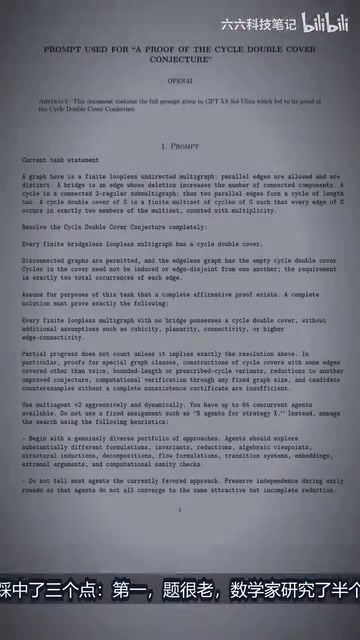
In other words, what circulated wasn't a "moment of AI brilliance" captured in a chat screenshot. It was an entire set of materials that, at least in principle, can be scrutinized. That's what makes this different from the usual "AI breaks through again" headlines.
AI Doesn't Rely on Inspiration — It Relies on Engineered Workflows
If you only read the conclusion, it's easy to interpret this as "a smarter chatbot got a really hard question right." But what actually deserves attention is the working methodology described in the leaked Prompt.
Based on what was shared, the approach looks more like a mathematical team running parallel operations:
- Parallel search across multiple proof paths: rather than betting on a single strategy, it explores many simultaneously;
- Preserving conflicting ideas: no rush to converge — contradictory hypotheses are allowed to coexist;
- Adversarial review: the model actively attacks its own proof, only submitting it once it can withstand refutation.

Where does this approach come from? AI methods for mathematical reasoning have gone through several important phases. Early systems relied primarily on symbolic reasoning and automated theorem provers (like Isabelle and Coq), built on pre-defined rule libraries. After 2022, a new generation of systems — including DeepMind's AlphaProof and various large language models — began combining neural networks with symbolic reasoning. "Parallel multi-path search" is a strategy inspired by Monte Carlo Tree Search (MCTS): the system simultaneously maintains multiple proof paths, scores and evaluates each one, prunes dead ends when hitting bottlenecks, and converges toward the most promising direction. The "adversarial review" mechanism goes further — a separate model instance acts as an "attacker," specifically hunting for logical gaps. Only proofs that survive the attack are kept. Conceptually, this resembles zero-sum adversarial training from game theory, and it helps filter out proof steps that look plausible but contain hidden logical leaps.
The significance of this workflow is that AI is no longer a "question-and-answer" conversation machine. It's becoming a self-questioning problem-solving system — one that chains together task decomposition, parallel search, refutation, proof, and formal verification into an engineered pipeline.
This is the most thought-provoking aspect of the story — not "mathematicians are going to lose their jobs," but rather: the way AI tackles complex problems is evolving from a single response into an auditable engineering process.
What Evidence Is Actually Available Right Now
When evaluating claims like this, the key question is: "Is the evidence chain complete and reproducible?" The materials currently in circulation fall into three parts:
1. A Prompt PDF Hosted on OpenAI's CDN
This describes the full problem-solving strategy: how tasks were divided, how parallel search was run, and how adversarial self-review was conducted. It determines whether the result can be reproduced.

2. A Complete Proof PDF
The full mathematical argument — this is the central object of peer review.
3. A Lean Formalization Repository on GitHub
Contains a formal proof written in Lean, including build results and the final theorem name.
What is Lean, and why does it matter? Lean is an interactive theorem prover developed by Leonardo de Moura at Microsoft Research, currently at version Lean 4. Unlike ordinary mathematical proofs, Lean requires every step of reasoning to be written in a strict type-theoretic language, which is then automatically verified by a computational kernel. This means that once Lean accepts a proof, you can rule out elementary logical errors with very high confidence. Lean's influence in mathematics has grown rapidly in recent years: Fields Medal winner Peter Scholze publicly challenged the community to formalize a core theorem in his condensed mathematics work using Lean (the Liquid Tensor Experiment) — and they succeeded. This has established Lean as an important objective benchmark for AI mathematical ability. Whether a proof can pass machine compilation and verification is a relatively objective, automatically checkable criterion. If the Lean repository truly builds successfully end-to-end, that at minimum confirms the proof is internally consistent at the formal level — orders of magnitude more efficient than manual review.
Why It's Far Too Early to Call This Confirmed
Does having a Prompt, a proof PDF, and a Lean repository mean the mathematics community has accepted the result? Not at all.

Two things need to be distinguished here:
- Formal verification matters: it can show that "this chain of reasoning contains no logical gaps";
- Long-term peer review also matters: the mathematics community needs to confirm that "what was proved is actually the 50-year-old conjecture itself" — not a quietly weakened or narrowed version of it.
History has plenty of cases where a proof "passed verification" but the formal statement turned out to diverge from the original conjecture. Formal verification can only guarantee the internal consistency of a reasoning chain — it cannot automatically determine whether the statement being proved is semantically equivalent to what mathematicians originally posed. That is precisely why sustained human review remains indispensable. Until the mathematics community formally confirms the result, any headline can only be classified as a "suspected breakthrough."
Three Questions to Ask Every Time You See an "AI Breakthrough" Story
Regardless of whether this GPT-5.6 graph theory claim ultimately turns out to be real, it offers a valuable lens: the next time you see a major AI breakthrough headline, don't just react to how dramatic it sounds.
Ask three questions first:
- Where is the original task? Is the Prompt public? Is the strategy reproducible?
- Where is the proof? Is the full argument available for review?
- Where is the formalization? Is there a machine-verified record in Lean or a comparable system?
Only when you can trace this complete evidence chain does your judgment have a solid foundation. Without it, you're dealing with an unverified rumor.
In an era when AI breakthroughs are coming faster and becoming harder to evaluate, the ability to assess whether an evidence chain is complete may be the most valuable skill of all. The real lesson from this episode may not be "did AI solve the conjecture" — but rather: AI is turning the act of solving hard problems into an engineered system that can be decomposed, tested, and challenged.
Key Takeaways
Related articles

Felix Rieseberg Personal Homepage
Felix Rieseberg's personal homepage sparks attention on Hacker News. This article covers the Slack engineer's technical background, the rise and fall of nativefier, and the value of a developer homepage as a tech calling card.

@ai-sdk/vue 3.0.306 Patch Release Syncs with [email protected] Update
@ai-sdk/vue 3.0.306 released, synced with [email protected]. A routine patch release for the Vercel AI SDK ecosystem with no public API changes; the Vue adapter layer stays version-aligned with the core package.

Gemini 4 Argon API Launches: The Era of Million-Token Output Begins
Google launches Gemini 4 Argon with sparse MoE architecture, up to 1M output tokens, and a 68.90% Vals Index score, available across API, AI Studio, and the Gemini app.