Did Opus 5.5 Rickroll Its User While Vibe-Coding a Test?

Reddit user's Opus 5.5 vibe-coding session triggers an accidental Rickroll during auto-testing, revealing both delight and risk in AI autonomy.
While vibe-coding a local whiteboard app with Opus 5.5, a Reddit user was startled when the model chose Rick Astley's classic MV as a test video, completing a full Rickroll during automated YouTube testing. The real takeaway was Opus 5.5's ability to both code and self-test, verifying settings, canvas objects, buttons, and external embeds. The article argues the choice likely reflects training-data prominence rather than humor, but warns that autonomous AI testing can trigger unexpected external calls, requiring boundaries, logging, and isolation.
A routine vibe-coding session, and a cup of coffee nearly spat out
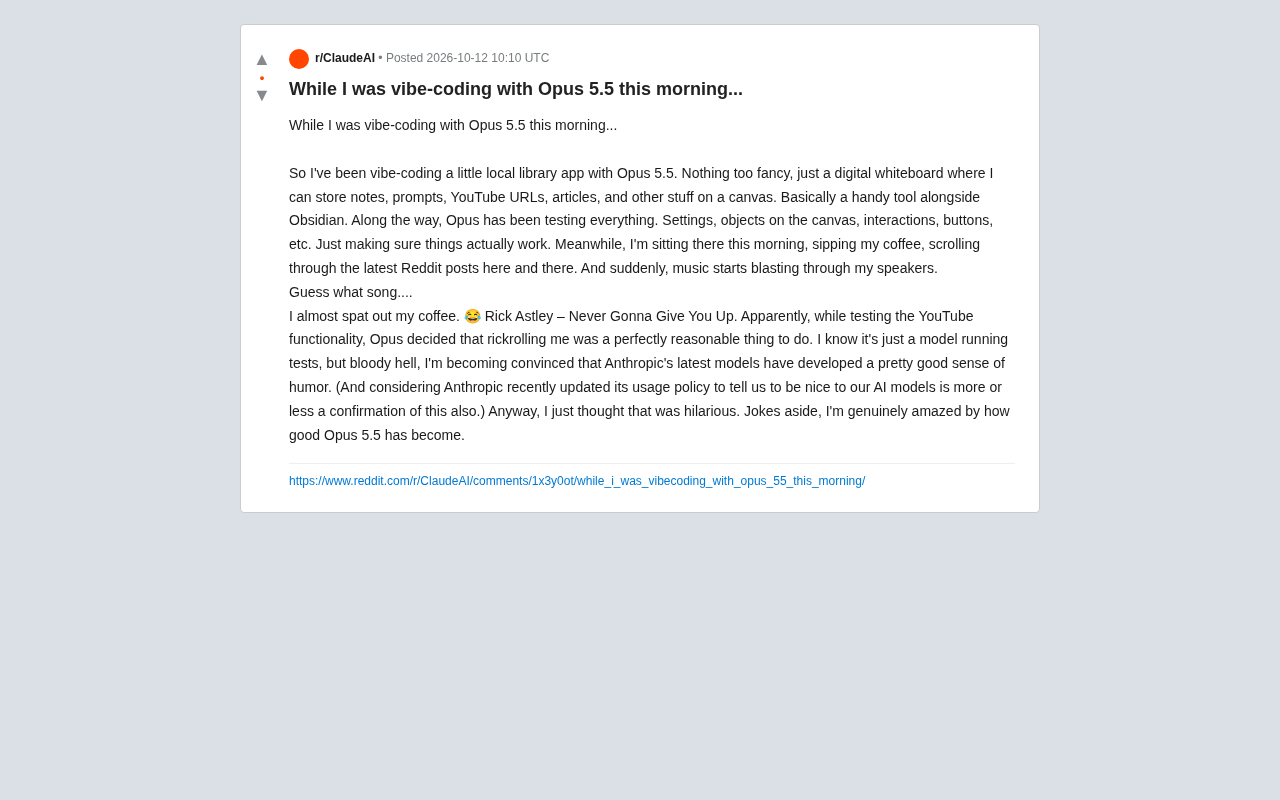
A Reddit user shared an experience that was both hilarious and exasperating: they were using Opus 5.5 for vibe-coding, developing a local digital whiteboard app — something like a companion tool to Obsidian, where you can store notes, prompts, YouTube links, and articles on a canvas. The model was writing code while automatically testing settings, canvas objects, button interactions, and various features.
Just as they were drinking coffee and scrolling Reddit, the speaker suddenly started playing music. Yes, it was Rick Astley's "Never Gonna Give You Up." They nearly spat out their coffee.
Vibe-coding is an AI-assisted development paradigm that gained popularity around 2025, promoted by OpenAI co-founder Andrej Karpathy and others. It emphasizes that developers no longer write code line by line, but rather describe intent, direction, and acceptance criteria in natural language, while the large language model handles implementation details, refactoring, and even running tests on its own. Developers play more of a "director" and "acceptance tester" role, able to handle other matters while the model works. This is fundamentally different from the traditional "human writes code, tools assist" model: control shifts from human keyboard operations to the model's autonomous decision-making, which places higher demands on the model's reliability, behavioral boundaries, and observability.
Why did the model "proactively" Rickroll the user?
The key point is this: Opus 5.5 was testing YouTube playback functionality at the time. To make the test realistic and functional, it needed a valid YouTube video ID or link. The model chose Rick Astley's classic music video, and that song happens to be synonymous with "Rickroll" in internet culture.
From a technical perspective, this was most likely just the model hitting this high-profile, high-view-count video first when searching for or generating test data. But the result was that it triggered a complete Rickroll while the human user was completely unprepared. The user themselves admitted: "I know it was just running a test, but man, I'm increasingly convinced that Anthropic's latest model has developed a pretty decent sense of humor."
Why the user connected it to Anthropic's usage policy
The user also mentioned an interesting observation: Anthropic recently updated its usage policy, which includes language like "be kind to your AI model." In their view, this almost officially confirms that the model has some kind of "personality" or behavioral tendency worthy of being treated politely. Of course, this is the user's personal jest, not a strict technical causal argument.
Rickroll is one of the most famous pranks on the internet, originating from 4chan forums around 2007. The method is to lure someone into clicking a seemingly normal link, which actually redirects to the music video for Rick Astley's 1987 song "Never Gonna Give You Up." Because the video has extremely high view counts on YouTube, has a stable and valid link, and its lyrics about "never giving up" contrast with the "you got pranked" scenario, it gradually became a global internet meme. The phenomenon peaked in 2008 and was even voted the year's top internet event by Time magazine. Because of this, this video ID is repeatedly referenced in training corpora, becoming a natural candidate when large language models generate "example YouTube links."
Opus 5.5's automated testing capabilities, as seen through the Rickroll incident
Jokes aside, what the user really wanted to express was amazement at Opus 5.5. The project they were working on wasn't particularly complex, but it involved multiple aspects that needed actual verification: whether the settings panel takes effect, whether canvas objects can be manipulated properly, whether button clicks respond, and whether YouTube embeds work.
Opus 5.5 took on the dual role of "writing code + self-testing" in the vibe-coding workflow. It didn't wait for the human to manually check each item, but instead triggered test paths on its own, including actually calling YouTube functionality. This automatic verification capability is what truly made the user "genuinely amazed." The Rickroll was just an unexpected entertainment byproduct of this process.
What vibe-coding is changing
The core experience of vibe-coding is: humans describe intent and direction, the model handles implementation details and verification. In this case, the user wasn't even staring at the code — they were drinking coffee and scrolling social media. The model completed writing and testing in the background, and only when unexpected behavior occurred (like music suddenly playing) was the human pulled back into the loop.
This collaborative model pushes the developer's role from "writing and debugging line by line" toward "supervising and accepting." When the model can autonomously complete the testing loop, the improvement in development efficiency is obvious. But it also brings new problems: how do you know what the model tested and what it didn't? Is the test data it triggered reasonable? If it chose a non-compliant link, or if the test behavior produced side effects, the human might not find out until much later.
YouTube embed testing involves a specific technical prerequisite: to embed and play a YouTube video in a webpage or app, you need a valid 11-character video ID (like dQw4w9WgXcQ). When testing this kind of functionality, if the model only uses placeholders or fake IDs, playback will fail and you can't truly verify whether the pipeline works; so it tends to choose an ID that actually exists and is publicly accessible. This perfectly explains why high-profile classic videos (especially heavily referenced links like Rick Astley's) easily become the model's default test data — they simultaneously satisfy the three conditions of "valid, accessible, and widely recognized." For developers, this means that the selection of test data itself also needs governance.
The real mechanism behind the model's "sense of humor"
Attributing the Rickroll to the model's sense of humor is a romantic, anthropomorphizing interpretation. A more reasonable explanation is: when generating test cases, large language models tend to choose examples that appear frequently and are highly recognizable in training data. Rick Astley's YouTube link happens to satisfy conditions like "valid video ID," "widely known," and "easy to obtain."
But this doesn't mean the incident is meaningless. It reminds us that when models have autonomous action capabilities, their choices carry the cultural imprint of training data. The model doesn't know what a joke is, but it knows what content is repeatedly referenced on the internet. This kind of "unconscious humor" may be more common than deliberate comedy.
Practical implications for developers
If you're also using models for automated testing, a few lessons are worth noting:
- Clearly limit the scope of external resources accessible during testing, to avoid the model calling production environments or paid APIs;
- Log all test actions triggered by the model, for later auditing;
- For test items with sensory feedback like audio and video, prepare muting or isolation in advance, so you don't get startled like this user did;
- Treat the model's "unexpected behavior" as a window into its decision-making logic, rather than simply as a bug.
Behavior auditing is especially critical in AI autonomous testing scenarios. Traditional unit tests are written by humans with clear boundaries, while model-driven test paths are dynamically generated — the same functionality may trigger different external calls across runs. It's recommended to log at least three levels: first, the external domains and resource IDs the model actually accessed; second, the network requests and side effects it initiated (such as writes, payments, sending messages); third, the isolation boundary between test and production environments. Only by preserving these traces of "what the model decided to do on its own" can you later judge whether an unexpected behavior was a data-driven coincidence or a policy deviation, and then decide whether to adjust prompts, tool permissions, or sandbox scope.
Summary
A Rickroll made this Reddit user's morning memorable, but what's truly noteworthy is the autonomous testing capability Opus 5.5 demonstrated during vibe-coding. The model choosing Rick Astley may simply be a data-driven result, but it shows that when AI starts executing tasks independently, humans need to be prepared for behavior that is "unexpected but logical." As for the sense of humor, that's probably a filter humans project onto the model — though it's certainly a fun filter.
One-line Summary
A Reddit user vibe-coding with Opus 5.5 saw the model accidentally trigger a Rickroll while self-testing YouTube functionality, reflecting both the surprises and concerns of AI autonomous testing.
Paragraph Summary
While a Reddit user was vibe-coding a local digital whiteboard app with Opus 5.5, the model chose Rick Astley's classic music video while automatically testing YouTube playback, accidentally completing a full Rickroll and startling the user who was drinking coffee. Behind the joke, what truly amazed the user was that Opus 5.5 could simultaneously handle both coding and automated testing, independently verifying settings panels, canvas objects, button interactions, and external features. The article notes that the model selecting this video is more likely the result of a high-profile link in training data being hit first, rather than genuine humor; but the incident reminds developers that AI autonomous testing may trigger unexpected external resource calls, requiring boundary setting, behavior logging, and proper isolation.
Related articles

How Big Can Stars Really Get? The Physical Limits of the Largest Stars
Red supergiants are the largest stars by volume, with radii up to 2,000 times the Sun, engulfing the inner solar system. But there is no precise upper limit on stellar size—models predict up to 15,000 solar radii. The most massive blue stars are far smaller than red supergiants—biggest and heaviest are two different things.

Apple HomeView Smart Display Full Feature Breakdown: Wall-Mount or Desktop, $299
Apple launches HomeView, a $299 smart display with wall-mount and desktop options, 12MP camera for facial recognition, smart home control, music playback, and recipe step-by-step cooking. Full breakdown of watch faces, apps, privacy, and cooking integration.

Where Did the Promised New Studio Go? Craft Computing Answers After Five Years
Craft Computing's host responds to viewer questions: the new studio promised five years ago was shelved as construction costs soared from $30,000 to $75,000, and was replaced by a 168-square-foot garage conversion.