Diet Claude: A Token-Saving Tool That Monitors Usage in Real Time and Optimizes Claude Consumption

Diet Claude monitors Claude usage in real time and optimizes token consumption to prevent unexpected limit hits.
Diet Claude is a Chrome extension that tackles the frustration of Claude's opaque usage limits. It provides a real-time usage dashboard showing consumption, remaining quota, and reset times. Its token optimization features include context trimming, prompt tightening, and model recommendations. When quotas run out, it enables seamless session handoff to other LLMs, making it an essential tool for heavy Claude users.
When Your AI Assistant Suddenly Runs Dry: Where Claude Usage Anxiety Comes From
For developers and content creators who rely heavily on Claude, there's an indescribable frustration: you're in the middle of debugging a complex piece of code, or you're on a roll writing a long article, when Claude suddenly pops up with a "usage limit reached" notice. Your work is forced to a halt, your train of thought derailed, and all you can do is wait helplessly for the quota to reset.
Behind this experience is Anthropic's dynamic usage limit mechanism for Claude. Similar to OpenAI's ChatGPT Plus, Claude Pro subscribers ($20/month) enjoy significantly higher quotas than free users, but caps still exist. The critical issue is that Anthropic has never disclosed specific token quota numbers—they only state that limits depend on conversation length, the model version used (e.g., Claude 3.5 Sonnet, Claude 3 Opus, etc.), and current system load. This lack of transparency makes it impossible for users to predict when they'll hit the ceiling.
This is exactly the core problem Diet Claude aims to solve. This Chrome extension, which reached #2 on the Product Hunt daily leaderboard (with 146 upvotes and 8 comments), sums up its value proposition in one straightforward tagline: "Never get blindsided by Claude's usage limits again."

Built by Surbhi Singla as a browser extension, Diet Claude falls under Chrome Extensions, Productivity Tools, and Artificial Intelligence categories. Its positioning is clear: it doesn't aim to replace Claude, but rather to help users use Claude "smarter."
Real-Time Usage Dashboard: Turning Claude's Black Box Transparent
Diet Claude's most intuitive feature is a live usage meter. It addresses a long-standing blind spot in the Claude experience—users often have no idea how much quota they've actually consumed.
Three Key Dashboard Metrics
According to the official description, this usage dashboard displays three core data points in real time:
- Usage consumed: How much quota your current session has used up
- Remaining capacity: How much you have left before hitting the ceiling
- Reset time: When the usage limit will refresh
This design philosophy deserves praise. Claude's official interface doesn't proactively notify users when they're approaching their limit—users can only guess until they slam into the "wall" and realize what happened. Diet Claude transforms this "black box" into a visual "fuel gauge," letting users plan their usage pace the same way drivers watch their gas meter.
From a technical implementation standpoint, this Chrome extension likely uses the Manifest V3 framework to inject Content Scripts, monitoring network requests from Claude's web interface (particularly API call requests and response bodies) to estimate token consumption, or parsing specific DOM elements on the page to obtain usage information. This browser-side "reverse engineering" approach, while clever, has inherent fragility—a challenge we'll discuss further below.
For Claude subscribers with daily or per-session rate limits, this kind of usage transparency is especially valuable. It lets users determine whether their current quota is sufficient to support an entire task before starting a major project.
Token Optimization: Proactive Throttling to Extend Claude's Usable Time
If the usage dashboard is "passive alerting," then Diet Claude's token optimization capabilities represent "active throttling." This is what sets it apart from ordinary usage monitoring tools.
To understand the value of token optimization, you first need to understand the token counting mechanism. Tokens are the basic unit by which large language models process text—for English text, one token corresponds to roughly 4 characters or 0.75 words; for Chinese, a single character typically costs 1.5-2 tokens. More critically, each conversation request sends the complete conversation history as context to the model. This means that in a session with 20 exchanges, the 21st request actually carries the cumulative token count of all previous conversation content. This is the fundamental reason why token consumption accelerates in long conversations.
Three Token Optimization Approaches
Diet Claude helps users reduce Claude's token consumption through the following methods:
-
Context trimming: Automatically prunes redundant or no-longer-relevant context from conversations, avoiding bloated history with every request. While Claude 3.5 Sonnet supports up to 200K tokens of context window (approximately 150,000 Chinese characters), larger context means faster quota consumption. Advanced trimming strategies use semantic relevance scoring to prioritize retaining context segments most relevant to the current task, rather than simply truncating earlier conversation content.
-
Tightening prompts: Optimizes users' prompt expressions to convey the same intent with fewer tokens. Research shows that many users' prompts contain significant redundant phrasing, repeated instructions, and unnecessary modifiers—streamlining can often reduce input tokens by 30%-50% without affecting output quality.
-
Suggesting apt models: Recommends appropriate models based on task type—lightweight models (like Claude 3 Haiku) for simple tasks, with advanced models (like Claude 3 Opus) reserved for complex ones. The quota consumption difference between models is enormous—a single Opus request might consume as much quota as multiple Haiku requests.
These three points strike at the core cost issue in LLM usage. Many users don't realize that the massive context in each conversation round is repeatedly counted toward token consumption. Through intelligent trimming and prompt optimization, it's theoretically possible to significantly extend a single session's usable duration without sacrificing output quality.
The model recommendation feature embodies a "tailored fit" philosophy: not all tasks require Claude's most powerful model, and thoughtful model selection is itself an effective cost control strategy.
Session Continuation: Seamless Cross-Model Handoff Even When Quota Runs Out
Diet Claude's most compelling feature may be its "session continuation" capability. When you've truly exhausted your Claude quota, it doesn't leave you waiting—instead, it migrates your current conversation and context to another LLM, letting you continue from where you left off rather than starting from scratch.
This design addresses a real pain point for users in the multi-model era. Today's users often have access to multiple AI tools simultaneously—Claude, ChatGPT, Gemini, Mistral, and more—but the biggest friction when switching between models is context loss. You're forced to copy and paste, re-explain background information. Diet Claude automates this process, essentially building a "cross-model bridge" for your workflow.
From a technical perspective, cross-model context migration faces multiple challenges. Format compatibility issues exist between different LLMs: Claude uses XML tag-structured system prompts, the GPT series uses a different role marking system (system/user/assistant), and Gemini has its own format specifications. Additionally, different models may interpret the same context differently—the new model needs to understand the complete context and intent without having "experienced" the preceding conversation. How Diet Claude handles these format conversions and semantic alignment issues is key to determining the actual quality of this feature.
From a product philosophy standpoint, this is also smart: it doesn't lock users into the Claude ecosystem. Instead, it acknowledges the reality of "limited quotas" and pivots to helping users optimize their experience across the entire AI tool matrix.
A Small Tool Solving a Real Pain Point: Diet Claude's Value and Challenges
From a product positioning perspective, Diet Claude is a classic "small but beautiful" tool—it doesn't pursue grand narratives, focusing instead on solving one specific, high-frequency pain point. These types of tools often perform well on platforms like Product Hunt because their value proposition is immediately obvious to target users.
Of course, as a browser extension, Diet Claude faces some inherent challenges: the accuracy of usage data depends on parsing Claude's interface, and any adjustments Anthropic makes to their frontend or billing logic could require continuous updates and maintenance. Chrome extensions use Content Scripts to read and modify webpage DOM structures and intercept network requests—this approach of relying on "reverse engineering" web page structures is inherently fragile. Any frontend refactoring, API endpoint changes, or code obfuscation strategies from Anthropic could cause the extension to break instantly. This is why such third-party tools require extremely high maintenance frequency and rapid response capability.
Furthermore, how "context trimming" balances token savings with retaining key information tests the product's actual level of polish. Overly aggressive trimming might cause the model to "forget" important preconditions or constraints, producing responses that don't meet expectations; being too conservative fails to achieve meaningful token savings. Striking this balance requires extensive real-world testing and iterative user feedback.
Nevertheless, the direction Diet Claude represents is worth watching: as AI subscription models become widespread, a third-party tool ecosystem around "usage management," "cost optimization," and "cross-model collaboration" is emerging. This trend mirrors the rise of FinOps (cloud financial operations) tools in cloud computing—when enterprises adopted cloud services at scale, the market for cost monitoring, resource optimization, and multi-cloud management tools expanded rapidly. The AI usage space is undergoing a similar evolutionary path. These tools don't produce AI, but they make the AI usage experience more efficient and controllable. For professional users who work with Claude daily, a tool that combines a "fuel gauge + fuel-saving assistant + backup tank" in one package genuinely addresses real-world frustrations.
Related articles

Brutalist Architecture in Forests: The Ultimate Collision of Nature and Concrete
Explore the aesthetic tension of Brutalist architecture in forests, how AI-generated imagery of concrete and nature creates viral visual trends, and why strong conceptual contrasts drive social media engagement.

What Is an FDE? The Most Underrated High-Paying Career of the AI Era
FDE (Forward Deployed Engineer) is an emerging high-paying AI-era role that doesn't require deep coding skills. Learn what FDEs do, core skills needed, salary expectations, and how to break in.
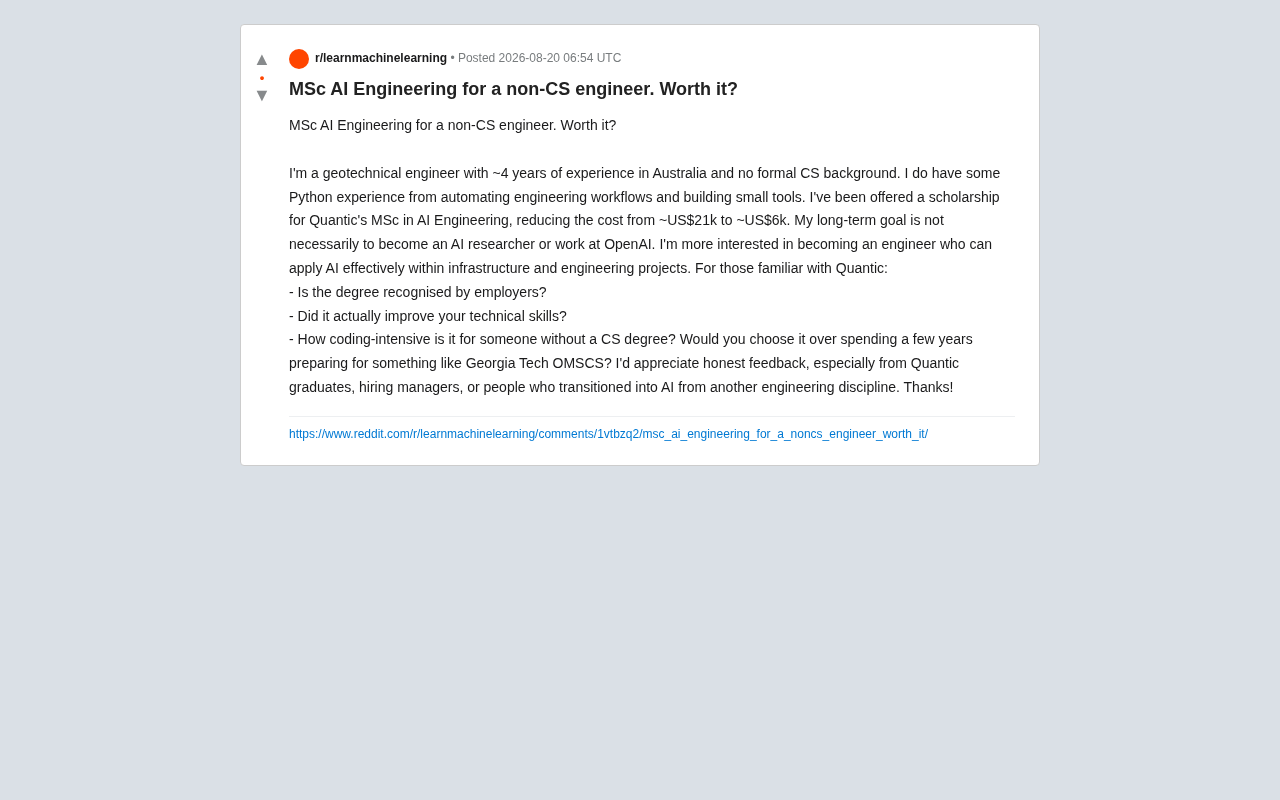
Is an AI Master's Worth It for Non-CS Engineers? Quantic vs OMSCS Deep Comparison
Should non-CS engineers pursue an AI master's? Deep comparison of Quantic AI Engineering vs Georgia Tech OMSCS, analyzing degree recognition, programming barriers, and ROI for traditional engineers transitioning to AI.