Diffusion Models for Online Goal Recognition: WoRD Uses Trajectory Priors to Infer Intent

WoRD learns trajectory priors with diffusion models to infer goals from partial observations.
WoRD uses diffusion models as trajectory priors for goal recognition, running warm-started denoising chains per candidate goal, steering samples with closed-form log-likelihood gradients, and applying Bayesian reweighting to produce calibrated multimodal posteriors under ambiguous trajectory prefixes—without explicit dynamics models.
Why Goal Recognition Needs to "Learn" How Agents Move
Inferring intent from observed behavior is the core task of goal recognition. Mainstream approaches follow a symbolic route: abstract continuous motion into discrete action sequences, then match against a planning library. These methods lose motion details and tend to fail when trajectory prefixes are ambiguous. Another class of methods handles continuous trajectories directly but relies on explicit dynamics models, which are hard to obtain and transfer poorly across scenarios.
Both routes share a common gap: neither explicitly learns "how the agent moves toward each candidate goal." Yet this is precisely the key knowledge for disambiguating trajectories—when the observation window is short and multiple paths are plausible, only a prior understanding of motion patterns can help make the call.
According to the paper, WoRD (Waypoint Recognition with Diffusion) attempts to fill this gap: using a learned trajectory prior to infer goals from partial observations.
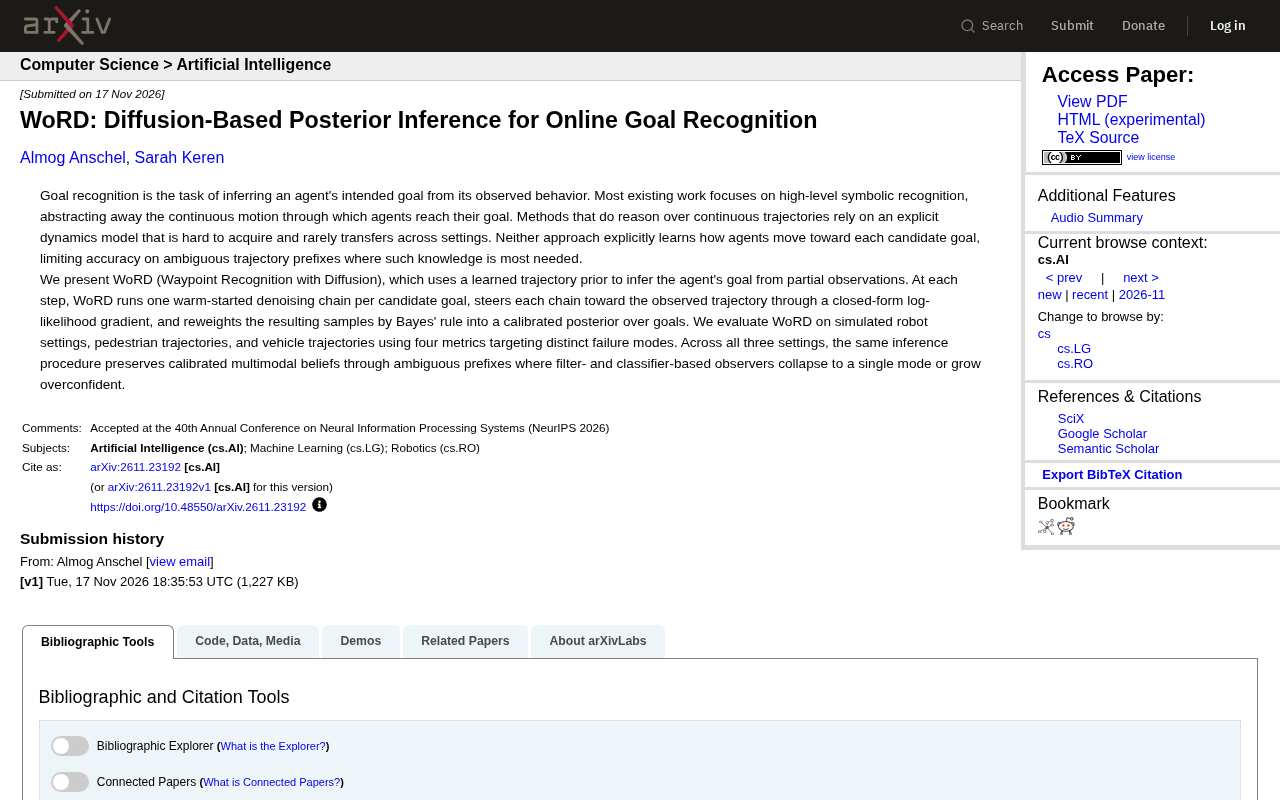
Goal Recognition is a classic problem in AI and planning: given partial observations of an agent's behavior (robot, pedestrian, vehicle, etc.), infer the final goal it intends to reach. It is closely related to Inverse Planning but differs in focus—inverse planning concerns recovering the agent's planning process, while goal recognition focuses on identifying the intended goal from observable behavior. The problem has direct applications in intelligent assistants, autonomous driving, human-robot collaboration, and security surveillance. The core difficulty is that observations are typically incomplete and noisy, and the same trajectory prefix may correspond to multiple plausible goals, so methods must output probabilistic belief distributions rather than a single answer. When evaluating such methods, "calibration" is a key dimension: the model's confidence should match its actual accuracy—both overconfidence and underconfidence harm downstream decision-making.
How WoRD Works: One Denoising Chain per Candidate Goal
WoRD's inference process can be broken into three steps.
Step 1: Run denoising chains in parallel for each candidate goal. At each observation step, WoRD launches a warm-started denoising chain for each candidate goal. The diffusion model acts as a trajectory prior here—it knows "what trajectories heading toward a given goal typically look like."
Step 2: Steer sampling toward observations with closed-form gradients. Each denoising chain is guided toward the actually observed trajectory via a closed-form log-likelihood gradient. This step aligns generated trajectory samples with the observation rather than sampling freely.
Step 3: Bayesian reweighting yields a calibrated posterior. Generated samples are reweighted according to Bayes' rule and aggregated into a calibrated posterior distribution over goals. This means the output is not just "the most likely goal" but a multimodal belief distribution with confidence levels.
The elegance of this design: the diffusion prior handles "how to move," the likelihood gradient handles "fitting the observation," and Bayesian reweighting handles "producing probabilities." Each component plays its role, with no need for explicit dynamics models.
Diffusion Models are a class of generative models whose core idea involves two processes: a forward process that gradually adds Gaussian noise to data until it becomes pure noise, and a reverse process that learns a denoising network to gradually recover the data distribution from noise. In conditional generation, guidance is often used to constrain the sampling process to desired conditions, with common forms including classifier guidance and classifier-free guidance. WoRD adopts guidance based on log-likelihood gradients: if the observation model is differentiable (e.g., Gaussian observation noise), the gradient of the observation log-likelihood with respect to the trajectory has a closed-form expression, which can directly push samples toward high-likelihood regions during denoising steps. This follows the "training-free guidance" idea—no additional classifier needs to be trained for guidance, yielding good sampling efficiency and controllability. Warm-started means the denoising chain does not start from pure noise but is initialized from particles/samples at the previous observation step, thereby maintaining belief continuity over time and reducing sampling cost.
Three Scenarios, Four Metrics: Performance Under Ambiguous Prefixes
The paper evaluates WoRD on three scenarios: simulated robot environments, pedestrian trajectories, and vehicle trajectories. Evaluation uses four metrics, each targeting a different failure mode.
The key result lies in behavior under ambiguous prefixes. Filter-based and classifier-based observers exhibit two degradation modes in such scenarios: either collapsing to a single mode or becoming overconfident. WoRD maintains calibrated multimodal beliefs across all three scenarios.
This comparison reveals the essence of the problem: uncertainty in goal recognition is not noise but a reasonable state when information is insufficient. Forcing a single answer actually masks the uncertainty the model should express. WoRD's posterior distribution form is naturally suited to expressing "it's still unclear, but leaning toward these goals."
Bayesian reweighting is a classic operation in particle-filter-style inference: for each candidate goal hypothesis (g), generate samples from the trajectory prior, weight them by the observation likelihood (p(\text{obs}\mid \text{trajectory})), and normalize to obtain the posterior (p(g\mid \text{obs})). The advantage is that it naturally expresses multimodal beliefs—when multiple goals are plausible, the posterior allocates mass across them rather than being forced to pick one. In contrast, filter-based methods typically maintain a single state distribution updated with observations and tend to lose modes under ambiguous prefixes due to resampling or hypothesis pruning; classifier-based methods directly map observations to goal labels, lack explicit uncertainty modeling, and often output overconfident predictions. The four common evaluation metrics typically cover: goal recognition accuracy, calibration error of the belief distribution (e.g., Brier score or ECE), multimodal retention capability (e.g., top-k recall), and convergence speed as observations accumulate.
Implications of Diffusion Models as Trajectory Priors
WoRD's value extends beyond being a goal recognition method. It demonstrates a paradigm: turning diffusion models from generation tools into inference components.
Traditionally, diffusion models are used to generate images, videos, and other content. WoRD treats denoising chains as inference paths, uses conditional guidance to constrain the generation process to observations, and then applies Bayes' rule for probabilistic aggregation. This line of thinking can transfer to other tasks requiring "inferring hidden states from partial observations"—such as behavior prediction, intent understanding, and intent alignment in human-robot collaboration.
Another notable point is the absence of dynamics models. Robotics and trajectory analysis have long been hampered by the cost of obtaining dynamics models. WoRD replaces explicit models with a learned trajectory prior, using the same inference pipeline across scenarios, which lowers the deployment barrier.
Of course, the paper's evaluation focuses on simulated environments and existing trajectory datasets. Sensor noise, distribution shift, and real-time requirements in real deployments are all questions that need further validation.
Key Takeaways
- WoRD uses diffusion models to learn trajectory priors, enabling goal inference from partial observations without explicit dynamics models
- At inference time, each candidate goal runs a warm-started denoising chain, aligned to observations via closed-form log-likelihood gradients
- Bayesian reweighting outputs a calibrated multimodal posterior that neither collapses nor becomes overconfident under ambiguous trajectory prefixes
- Validated on three scenarios—simulated robots, pedestrian trajectories, and vehicle trajectories—across four metrics
- Demonstrates the potential of diffusion models as inference components rather than mere generation tools
One-line Summary
WoRD uses diffusion models to learn trajectory priors, enabling calibrated goal inference from partial observations without dynamics models.
Paragraph Summary
This article introduces WoRD (Waypoint Recognition with Diffusion), a goal recognition method. Addressing the common gap of both mainstream routes—symbolic methods and explicit dynamics models—namely the failure to explicitly learn how agents move toward each candidate goal, WoRD uses diffusion models as trajectory priors, running warm-started denoising chains in parallel for each candidate goal at inference time, steering samples toward actual observations via closed-form log-likelihood gradients, and obtaining a calibrated multimodal posterior through Bayesian reweighting. Evaluations on three scenarios (simulated robots, pedestrian trajectories, vehicle trajectories) across four metrics show that WoRD neither collapses to a single mode nor becomes overconfident under ambiguous trajectory prefixes, outperforming filter-based and classifier-based observers. The article further discusses the paradigm significance of turning diffusion models from generation tools into inference components, the deployment advantages of being dynamics-model-free, and open questions for real-world scenarios.
Related articles
Watching Movies in the Terminal: Building an SSH Streaming Service with Codex Multi-Agent Workflow
A creator uses Codex multi-agent workflow to build an SSH-accessible streaming service in the terminal, with planning, cloud async dev, AI-drawn scenes, and synced live channels.

AI Face Licensing: A New Micro-Drama Trend or a Hollywood Trap?
Actors are licensing their faces to micro-drama startups for AI digital doubles to perform. Popular in China, the model raises concerns in Hollywood over lost control and diluted bargaining power.

Amazon's First Digital Photo Frame Is 50% Off for Black Friday: Is the Alexa Frame Worth Buying?
Amazon's first digital photo frame, the Alexa Photo Frame, is nearly 50% off for Black Friday, with prices starting at $114. We analyze why this new product dropped in price just one month after launch, its positioning, who it's for, and buying advice.