DiffusionEngine: Modular DDPM Framework Goes Open Source, Recruiting Contributors

DiffusionEngine is an open-source modular framework focused on DDPM, aiming to integrate diffusion algorithms and sampling strategies.
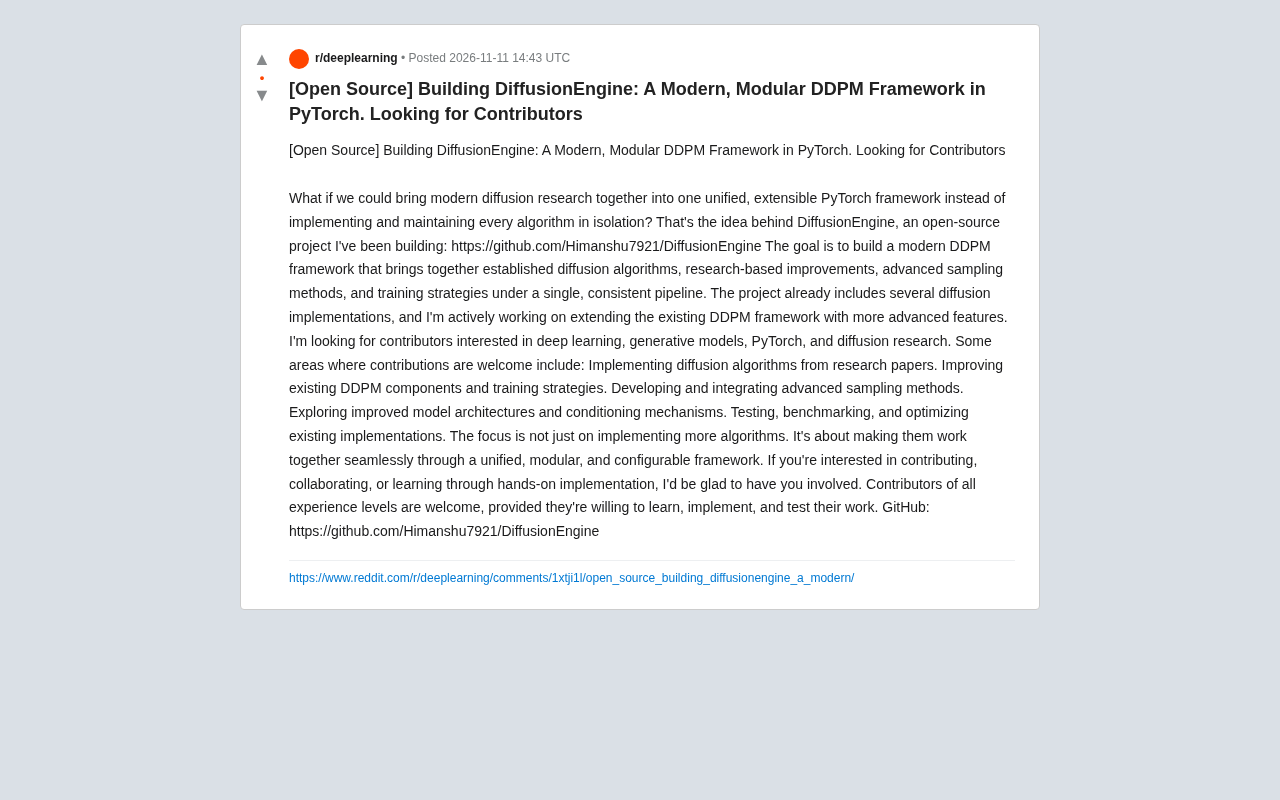
DiffusionEngine is an open-source project promoted on Reddit. Its goal is to integrate scattered diffusion model algorithms, research improvements, sampling methods, and training strategies into a unified modular PyTorch pipeline, with a particular focus on the DDPM technical route. The project emphasizes seamless collaboration between algorithms and reduces the cost of migrating and reproducing new algorithms by decoupling components such as noise schedules, network structures, samplers, and trainers. The founder is openly recruiting contributors, with directions ranging from implementing new algorithms from papers and improving existing components to developing advanced sampling methods and conducting testing and benchmark evaluation, and welcomes people of all experience levels. The article argues that this lightweight, hackable positioning focused on DDPM experiments fills a gap among existing frameworks, but its continued development depends on community appeal and the clarity of module boundaries.
Research on diffusion models moves far faster than engineering integration. Every day, new papers propose improved sampling strategies, training techniques, or model architectures, but these results often end up scattered across separate code repositories with inconsistent implementation styles, making them hard to compare or combine directly. I recently came across an open-source project on Reddit called DiffusionEngine that tries to solve this problem.
A unified DDPM experimental playground
DiffusionEngine's goal is not to write yet another DDPM implementation, but to bring existing diffusion algorithms, research improvements, sampling methods, and training strategies together into a single pipeline. In the post, the project founder explicitly states that the focus is on letting these algorithms "collaborate seamlessly," organizing code through a unified, modular, configurable framework.
This approach is similar to Hugging Face's Diffusers, but DiffusionEngine is more narrowly focused on the DDPM technical route and has a stronger community-driven flavor—it is currently an individual-initiated open-source project that is openly recruiting contributors.
DDPM (Denoising Diffusion Probabilistic Models) is one of the foundational works in diffusion models, proposed by Ho et al. in 2020. Its core idea is to define a forward process that gradually adds Gaussian noise to data until it becomes pure noise, and then learn a reverse denoising process to recover data from noise. The DDPM training objective is usually simplified to predicting the noise added at each step, and sampling generates samples through iterative denoising. Although more efficient sampling methods such as DDIM and DPM-Solver, as well as architectural improvements such as Latent Diffusion, have appeared since then, the "noise schedule—UNet denoising—iterative sampling" paradigm established by DDPM remains the foundation of most diffusion models. DiffusionEngine's focus on the DDPM route means it pays more attention to the experimentability and extensibility of this foundational paradigm, rather than directly targeting production-oriented inference optimization libraries.
Current project status and contribution directions
According to the original post, the project already includes implementations of several diffusion models, and the founder is expanding the DDPM framework with more advanced features. The contribution directions he lists cover several key stages of diffusion research:
- Implement new diffusion algorithms from research papers
- Improve existing DDPM components and training strategies
- Develop and integrate advanced sampling methods
- Explore improved model architectures and conditioning mechanisms
- Test, benchmark, and optimize existing implementations
These directions basically correspond to the full chain from publication to reproducibility for a diffusion paper: algorithms, training, sampling, architecture, and evaluation. Putting them under the same framework has obvious benefits—new algorithms can reuse existing training loops and evaluation protocols, so researchers do not have to build an experimental environment from scratch every time.
Why modularity matters
Code reuse in the diffusion model field has long been a pain point. A typical scenario is this: a paper proposes a new sampler, but its official implementation is tied to a specific UNet structure and training configuration. If you want to try it on your own model, you first have to extract and rewrite the code. If the framework itself decouples the noise schedule, network structure, sampler, and trainer into replaceable modules, the cost of such migration drops substantially.
The "unified, modular, configurable" emphasis of DiffusionEngine is aimed precisely at this. What it wants to do is not pile up more algorithms, but enable implementations from different sources to be combined and validated against one another. For researchers and engineers running diffusion model experiments, the value of this kind of infrastructure is often higher than yet another SOTA implementation.
The noise schedule is a key hyperparameter in diffusion models. It defines how much noise is added at each time step in the forward process; common choices include linear and cosine schedules. The network structure usually adopts a U-Net, which is responsible for predicting noise or the denoised image given a noisy image and a time step. The sampler determines how to use the trained network to gradually generate samples from pure noise, such as DDPM ancestral sampling, DDIM deterministic sampling, and higher-order ODE solvers. The trainer encapsulates processes such as loss computation, optimizer configuration, learning rate scheduling, and logging. After decoupling these components, researchers can fix the other parts and replace only one module for controlled experiments, thereby evaluating the impact of an improvement more clearly. This design also makes it easier to quickly embed new algorithms from papers into an existing pipeline without rewriting the entire training or sampling loop.
Who can participate
The founder's requirements for contributors are very broad: all experience levels are welcome, as long as they are willing to learn, implement hands-on, and test their own work. The relevant skill stack includes deep learning, generative models, PyTorch, and diffusion research. For students or developers who want to enter the generative model field, contributing to this kind of framework project is a good path—it forces you to understand the details of the algorithms rather than just call APIs.
The project is on GitHub (Himanshu7921/DiffusionEngine). Interested readers can go directly to look at the code structure and existing implementations, and then decide which direction to start from. Starting with testing and benchmark evaluation is usually the lowest-barrier way to contribute, and it is also the fastest way to become familiar with the overall framework design.
A few observations
Competition among open-source diffusion frameworks is already considerable, with Diffusers, K-diffusion, and others each occupying their own niche. Whether DiffusionEngine, as an individual-initiated project, can continue to attract contributors and establish clear module boundaries and documentation systems is key to whether it can keep going. Still, judging from its positioning, it targets a real gap: researchers need a lightweight, hackable framework focused on DDPM experiments, not a large all-in-one inference library. If it can stick to this positioning, it has a chance to become a practical tool for the diffusion research community.
Related articles

Prompt Engineering for Beginners: From Writing Prompts to Engineering Thinking
Starting from the essence and four functions of prompts, this article systematically explains the six-step process, four success criteria, learning value, and practical limitations of prompt engineering to help you build a complete understanding.

Anthropic Launches Nasdaq IPO: AI Giant's Listing and Risk Disclosures
Anthropic officially launches its Nasdaq IPO under ticker ANT, with market valuation expected to potentially exceed SpaceX's record. The prospectus devotes nearly 100 pages to AI risks, while first-half revenue grew over 14x but net losses widened sharply, reigniting the AI bubble debate.

Rust cURL Clone Uses 4,832 unsafe Blocks—Is the Memory Safety Myth Broken?
A Rust cURL clone uses 4,832 unsafe keywords, challenging Rust's memory safety narrative. We analyze what unsafe really means, compare Fil-C, and examine rewrite motives.