DiffusionGemma Explained: Google Reimagines Text Generation with Diffusion Models

Google's DiffusionGemma applies diffusion models to text generation, challenging autoregressive dominance.
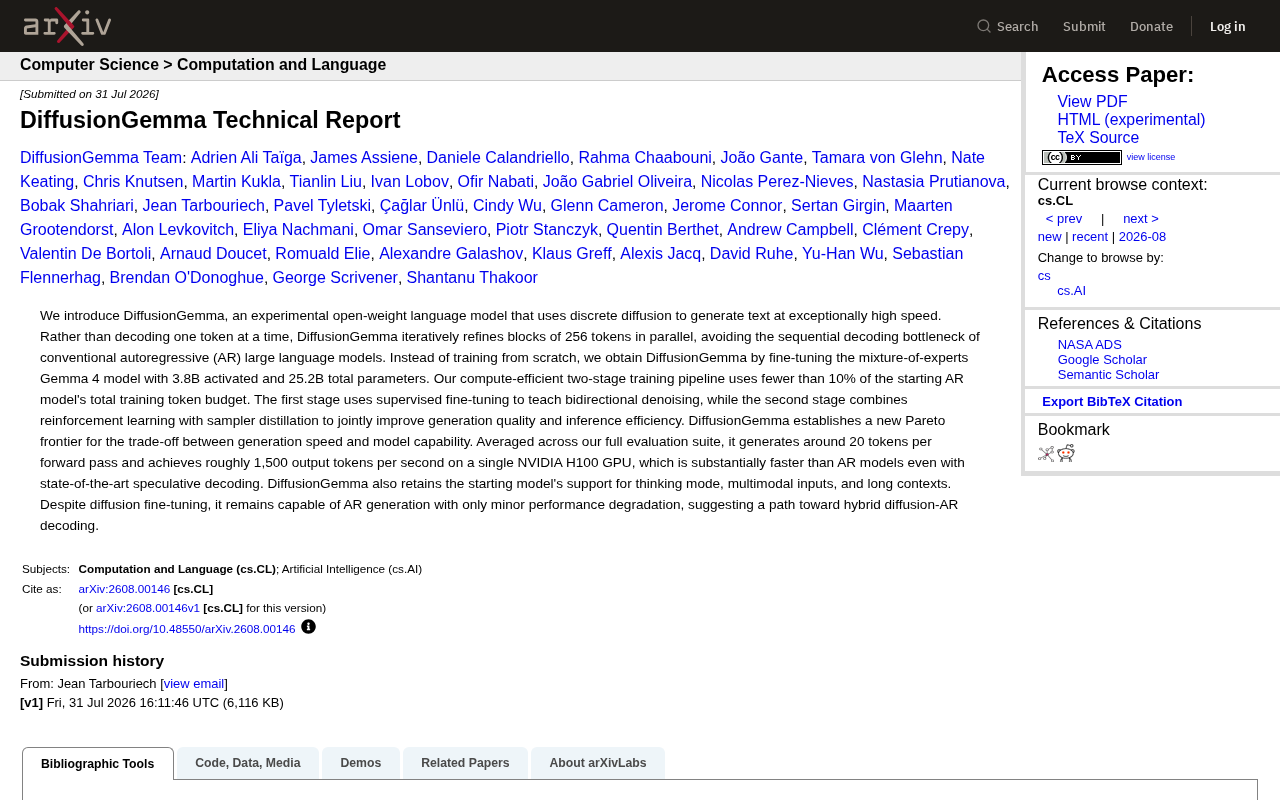
Google's DiffusionGemma technical report explores applying diffusion models to text generation by building on the open-source Gemma architecture. Unlike autoregressive models that generate tokens sequentially, DiffusionGemma uses iterative denoising to enable parallel generation, global planning, and native text editing capabilities, potentially reshaping how AI generates text.
Introduction: When Diffusion Models Meet Language Generation
Google's recently released DiffusionGemma technical report marks a significant step forward for diffusion models in the field of natural language processing. For a long time, diffusion models have been the dominant force in generating continuous data such as images, video, and audio—from Stable Diffusion to Sora, all built upon the diffusion paradigm. However, for text generation—a task centered on discrete symbols—autoregressive Transformer models, represented by the GPT series architecture, have consistently maintained dominance.
The core idea behind diffusion models originates from non-equilibrium thermodynamics, with a mechanism consisting of two processes: the Forward Process gradually adds Gaussian noise to data until it becomes pure random noise; the Reverse Process learns how to progressively recover the original data from noise. In the image domain, this means starting from a pure noise image and, through tens to hundreds of denoising iterations, ultimately generating a clear image. This paradigm was theoretically established by the 2020 DDPM (Denoising Diffusion Probabilistic Models) paper, and later validated for industrial potential through products like DALL·E 2 and Stable Diffusion.
The emergence of DiffusionGemma represents a powerful challenge to this established landscape. Built on Google's open-source Gemma model family, it introduces diffusion generation mechanisms into language modeling, exploring a text generation path different from word-by-word prediction.
Why Diffusion Language Models Deserve Attention
Inherent Limitations of Autoregressive Generation
Mainstream large language models use autoregressive methods, generating text token by token from left to right. The core mechanism of autoregressive Transformers is Causal Language Modeling: given all previously generated tokens, predict the probability distribution of the next token. This is implemented through a Causal Attention Mask—the model can only see content before the current position when computing attention, unable to "peek" at future information. GPT series, LLaMA, Gemini, and other mainstream large models all adopt this architecture. Its advantage lies in a clear training objective (maximizing the log-likelihood of the next token) and stable generation quality, but this approach, despite being effective, has two inherent problems:
- Generation Speed Bottleneck: Serial decoding cannot truly parallelize, and inference latency grows linearly with text length. Each forward pass can only determine one token, so generating text of length N requires N forward passes, creating significant time overhead in long-text generation scenarios.
- Lack of Global Planning: The model lacks the ability to plan overall structure. Once earlier generation goes off track, subsequent content is difficult to correct. This is an inevitable cost of the causal attention mask—the model can only rely on the generated prefix when producing each token, unable to foresee the structural direction of the full text.
The Core Idea of the Diffusion Paradigm
Diffusion language models adopt a fundamentally different generation strategy. Starting from a fully "noised" or "masked" sequence, they gradually denoise through multiple iterative steps, ultimately recovering coherent text.
It's worth noting that migrating diffusion models from continuous data (such as image pixel values) to discrete data (such as text tokens) poses fundamental challenges. Traditional diffusion models rely on adding and removing Gaussian noise in continuous space, but text tokens are discrete symbols that cannot be directly subjected to continuous noise operations. There are currently two mainstream solutions: one maps discrete tokens to a continuous embedding space, performs diffusion in the embedding space, then maps back to discrete tokens (e.g., Diffusion-LM); the other designs dedicated discrete diffusion processes, using masking or token replacement to simulate "noising" operations (e.g., D3PM, MDLM). DiffusionGemma most likely adopts the masked diffusion approach, where the forward process progressively replaces tokens with [MASK] markers, and the reverse process learns to recover the original text from a fully masked sequence.
This process brings three key advantages:
- Parallel Generation: The model can process all positions in the sequence simultaneously rather than generating word by word, theoretically offering higher inference throughput potential. During each denoising step, diffusion models can predict and update all positions in the sequence simultaneously. Although diffusion models require multiple iterations (typically 10-50 steps), if the number of iteration steps is much smaller than the sequence length, overall inference efficiency may still surpass autoregressive methods. Additionally, diffusion models are simpler in KV Cache management—autoregressive models need to maintain a constantly growing KV cache, while diffusion models perform global processing on the complete sequence at each step, with more regular memory access patterns that are more GPU-friendly.
- Global Vision: Each denoising step can see the current state of the entire sequence, giving the model stronger global consistency and controllability during generation.
- Editability: Because generation is iterative, diffusion models naturally support local modifications and infilling of text.
DiffusionGemma validates the feasibility and competitiveness of the diffusion paradigm in language tasks on the mature Gemma foundation.
Technical Architecture and Design Choices of DiffusionGemma
Google's choice of Gemma as the foundation is no coincidence. Gemma is an open-source model series released by Google DeepMind in early 2024, available in 2B and 7B parameter versions, with Gemma 2 (including 2B, 9B, 27B) released subsequently. Gemma is built on the same research and technology as Gemini, incorporating modern Transformer designs such as Rotary Position Embedding (RoPE), GeGLU activation functions, and RMSNorm normalization. As an open-source model, Gemma is freely available on platforms like Hugging Face, supporting researchers in fine-tuning and secondary development.
Starting from Gemma means DiffusionGemma can reuse language representation capabilities that have been thoroughly pre-trained, without needing to train a diffusion language model from scratch. Choosing Gemma as the foundation both leverages the rich linguistic knowledge encoded in its pre-trained weights and facilitates community reproduction and extension.
This strategy of "converting a powerful autoregressive base into a diffusion model" is a mainstream approach currently being explored by both academia and industry. Compared to training entirely from scratch, it can:
- Significantly reduce computational costs
- Shorten convergence time by leveraging the linguistic knowledge accumulated by the original model
- Improve final generation quality
From a technical perspective, this conversion typically involves replacing the original causal attention mask with Bidirectional Attention, allowing the model to attend to both preceding and following context information during the denoising process. It also requires introducing a Noise Scheduler and Timestep Embedding to let the model perceive which stage of the denoising process it's currently in.
From the positioning of the technical report, DiffusionGemma is more of a systematic exploration and engineering validation, aimed at answering a core question: Can the diffusion paradigm match or even surpass autoregressive models in text generation?
Industry Development Context for Diffusion Language Models
DiffusionGemma is not an isolated event. Over the past year or two, Diffusion Language Models (dLLMs) have gradually become a research hotspot:
- Inception Labs' Mercury model demonstrated significant speed advantages. Released in early 2025, Mercury is the first commercially deployed diffusion language model, with its core selling point being inference speed: in some benchmarks, Mercury's generation speed reached 5-10x that of autoregressive models of comparable quality. Mercury achieved high-quality text generation in fewer iteration steps by optimizing discrete diffusion denoising steps and parallel decoding strategies. This result sparked widespread industry attention to the commercial viability of diffusion language models and established market expectations for subsequent models like DiffusionGemma.
- Multiple academic teams have validated the potential of diffusion text models in tasks such as code generation and structured output
- Increasing research shows that the diffusion paradigm can complement autoregressive models in specific scenarios
As one of the key drivers of diffusion model technology—from early image diffusion research to products like Imagen and Veo—Google has a natural advantage in transferring its deep image domain expertise to the language domain. The release of DiffusionGemma can be seen as a major tech company officially entering the field, injecting stronger resources and credibility into this emerging direction.
Interestingly, diffusion language models are still in their early stages. In terms of generation quality, long-text coherence, and training stability, there are still gaps to bridge compared to mature autoregressive models. The value of the technical report lies precisely in transparently presenting these real challenges and experimental results, providing reference baselines for subsequent research.
Potential Application Scenarios for DiffusionGemma
If the performance of diffusion language models continues to improve, their application prospects are quite broad:
High-Throughput Inference Scenarios
Thanks to parallel decoding capabilities, diffusion models have the potential to significantly reduce latency in scenarios requiring large-scale batch text generation, such as real-time content production and large-scale data processing. In practical deployment, the inference cost of autoregressive models is primarily determined by sequence length—each token generated requires a complete forward pass and KV Cache update. The inference cost of diffusion models is primarily determined by the number of denoising steps, decoupled from sequence length. When the target sequence is long and denoising steps are controllable (e.g., generating 1000 tokens with only 20 iteration steps), diffusion models may demonstrate orders-of-magnitude advantages in throughput.
Controllable Text Generation
The iterative denoising mechanism makes it more natural to impose constraints during generation (such as format, keywords, length, style), suitable for business scenarios requiring precise output control. Under the diffusion framework, controllable generation can be achieved through Guidance mechanisms—similar to Classifier-Free Guidance in image diffusion, introducing additional conditional signals during the denoising process to guide generation direction without retraining the model. This flexibility allows a single base model to adapt to multiple downstream needs through different guidance strategies.
Text Infilling and Editing
Compared to the unidirectional generation of autoregressive models, the diffusion model's ability to model bidirectional context gives it greater potential in text completion, content rewriting, and paragraph insertion tasks. Specifically, for text editing tasks, one only needs to re-mask the parts that need modification, keep the rest unchanged, and then let the model perform denoising reconstruction on the masked portions. This "local regeneration" capability is difficult for autoregressive models to natively support—they typically need to regenerate all subsequent content from the point of modification.
Conclusion: Can the Diffusion Paradigm Reshape Text Generation?
The significance of the DiffusionGemma technical report lies not only in releasing a specific model, but more importantly in representing a major tech company's formal investment in "text diffusion" as a frontier direction. Although discussion of this report in the community remains limited, the core question it explores—whether the diffusion paradigm can reshape text generation—holds far-reaching implications.
After years of autoregressive model dominance, diffusion language models are attempting to open another door. They may not immediately replace the GPT-style architecture, but they are likely to become an important pillar in the diversified landscape of future large model technology. From a broader perspective, the evolution of AI generative models has never been a single-track victory—just as GANs, VAEs, Flow Models, and Diffusion Models each excel in different aspects of image generation, the text generation domain will eventually enter an era of paradigm diversification. For practitioners following the evolution of AI generative technology, DiffusionGemma is worth continued attention.
Key Takeaways
Related articles

Chain of Thought Isn't Just for AI: How Humans Can Use CoT to Improve Thinking Quality
Chain of Thought isn't just a prompt trick for large models. Starting from a Hacker News discussion, this article analyzes why CoT works for human thinking too, breaks down actionable ways to transfer it, and highlights the key differences between human CoT and machine CoT.
Cloudflare Teams Up with OpenAI: Closi…
Cloudflare Teams Up with OpenAI: Closing the Loop from Vulnerability Discovery to Defense with AI
Cloudflare uses OpenAI Daybreak to investigate security vulnerabilities and generate reviewable remediation plans, while developers use Codex to boost coding efficiency and quality.

Orca Multi-Agent Orchestration in Practice: A Guide to Parallel Collaboration with Claude and Codex
Orca is Stable AI's free open-source agent workbench supporting 34 agents like Claude Code and Codex in parallel. Learn its Git worktree isolation, multi-model orchestration, and mobile management.