DiffusionGemma-Jev Joins vLLM: Every Answer Now Comes with a Confidence Score
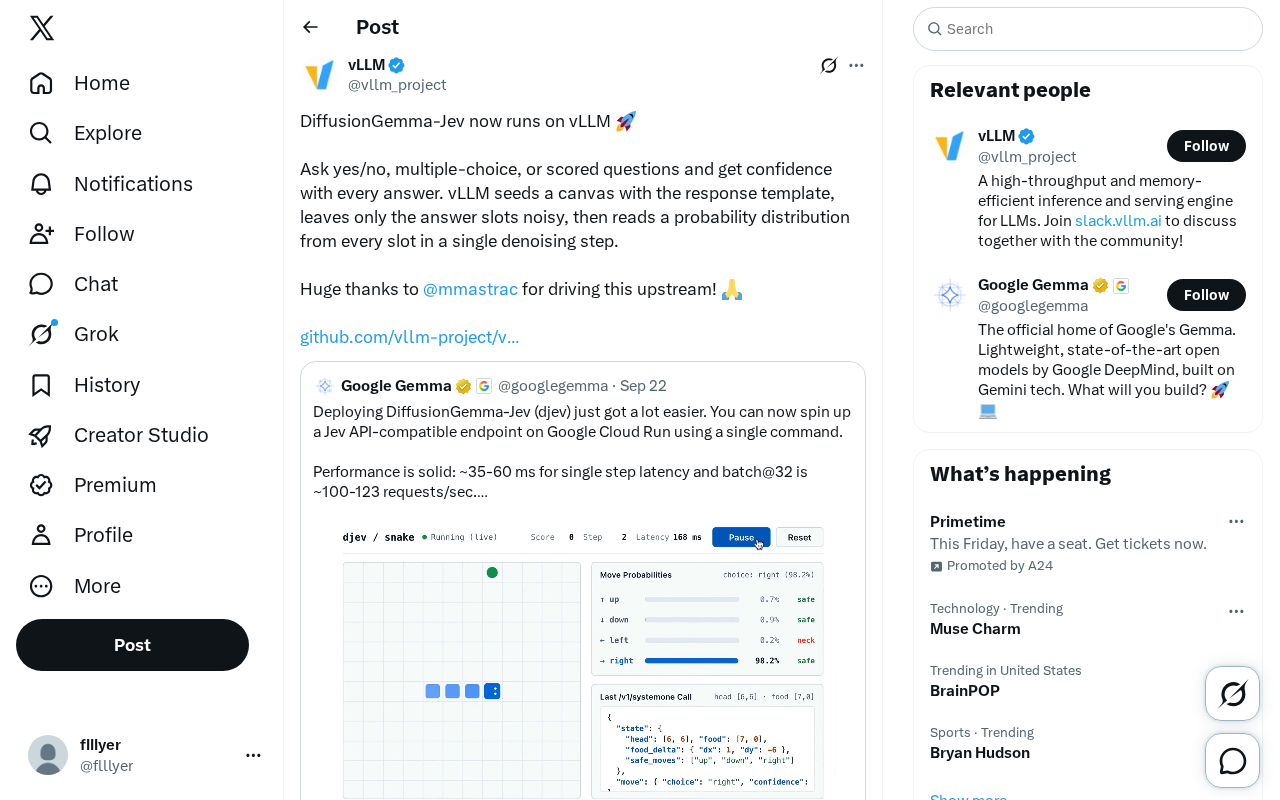
DiffusionGemma-Jev integrates with vLLM, using single-step denoising to output structured answers with native confidence scores.
DiffusionGemma-Jev has been successfully integrated into the high-performance inference engine vLLM, with the changes merged upstream. The key highlight is its structured question answering with confidence scores: using a canvas template where only answer slots are noisy, the model reads probability distributions across all answer positions in a single denoising step, producing both answers and confidence values in parallel. Compared to autoregressive models that generate tokens sequentially before back-calculating probabilities, diffusion architecture offers lower latency and native probability output for structured QA — marking a meaningful step from research prototype toward production deployment.
Diffusion language models are stepping out of their image-generation comfort zone and into the domain of structured reasoning and evaluation. DiffusionGemma-Jev has announced support for running on vLLM, a development that opens new possibilities for deploying diffusion-based language models in production — especially in scenarios where confidence scores are a critical requirement.
DiffusionGemma-Jev Meets vLLM
According to information shared on Twitter, DiffusionGemma-Jev can now run directly on vLLM, the high-performance inference engine widely adopted across the industry. vLLM is known for its high throughput and efficient memory management, and has primarily served autoregressive large language models up to this point.
Integrating a diffusion-based language model into vLLM means that diffusion architecture inference is no longer confined to research prototypes — it can now be deployed using mature, production-grade serving infrastructure. The announcement specifically acknowledged @mmastrac for driving the upstream integration work, indicating that this support has been merged into vLLM's main codebase rather than remaining in a private fork.

Question Answering with Confidence Scores
The most notable capability introduced in this update is the ability to output a confidence score alongside each answer. It supports three types of question formats:
- Yes/No questions: suited for binary judgment tasks
- Multiple-choice questions: suited for selecting from a set of candidates
- Scored questions: suited for scenarios requiring quantitative evaluation
For every question type, the system attaches a confidence value to each answer. This is highly valuable for downstream applications — in automated evaluation, content moderation, data annotation, RAG result filtering, and similar tasks, having only an answer is often insufficient. The model's degree of certainty about its own output is an equally critical input for decision-making. Traditional autoregressive models typically require additional processing or approximations to yield reliable probability distributions, whereas diffusion models have a structural advantage here.
How Single-Step Denoising Reads Probability Distributions
What truly reflects the diffusion architecture's strengths is the mechanism under the hood. As described in the original announcement, the workflow works roughly as follows:
- Seed a canvas: vLLM starts with a "canvas" containing a response template, fixing the structural framework of the entire response.
- Keep only the answer slots noisy: The fixed portions of the template remain clear, while only the "answer slots" that the model needs to fill in are set to a noisy state.
- Read the distribution in a single denoising step: In one denoising pass, the model directly reads out a probability distribution for each answer slot, rather than sampling token by token.
The elegance of this approach lies in the fact that diffusion models naturally support parallel prediction across multiple positions, allowing probability distributions for all answer slots to be obtained in one shot. Compared to autoregressive models that must generate text sequentially and then back-calculate probabilities, this "fill-in-the-blank" inference style is better suited for structured question answering — and makes confidence score extraction both direct and efficient. Single-step denoising also implies extremely low latency, which aligns well with vLLM's high-throughput serving goals.
Significance and Outlook
Diffusion language models have in recent years been viewed as an important direction to explore beyond the autoregressive paradigm. They have demonstrated unique potential in parallel generation, controllability, and structured output — but have historically lacked a mature inference stack to support engineering deployment. DiffusionGemma-Jev's integration with vLLM represents a substantive step toward bringing these models from research papers into production environments.
For developers, this means being able to use the familiar vLLM interface to call a diffusion model that natively outputs confidence scores, enabling the construction of more reliable evaluation and judgment-oriented applications. That said, the information currently available comes primarily from a community announcement; specific performance characteristics, model scale, and side-by-side comparisons with mainstream autoregressive models still await more detailed documentation and benchmark results.
Regardless, the trend of diffusion architectures merging with mainstream inference engines is now clearly visible — and the maturation of this path is well worth watching going forward.
Related articles

Chain of Thought Isn't Just for AI: How Humans Can Use CoT to Improve Thinking Quality
Chain of Thought isn't just a prompt trick for large models. Starting from a Hacker News discussion, this article analyzes why CoT works for human thinking too, breaks down actionable ways to transfer it, and highlights the key differences between human CoT and machine CoT.
Cloudflare Teams Up with OpenAI: Closi…
Cloudflare Teams Up with OpenAI: Closing the Loop from Vulnerability Discovery to Defense with AI
Cloudflare uses OpenAI Daybreak to investigate security vulnerabilities and generate reviewable remediation plans, while developers use Codex to boost coding efficiency and quality.

Orca Multi-Agent Orchestration in Practice: A Guide to Parallel Collaboration with Claude and Codex
Orca is Stable AI's free open-source agent workbench supporting 34 agents like Claude Code and Codex in parallel. Learn its Git worktree isolation, multi-model orchestration, and mobile management.