Dify AI Platform Full-Stack Analysis: How Frontend Developers Can Compete in AI Through Differentiated Positioning

Using Dify AI as a sample, this analyzes the full pipeline of low-code AI applications and argues for frontend developers' differentiated entry into AI.
Based on a Bilibili creator's sharing, this article uses the Dify AI low-code platform to break down the full-stack design of AI agent construction and RAG pipelines. Its core point: low-code platforms lower implementation barriers but raise demands on business process design—frontend developers' strength zone. Since most frontend devs' AI exposure stays at tool usage while deep AI application developers are rare, a window exists for differentiated positioning. Mastering the pipeline also yields interview-ready project experience, though low-code is no shortcut.
Dify AI Platform Full-Stack Analysis: How Frontend Developers Can Compete in AI Through Differentiated Positioning
While most frontend developers are still discussing tips for using tools like Cursor and Chain, some have already started digging into the underlying logic of AI large model application development. This cognitive gap is becoming a new window of career opportunity. In one of his videos, Bilibili creator "Frontend AI Agent" used the Dify AI platform as a sample to break down the full-stack design of a low-code AI application engine, and offered a judgment that frontend developers should take seriously: the time to compete in the AI space through differentiated positioning is now.
What Is Dify AI: The Positioning of a Low-Code AI Application Engine
Dify AI is a development application engine platform for building AI agents and RAG (Retrieval-Augmented Generation) pipelines. In the video, the creator explicitly noted that there are already several well-known products of this kind on the market, and Dify AI is one of the representative ones. The core value of this platform lies in the fact that it encapsulates the repetitive engineering steps in AI application development, allowing developers to connect agents and knowledge bases through visual configuration rather than coding from scratch.

There is a key insight here: low-code or no-code platforms do not mean "no technical understanding required." The creator particularly emphasized that "a low-code platform or no-code platform absolutely requires you to have a very clear understanding of the business process before you can build anything." In other words, the platform lowers the barrier to implementation while raising the demands on process design capability. For frontend developers, this is precisely their area of strength—the interaction logic, state management, and API orchestration experience accumulated in daily work can be directly transferred to the workflow design of AI applications.
RAG (Retrieval-Augmented Generation) is a mainstream architecture in large model applications: before the model generates an answer, it first retrieves passages relevant to the question from an external knowledge base, splices these passages as context into the prompt, and then hands it to the model to answer. It addresses two inherent shortcomings of large models—training data has a cutoff date and cannot cover a company's internal private knowledge—while significantly reducing the probability of the model "confidently making things up" (hallucination). A typical RAG pipeline includes document chunking and vectorization, vector store storage, similarity retrieval, reranking, prompt assembly, and generation. The value of a low-code platform is that it encapsulates these steps into visual nodes, so developers only need to configure retrieval strategies and prompts without writing vector retrieval and invocation code themselves.
Full-Stack Design Breakdown: From Frontend Agents to RAG Pipelines
The core content of the video is an analysis of Dify AI's overall implementation approach and full-stack design. Although the material does not expand on the technical details of each module, it is clear that this pipeline covers the complete chain from frontend AI agent construction to RAG retrieval pipelines. The value of RAG lies in enabling large models to answer based on external knowledge bases, reducing hallucinations and improving answer accuracy, and low-code platforms break this process down into configurable nodes: knowledge base integration, retrieval strategy, prompt orchestration, model invocation, and output control.

Understanding this pipeline means more than just "knowing how to use the tool." The creator pointed out that after learning this process, it provides strong support for interviews—when an interviewer asks "Have you done any AI-related development?" you can specifically explain which directions you've worked on, which technical points you've used, and what the whole process and pipeline look like. This is far more convincing than vaguely saying "I know about AI." For frontend developers who want to expand into full-stack or AI, this is real material that can be written into project experience.
AI agents are fundamentally different from ordinary large model calls: an ordinary call is "question and answer," while an agent has the ability to decompose goals, invoke tools, and execute multiple steps. It usually consists of four parts—a large model as the reasoning core, a set of callable tools (such as search, database queries, code execution), a memory mechanism (saving conversation history or intermediate results), and the orchestration logic that drives the loop. After receiving a task, the agent autonomously decides "what to do next and which tool to call" until the task is complete. On platforms like Dify, an agent's tools and workflows are also configured as nodes, which is highly similar to the "state machine + event-driven" thinking familiar to frontend developers—and is also the technical reason why frontend experience can be smoothly transferred.
The Differentiated Competition Logic for Frontend Developers
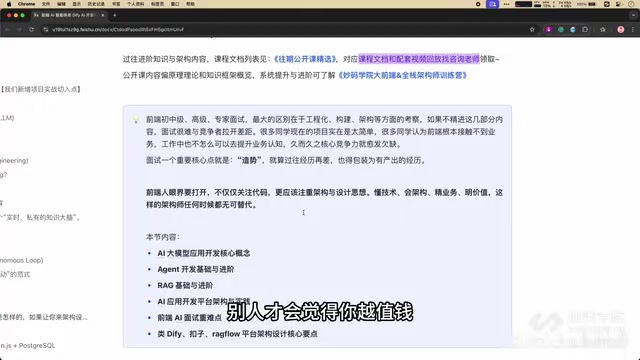
The most striking point in the video is the analogy of job seekers to commodities: "If you treat yourself as a commodity, you can understand these things... you must know more, you must master more knowledge points than others, and only then will others think you are more valuable." The creator repeatedly reminded viewers not to limit themselves, not to box themselves into the boundary of "only doing React or Vue development."

The point of this logic lies in differentiation. If all frontend developers only know React and Vue, their capabilities become highly homogeneous and cannot form a competitive advantage. Currently, most frontend developers' exposure to AI remains at the tool-usage level, without going deep into AI large model application development—this is the window of opportunity. The creator summed up this strategy as "differentiated competition": laying groundwork early where others haven't yet realized it, and exchanging scarcity for bargaining power.
What needs to be viewed objectively is that the premise of this logic is that demand for AI application development continues to exist and talent supply is insufficient. From a trend perspective, enterprises are increasing their investment in AI implementation, while developers with engineering implementation capabilities remain scarce—this judgment holds up at the current stage. But for individuals, the learning path needs to be combined with one's own foundation—those with frontend engineering experience will get up to speed faster on low-code AI platforms, because workflow orchestration is essentially isomorphic to frontend state transitions.
Differentiated competition originates from business strategy theory, referring to enterprises not competing head-on with the strong in the mainstream battlefield, but instead choosing a niche where competitors have not yet paid attention or have insufficient capability coverage to establish an advantage. Transferred to personal career development, its core is "supply scarcity": when the market supply of a certain skill is far smaller than demand, those who master it have higher bargaining power. To judge whether a direction is suitable for differentiated entry, people usually look at three things—whether demand is growing, whether existing supply is insufficient, and whether you have transferable adjacent capabilities. Frontend developers entering AI application development happen to satisfy all three at once: AI implementation demand is rising, developers who understand engineering implementation are scarce, and workflow orchestration is isomorphic to frontend state management capabilities. It should be noted that differentiated competition is a time-window strategy; as more entrants arrive, scarcity will gradually disappear, so early movers need to continuously migrate toward deeper capabilities.
Learning Path Suggestions and Rational Expectations
Based on the video content, a relatively pragmatic path can be outlined: first understand the basic pipeline of AI applications (agents, knowledge bases, RAG, prompt engineering), then use platforms like Dify AI to build a complete process hands-on, and finally turn the project experience into a case you can expand on in interviews. The creator's emphasis on "clear business processes" is the main thread throughout—platform operations can be learned quickly, but process design capability requires deliberate practice.
At the same time, it is important to avoid a misunderstanding: low-code platforms do not equal low-barrier careers. Tools encapsulate implementation details, but judgment-based work such as requirement decomposition, process design, and effect evaluation still depends on people. Treating Dify AI as an entry point for learning AI application development is reasonable; treating it as a shortcut to "quickly becoming an AI engineer" is likely to fall short. The essence of differentiated competition is accumulating scarce capabilities early, not bypassing capability accumulation.
One-line Summary
Using Dify AI as a sample, this article analyzes the full pipeline of low-code AI applications and argues for the timing and path for frontend developers to compete in AI through differentiated positioning.
Paragraph Summary
Based on a sharing by Bilibili creator "Frontend AI Agent," the article uses the Dify AI low-code platform as a sample to break down the full-stack design of AI agent construction and RAG retrieval pipelines. The core point is that low-code platforms lower the barrier to implementation while raising the demands on business process design capability—which happens to be frontend developers' area of strength. The author notes that most frontend developers' exposure to AI remains at the tool-usage level, and those who go deep into AI application development are rare, creating a window of opportunity; frontend developers should gain a differentiated competitive advantage by laying groundwork early. It also emphasizes that mastering the full pipeline can be turned into project experience to expand on in interviews, but low-code platforms are not a shortcut—judgment-based work such as requirement decomposition and process design still depends on people.
Related articles

JobRunner MCP Server: AI Agents Can Now Fix Failed Java Jobs
JobRunner launches an open-source MCP server enabling AI agents to view cluster status, diagnose failures, and recover Java jobs—incident response from any cloud coding environment or existing agent.

MLAI Digital Launches 9 Security Agents: MCP Server Safeguards the Full Lifecycle of Agentic AI
MLAI Digital launches Security MCP Server with nine built-in specialized security agents covering vulnerability discovery, attack simulation, prompt injection detection, API and infrastructure assessment, and accelerated remediation—embedding security validation across the full Agentic AI lifecycle from development to production.

Running Isaac Lab on H100 GPUs: Exploring Better Approaches
Exploring optimization methods for running Isaac Lab on NVIDIA H100 GPUs, including MIG configuration, mixed precision, TensorRT acceleration, and community experience to improve robotics simulation and reinforcement learning efficiency.