Dify Enterprise in Practice: Master AI Workflow Building Through 90+ Projects

Outlines the core architecture, four course modules, and enterprise implementation path of the Dify low-code AI platform.
Based on the Bilibili course "Dify Intelligent Application Development in Practice," the article introduces Dify, a low-code/no-code enterprise-level large model application development platform. Dify supports agent, RAG, and workflow architectures, with an audience ranging from non-technical business staff to technically capable enterprise teams. The course has four modules: complete private deployment of Dify and language, embedding, vector, and multimodal models; three agent projects; two workflow projects—intelligent writing and enterprise customer service integrated with WeCom and Feishu; and two types of private knowledge base Q&A—pure text and mixed text-image. The article notes that the private deployment module is more difficult and its value lies in keeping data within the domain, and reminds that "mastering in seven days" is marketing language, suggesting learners choose modules based on their needs.
Dify, as a low-code or even no-code platform for developing large model applications, is becoming a key tool for enterprises to quickly implement AI capabilities. There is a course on Bilibili titled "Dify Intelligent Application Development in Practice," which claims to help learners master AI workflow building in seven days through 90+ enterprise-level practical projects. This article, based on the course content, outlines Dify's core capabilities, project cases, and learning path, providing a reference for developers who want to systematically get started with Dify.
What is Dify: A Low-Barrier Enterprise AI Application Platform
According to the course introduction, Dify is a platform that allows users to quickly generate enterprise-level large model applications through low-code or no-code methods. It supports three main application types: agent architecture, RAG (Retrieval-Augmented Generation) architecture, and workflow architecture. Users can build various agents based on the agent's functions, implement private knowledge base applications based on the RAG architecture, or achieve more complex intelligent applications through workflows. The course instructor describes it as "one of the large model development platforms with the lowest barrier, the most popularity, and the best results."
This positioning determines Dify's audience range: it includes both business personnel without a development background and technical teams that need to build data security solutions for enterprises.
RAG (Retrieval-Augmented Generation) is a technical paradigm that combines external knowledge retrieval with LLM generation. Its basic process is: first, split private documents, vectorize them, and store them in a vector database; when a user asks a question, the system first retrieves several text fragments most relevant to the question, then splices these fragments as context into the prompt and hands them to the large model to generate an answer. Compared with directly fine-tuning the model, RAG's advantages are that knowledge can be updated at any time, answers can be traced, and costs are lower, so it has become the mainstream solution for enterprises to implement private knowledge base question answering. Dify encapsulates the key steps of RAG (document parsing, segmentation, embedding, retrieval, reranking) as visual configurations, so users can build knowledge base applications without writing retrieval code.
Agent architecture differs from RAG in that Agent enables the large model to have autonomous decision-making capabilities: the model judges on its own according to the goal whether it needs to call tools (search, calculation, API, database, etc.), which tool to call, and how to integrate the results after multiple rounds of calls. Agents in Dify can be configured with a tool list and reasoning strategy, suitable for scenarios where the task path is not fixed and dynamic planning is required; the workflow architecture, by contrast, pre-arranges steps into a deterministic flowchart, with stronger controllability and debuggability. The three are not mutually exclusive; in actual projects, RAG retrieval or Agent calls are often embedded within workflow nodes.
The Course's Four Major Modules: From Private Deployment to Application Implementation
The course content is divided into four major modules, covering the complete chain from underlying deployment to upper-layer applications.
Module 1: Dify Private Deployment
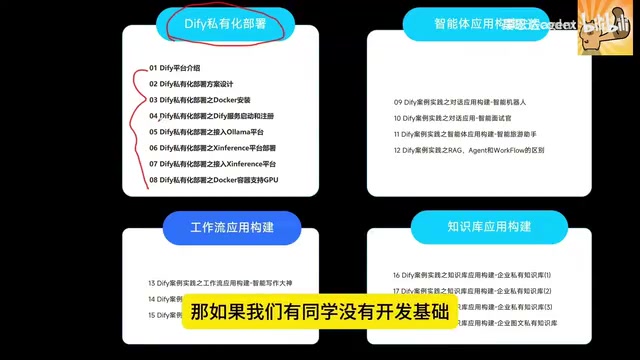
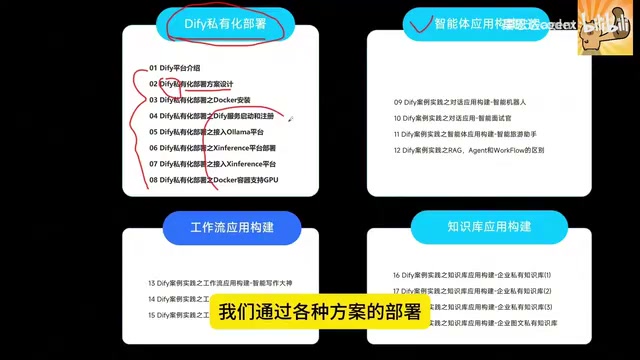
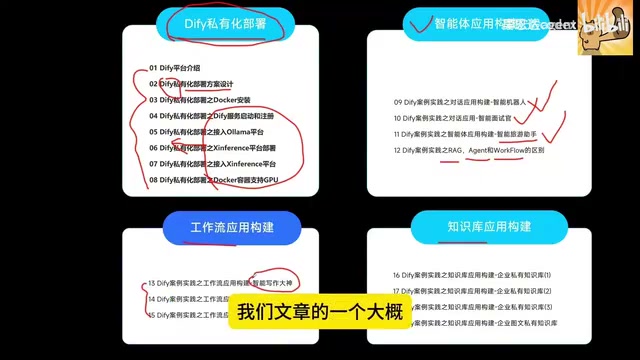
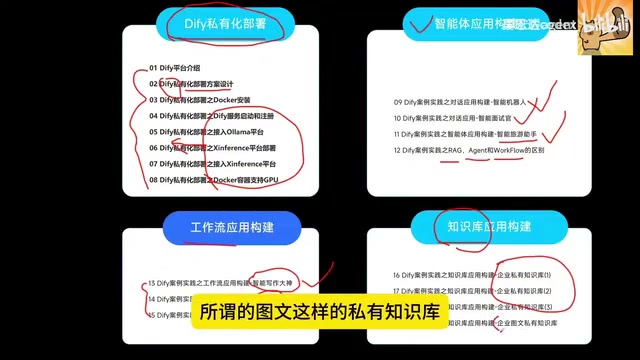
The first module focuses on the complete private deployment of the Dify platform, including the private deployment and management of the platform itself and various models. The course mentions that the types of models to be deployed involve language models, embedding models, vector models, and multimodal models, which are ultimately connected to the Dify platform in a unified way. This module is somewhat difficult and suitable for students with a development background; learners without a development background can skip it and continue subsequent learning directly based on the public cloud platform.
For enterprises, the core value of private deployment lies in data security. The course emphasizes that applications built by enterprises need to ensure that data does not leave the domain, so complete privatization is an important option.
The several types of models mentioned in private deployment each have their own roles: language models (LLM) are responsible for understanding and generating text and are the main inference engine of the application; embedding models convert text into high-dimensional vectors and are the foundation of knowledge base retrieval; vector models/vector databases are responsible for storing these vectors and supporting similarity retrieval (such as Milvus, Qdrant, Weaviate, etc.). Strictly speaking, they are not "models" but retrieval infrastructure, and are often mentioned together with embedding models in the course description; multimodal models can process both text and images, supporting mixed text-image question answering and image understanding.
The typical method of private deployment is to use Docker Compose to orchestrate the various service components of Dify, while on the model side, open-source models are loaded locally through inference frameworks such as Ollama, vLLM, and Xinference, and then connected in Dify's "Model Provider" settings via an OpenAI-compatible interface. This chain involves GPU memory planning, model quantization, intranet ports, and authentication configuration, so the course marks it as difficult and suitable for those with a development background. For enterprises with high data compliance requirements, local retention of logs and conversation records also needs to be considered.
Module 2: Agent Application Development
After the platform is ready, the course enters the application building stage. The agent section includes three projects: intelligent robot, intelligent interviewer, and intelligent travel assistant. The course also compares in detail the differences and similarities among RAG architecture, Agent architecture, and workflow architecture to help learners understand the applicable scenarios of different architectures.
Module 3: Workflow Application Development
The workflow module builds two applications: an intelligent writing master and intelligent customer service. The intelligent writing tool only requires inputting a title and first-level outline to generate long text with complete structure and beautiful language, suitable for writing articles, books, and even papers. Intelligent customer service is connected to platforms such as WeCom and Feishu, and can significantly reduce customer service costs.
The intelligent customer service's ability to "connect to WeCom and Feishu" relies on the platform's channel integration and API callback mechanism. A typical approach is: create a self-built application on the WeCom or Feishu open platform, obtain credentials such as CorpID, AgentID, and Secret, and configure the callback address for receiving messages; on the Dify side, expose the workflow's inference capability as a service endpoint through its API or Webhook, and after both parties complete authentication and message format conversion, two-way sending and receiving can be achieved. The engineering difficulty in this link is usually not the model itself, but message encryption and decryption, event subscription verification, and the mapping between conversation context and enterprise user identity.
The long-form writing capability in the workflow relies on node orchestration: usually multiple LLM nodes such as outline generation, chapter-by-chapter expansion, style polishing, and merging verification are connected in series, with variables passing intermediate results between nodes, and length controlled through conditional branches or loop nodes. Compared with single-prompt generation, this split-style orchestration can significantly alleviate structural drift and inconsistency in long-text generation, and also makes it easier to debug individual chapters separately and replace models.
Module 4: Private Knowledge Base Applications
The last module focuses on building private knowledge bases, including two requirement scenarios: pure text knowledge base question answering, and mixed text-image knowledge base question answering. The latter allows the model to output both text and images in answers, closer to the form of actual enterprise documents.
Course Features and Target Audience
From the course description, this content emphasizes "all practical content, no nonsense throughout" and covers Dify's main functions in a project-driven way. The claim of 90+ practical projects is not listed one by one in the original material; the actual course may include more subdivided cases. For developers who want to systematically learn Dify, it can be used as a structured learning path reference; for enterprise technical teams, the practical value of the private deployment module and the knowledge base module is relatively higher.
It should be noted that the course promotion's "easily master in seven days" is marketing language, and the actual degree of mastery still depends on the learner's basic investment. It is recommended to first clarify your own needs—whether to quickly build a prototype or build a compliant private AI platform for the enterprise—and then choose the corresponding module for in-depth learning.
One-line Summary
Outlines the core architecture, four course modules, and enterprise implementation path of the Dify low-code AI platform.
Paragraph Summary
Based on the Bilibili course "Dify Intelligent Application Development in Practice," the article introduces Dify, a low-code/no-code enterprise-level large model application development platform. Dify supports three application architectures: agent, RAG, and workflow, and its audience covers business personnel without a development background as well as technically capable enterprise teams. The course is divided into four major modules: complete private deployment of Dify and language, embedding, vector, and multimodal models; three agent projects—intelligent robot, intelligent interviewer, and intelligent travel assistant; two workflow projects—intelligent writing and enterprise intelligent customer service connected to WeCom and Feishu; and two types of private knowledge base question answering—pure text and mixed text-image. The article points out that the private deployment module is relatively difficult and its value lies in keeping data within the domain, and reminds that "mastering in seven days" is marketing language, suggesting that learners choose modules according to their own needs.
Related articles

Chain of Thought Isn't Just for AI: How Humans Can Use CoT to Improve Thinking Quality
Chain of Thought isn't just a prompt trick for large models. Starting from a Hacker News discussion, this article analyzes why CoT works for human thinking too, breaks down actionable ways to transfer it, and highlights the key differences between human CoT and machine CoT.
Cloudflare Teams Up with OpenAI: Closi…
Cloudflare Teams Up with OpenAI: Closing the Loop from Vulnerability Discovery to Defense with AI
Cloudflare uses OpenAI Daybreak to investigate security vulnerabilities and generate reviewable remediation plans, while developers use Codex to boost coding efficiency and quality.

Orca Multi-Agent Orchestration in Practice: A Guide to Parallel Collaboration with Claude and Codex
Orca is Stable AI's free open-source agent workbench supporting 34 agents like Claude Code and Codex in parallel. Learn its Git worktree isolation, multi-model orchestration, and mobile management.