Dify + MCP in Practice: Building Enterprise-Grade Role-Specific AI Copilot Workflows

Build enterprise AI copilot workflows with Dify + MCP using a word cloud tool as a practical end-to-end example.
This article walks through a practical case study of building an enterprise-grade AI copilot using Dify workflows and the MCP protocol. Using a word cloud rendering tool as the example, it covers the full pipeline from tool integration to result rendering, explains the roles of Dify, MCP, and cloud platforms, and highlights critical version compatibility issues developers must watch out for.
Starting with a Word Cloud Tool: MCP Service in the Real World
As large model applications enter the enterprise deployment phase, how to deeply integrate AI capabilities with real-world business processes has become a core challenge for developers. A Bilibili content creator recently shared a hands-on case study built on Dify workflows combined with MCP (Model Context Protocol) services — using a "word lookup + word cloud rendering" tool to demonstrate the complete architecture of an enterprise-grade AI application.
While the functionality itself isn't complex, it successfully runs through the entire pipeline — from tool integration and parameter passing to code execution and result rendering — making it an excellent entry point for understanding how Dify and MCP work together.
How the Tool Works
The service workflow can be broken down as follows: the user enters target words in Dify → the workflow passes parameters to the MCP service → the service executes the word cloud rendering code → a shareable result link is returned.
As demonstrated in the walkthrough, after entering test words like "username" and "password," the system completes execution almost instantly and returns a rendered link. Since the word cloud rendering runs on a local server, users can simply open the link to view the generated graphic — a smooth, seamless experience.
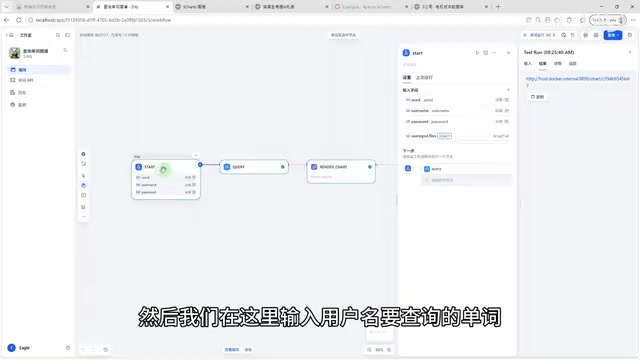
Dify Workflows: The Orchestration Hub for Enterprise AI
Dify is an open-source LLM application development platform built by the LangGenius team. Since its release in 2023, it has accumulated over 40,000 GitHub stars, making it one of the most prominent open-source projects in the enterprise AI space. Its core architecture consists of three key modules: the Workflow Engine, which supports visual DAG (Directed Acyclic Graph)-based orchestration of LLM calls, tool execution, conditional branching, and iterative loops; the Tool Integration Layer, which includes native tools like HTTP requests, code execution, and knowledge base retrieval, while also supporting custom external services via OpenAPI specs or the MCP protocol; and the Model Abstraction Layer, which normalizes interface differences across providers like OpenAI, Anthropic, and local models.
In this case, Dify plays the role of a "command center" — receiving user input, invoking external tools, processing results, and returning outputs. For enterprises, this "role-specific AI copilot" paradigm is highly instructive. Different teams can plug in their own specialized tools on top of a unified workflow framework, creating highly customized AI assistants. The word cloud tool is just a starting point — the same pattern can easily extend to data querying, report generation, content moderation, and many other business use cases.
For enterprise deployment, Dify's greatest value lies in transforming what would normally require heavy engineering investment into a visual configuration process that business teams can participate in — significantly reducing the cost of building and maintaining AI applications.

Flexible Rendering Configuration
The tool offers rich configuration options for rendering output. As shown in the demo, the word cloud layout direction can be freely switched — left to right, right to left, top to bottom, bottom to top — and even supports alternative display formats like line charts.
This flexibility is precisely what enterprise applications demand: the same underlying capability can be adapted to different business display requirements through configuration alone, dramatically reducing redundant development effort.

MCP Protocol: A Standardized Bridge Between AI and Tools
MCP (Model Context Protocol) was officially released and open-sourced by Anthropic in late 2024. Its design goal is to solve the "fragmented integration" problem that arises when AI models interact with the external world. Before MCP, every AI application that needed to call an external tool — such as a database, API, or file system — had to write custom adapter code, resulting in massive duplication of effort.
MCP draws inspiration from the Language Server Protocol (LSP) — the same design that successfully solved the N×M adapter problem between IDEs and programming language services. MCP uses a Client-Server architecture: AI applications (like Dify) act as MCP Clients, while tool services act as MCP Servers exposing their capabilities. Communication between them follows a standardized JSON-RPC protocol, defining three core primitives: Tools (tool invocation), Resources (resource access), and Prompts (prompt templates). This allows any MCP-compatible AI platform to plug into any MCP service out of the box.
In this case, the word cloud rendering capability is exposed via an MCP service, with the Dify workflow acting as the client. This decoupled design allows tool development and application orchestration to proceed independently — ideal for team collaboration and capability reuse.
Version Compatibility: A Critical Pitfall When Deploying MCP
The root cause of MCP version compatibility issues lies in the fact that the protocol is in an early phase where specification development and ecosystem building are happening simultaneously. Since the first public release in November 2024, the MCP specification has gone through several major updates — touching core aspects like transport layer protocols (expanding from stdio-only to supporting SSE/HTTP Streaming), tool parameter schema definitions, and authentication mechanisms. Meanwhile, SDK implementations across languages (Python's mcp library, TypeScript's @modelcontextprotocol/sdk, etc.) often lag behind the spec, and serialization formats between different SDK versions may be incompatible.
The creator specifically emphasized this critical lesson: MCP iterates extremely fast, with frequent version updates, and parameters can differ significantly between versions. Developers must pay close attention to version numbers when installing and integrating MCP components. Recommended engineering practices include: pinning specific version numbers in project dependencies (e.g., via requirements.txt or package-lock.json), establishing integration test pipelines for version upgrades, monitoring Breaking Changes in the official MCP GitHub repository, and maintaining version consistency between production and development environments. This is a hallmark of the current rapid-iteration phase of the MCP ecosystem — and a risk that any team deploying MCP needs to proactively mitigate.

Cloud Platform Support: The Role of Huawei Cloud ModelArts
The MCP service in this case was developed on Huawei Cloud ModelArts. ModelArts is Huawei Cloud's all-in-one AI development platform, covering the full lifecycle from data labeling and model training to model deployment and inference services. In the era of large models, ModelArts has focused on building API service capabilities for the Pangu model series, while also providing inference access interfaces compatible with mainstream open-source models.
For MCP service development and deployment, cloud platforms offer value across three dimensions: elastic compute — on-demand GPU/NPU resources that eliminate the complexity of local environment setup; network accessibility — cloud-deployed MCP services naturally support public internet or VPC internal network access, enabling multi-application reuse; and managed operations — the platform handles foundational DevOps responsibilities like high availability, monitoring, and alerting. This choice reflects a broader industry trend: as enterprise AI applications proliferate, major cloud providers are building increasingly mature AI development and deployment infrastructure. When evaluating platforms, teams should weigh model ecosystems, pricing models, and existing resource commitments.
Of course, the creator also candidly admitted that part of the reason for choosing this platform was that "credits on other platforms had run out" — which speaks to the fact that cost and quota management are equally important practical considerations in real-world development.
Summary: A Replicable Enterprise AI Deployment Pattern
This seemingly simple word cloud tool case study actually distills three core layers of enterprise AI application development:
- Dify as the orchestration layer: Provides visual workflow construction capabilities, lowering the barrier to AI application development;
- MCP as the connectivity layer: Enables standardized, reusable integration between AI and external tools;
- Cloud platforms as the infrastructure layer: Provides stable compute and model capabilities.
These three layers working in concert form a replicable, scalable paradigm for building "role-specific AI copilots." For teams looking to drive AI adoption within their organizations, starting with a small but complete tool, running the full pipeline end-to-end, and then gradually expanding to more complex business scenarios is often the most pragmatic path forward.
That said, the rapid evolution of the MCP protocol is a reminder: while embracing the benefits of emerging technology, teams must also build strong practices around version management and compatibility testing — only then can AI applications truly serve production environments with stability.
Key Takeaways
Related articles

Alguard: Building a Dual-Layer Trust Defense for AI Agent Shopping
Alguard, an Amazon Developer Hackathon project, designs a dual-layer trust architecture for Alexa+ agent shopping. Through physical isolation between an MCP server and a human approval channel, it replaces prompt defenses with structural constraints to block unauthorized purchases caused by prompt injection.

Food Poisoning: Causes, Symptoms, Treatment, and Prevention Explained
Food poisoning is caused by bacteria, viruses, parasites, or toxins contaminating food, with common symptoms including vomiting, diarrhea, and dehydration. This article explains the causes, symptoms, treatment, and prevention of food poisoning to help you safeguard food safety.

Meta Uses LLMs to Make Facebook Feed Customizable
Meta launches LLM-powered algorithm personalization for Facebook and Reels, letting users manage interests via menu and customize feed with a text box.