Dino Kids: A Free, Ad-Free Learning App for Kids in Five Languages

A free, ad-free kids' education app supporting five languages and offline use, offering a zero-barrier example for the market.
Dino Kids is a learning app from Digi Dinos for children aged 3 and up, available on Android and iOS. It offers coloring, letter tracing, phonics, math, piano, and 500 folk tales, supporting five languages—Vietnamese, Japanese, English, Korean, and Chinese—with a combination clearly leaning toward Asian markets. Its standout feature is being completely free, with no ads, no in-app purchases, no account registration, and offline use, forming a clear positioning in a market surrounded by subscriptions and ads. It received 67 upvotes, 7 comments, and ranked 20th on Product Hunt, indicating limited attention. The article notes that the sustainability of the free model and localization quality across five languages remain key points for future observation.
In a children's education app market that's largely dominated by subscriptions, ads, and in-app purchases, a product called Dino Kids has taken a very different path: completely free, no ads, no in-app purchases, no account registration, and offline support. This learning app for children aged 3 and up recently drew attention on Product Hunt. Launched by the development team Digi Dinos, it's available on both Android and iOS.
A Content Matrix Spanning Five Languages and Multiple Subjects
Dino Kids' content is designed around the core skills of preschool children, covering coloring, letter tracing, phonics, math, piano, and 500 folk tales. Language support is its most distinctive differentiator—it offers versions in five languages simultaneously: Vietnamese, Japanese, English, Korean, and Chinese.
This multilingual combination is not common. Most children's education apps focus on English or a single local language, while Dino Kids' language selection clearly leans toward Asian markets. The simultaneous inclusion of Vietnamese and Japanese in particular suggests the team has given targeted consideration to the needs of families in Southeast and East Asia. For multilingual families or parents who want their children to be exposed to a second language early on, this coverage offers direct value.
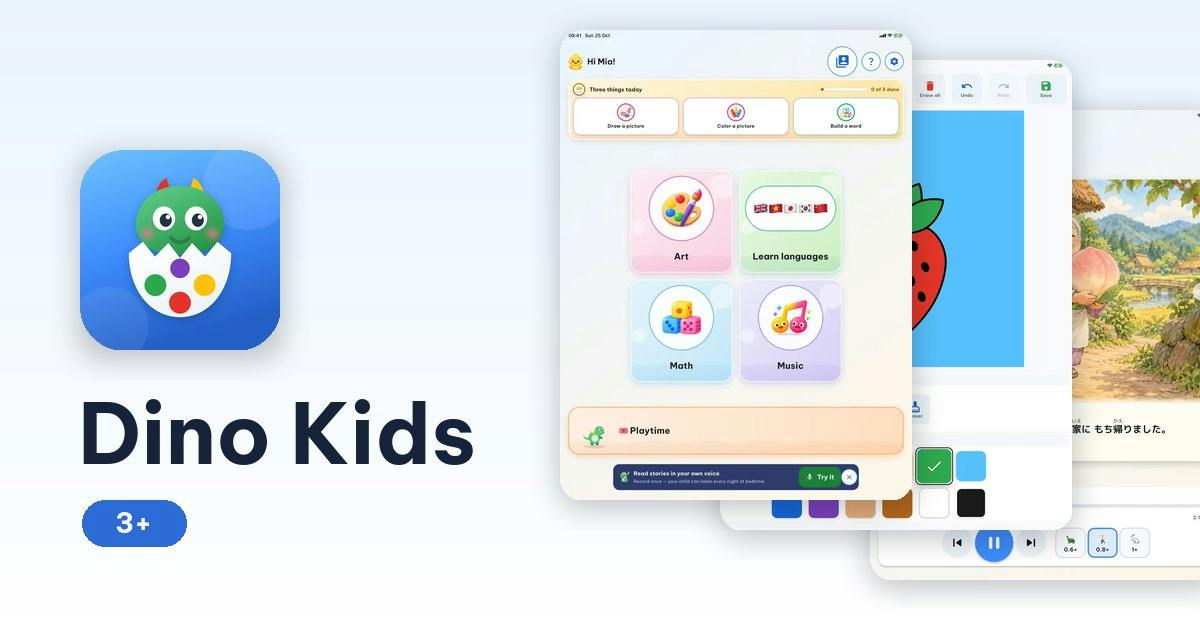
Phonics is an early reading instruction method centered on the correspondence between letters and sounds, widely used in native English-speaking countries from kindergarten through the early elementary grades. It emphasizes first establishing "sound—form" mappings, then gradually blending words, rather than relying on whole-word memorization or reciting the alphabet. For non-native English-speaking children, phonics is often used as an entry point for English启蒙 (early English learning), but writing systems differ greatly across languages: Japanese uses kana syllables as units, Chinese is primarily logographic with Han characters, and Korean, though alphabetic, has a different syllable structure. So the same "phonics" framework will inevitably be implemented differently across five languages, making localization quality a key variable.
Why "No Ads, No In-App Purchases" Deserves Its Own Section
The business models in the children's app space have long faced a structural contradiction: parents have limited willingness to pay, while ads and in-app purchases are the main revenue sources for most developers. The result is that many apps billing themselves as "kid-friendly" are in fact packed with interstitial ads,诱导性 (manipulative) in-app purchases, and subscription pop-ups.
Dino Kids explicitly promises no ads, no in-app purchases, and no account required, which is a clear positioning statement in today's environment. No account means no collection of children's personal information, sidestepping sensitive areas of children's privacy compliance; offline availability means content works without a network once downloaded, which is more practical for families with limited connectivity or when traveling. From a product design perspective, these choices lower the barrier to use and reduce parents' concerns about screen time and content safety.
A note: the source material does not explain the app's specific revenue model or the business arrangements behind it, so the sustainability of "free" cannot currently be judged. This is both the product's appeal and an issue worth watching going forward.
Children's privacy compliance is a hard constraint in the children's app space. Represented by the U.S. Children's Online Privacy Protection Act (COPPA) and the children's provisions of the EU's General Data Protection Regulation (GDPR), regulators require verifiable parental consent before collecting personal information from children under 13, and restrict data use for ad targeting. A design without account registration technically reduces the surface for personal information collection, but it does not automatically equal compliance—device identifiers, crash logs, and similar data may still involve data processing. For developers, this choice lowers compliance complexity and the trust barrier for parents, but it also forgoes user-data-driven growth and monetization levers.
Content Breadth and Product Maturity
The 500 folk tales are the largest part of the content library. Folk tales have advantages as early reading material: simple narrative structures, high cultural recognizability, and suitability for parent-child co-reading. Combined with coloring, tracing, phonics, and math modules, Dino Kids attempts to cover cognition, fine motor skills, and language启蒙 (early language development) rather than focusing on a single skill.
The inclusion of a piano module is slightly unexpected, but it fits the common "all-in-one" approach of children's apps—satisfying multiple early education needs with one app and reducing the cost of parents switching between multiple apps.
Judging from the Product Hunt feedback, the product received 67 upvotes and 7 comments, ranking 20th. This data shows it attracted some attention but has not yet generated large-scale discussion. As a product launched by an independent team (Digi Dinos), its content quality and long-term maintenance capacity still need to be verified through actual use.
Product Hunt rankings are based on community votes and interactions on launch day, essentially a one-time exposure metric rather than long-term user scale or retention data. A result of 67 votes and 20th place typically means the product entered the top tier of the day within its launch window but did not generate sustained discussion. For indie developer products, Product Hunt's value lies more in early customer acquisition and media exposure; its popularity has no necessary connection to actual product quality or subsequent update capacity. This data is therefore better used as a reference for "whether it attracted attention" rather than a direct inference of product maturity.
Another Possibility for Children's Education Apps
Dino Kids' value lies not in technological breakthroughs but in its product stance: in a race where everyone is chasing revenue from ads and subscriptions, it offers a zero-barrier, zero-tracking, offline-usable tool. For families with limited budgets, sensitivity to ads, or lives in multilingual environments, the practical significance of such a product may exceed that of flashier but more commercially driven competitors.
Whether it can continuously update content, maintain its free strategy, and how good the localization quality is across five languages are all key variables determining its long-term value. But at least from its product positioning, Dino Kids offers a reference example of a children's education app that does not rely on ads and in-app purchases.
Common monetization paths for children's education apps fall roughly into two categories: subscription or one-time purchase, and a hybrid model of free plus ads/in-app purchases. The former depends on sustained willingness to pay, the latter on usage time and conversion. For a completely free, ad-free product, sustainable models usually include developers' own funding, serving as a brand entry point for other businesses, nonprofit grants, or later releasing paid derivative versions. The original text does not disclose which arrangement Dino Kids uses, so how long "free" can last depends on this undisclosed support chain.
One-line Summary
A free, ad-free children's education app supporting five languages and offline use, offering a zero-barrier example for the market.
Paragraph Summary
Dino Kids is a learning app from Digi Dinos for children aged 3 and up, available on Android and iOS. It offers coloring, letter tracing, phonics, math, piano, and 500 folk tales, supporting five languages—Vietnamese, Japanese, English, Korean, and Chinese—with a language combination clearly leaning toward Asian markets. Its standout feature is being completely free, with no ads, no in-app purchases, no account registration, and offline use, forming a clear positioning in a children's app market surrounded by subscriptions and ads. The product received 67 upvotes, 7 comments, and ranked 20th on Product Hunt, indicating limited attention. The article notes that the sustainability of the free model and the localization quality of content across five languages remain key points for future observation.
Related articles
 Tech Frontiers
MuJoCo: An Analysis of DeepMind's Open-Source General-Purpose Physics Simulator
An in-depth analysis of Google DeepMind's open-source physics simulator MuJoCo: high-performance C++ kernel, MJCF modeling format, contact solving principles, MJX GPU acceleration, and robot reinforcement learning use cases.
 Tech Frontiers
Claude API Quick Start: The Official Quickstarts Project Collection
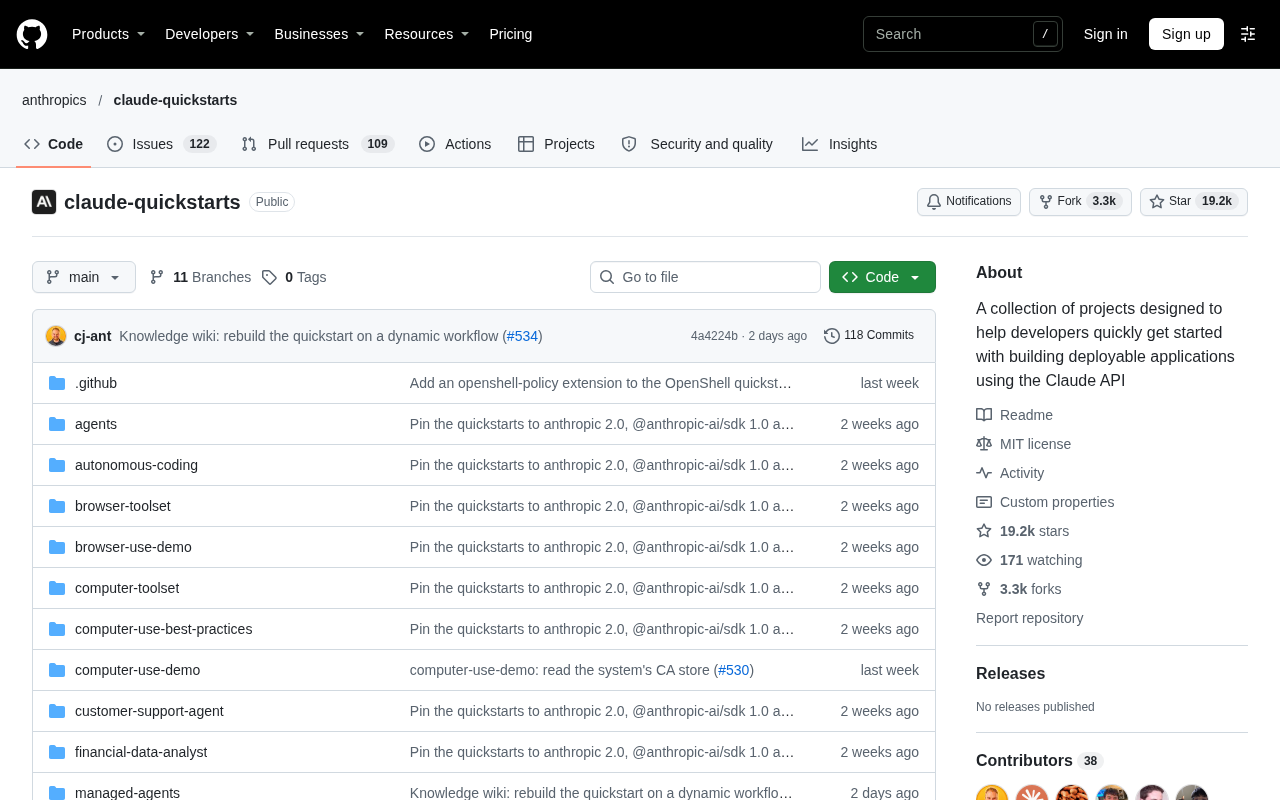
Anthropic's official claude-quickstarts project collection helps developers quickly build deployable apps with the Claude API. Nearly 20k stars, Python-based, great for beginners and prototyping.
 Tech Frontiers
AI Agents Connecting Directly to APIs: Which Calls Can Be Safely Allowed?
AI agents can call any API, but the real challenge is deciding which calls can be safely allowed. This article analyzes allowance decisions from three dimensions—intent matching, least privilege, and controllable impact—and argues that the control layer should sit outside the agent, combined with audit traceability to build a trustworthy API call governance mechanism.