Discord Drops Electron: Windows 11 App Memory Usage Plummets 70%
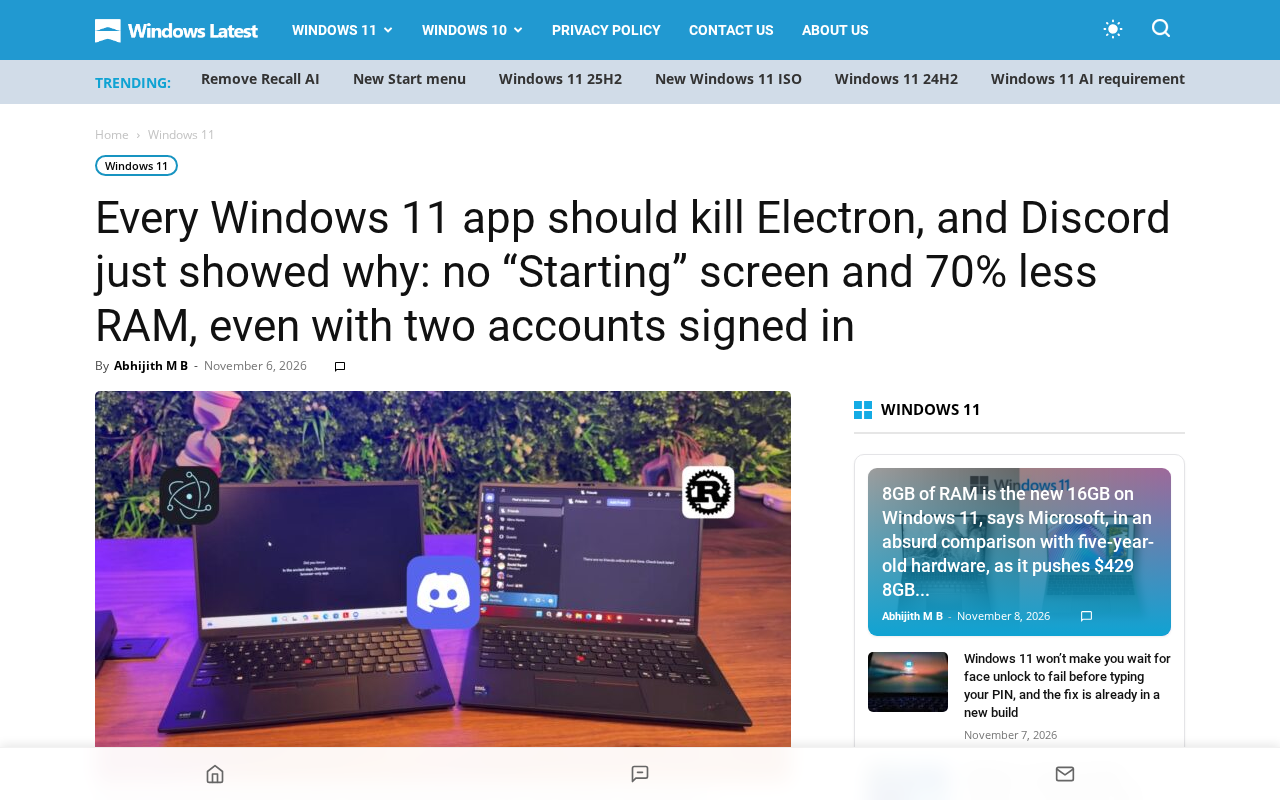
Discord abandons Electron for native development on Windows 11, cutting memory usage by 70% and prompting reflection on desktop app technology choices.
In its latest Windows 11 version, Discord abandoned the Electron framework in favor of a native development approach, eliminating the startup loading screen and reducing memory usage by 70% in dual-account scenarios. The change sparked over 200 comments on Hacker News, with the community calling for Windows 11 apps to re-evaluate Electron. The article analyzes Electron's architectural redundancy — each app bundles a full Chromium engine and Node.js runtime, leading to large size and high memory usage that is especially uneconomical for performance-sensitive apps. Discord's case is seen as a signal of a native development comeback, and Microsoft is also promoting WinUI 3 and the Windows App SDK. However, the article cautions that native development means higher engineering investment and platform lock-in risk, and teams need to balance development efficiency with user experience and assess in phases whether performance bottlenecks truly stem from the framework itself.
From Electron to Native: A Performance Awakening
According to Windows Latest, the latest version of Discord on Windows 11 has abandoned its long-time reliance on the Electron framework in favor of a native development approach. The results are striking: the app's splash screen is gone, and memory usage has dropped by 70% — even when logged into two accounts simultaneously. This change sparked over 200 comments on Hacker News, with a clear central theme: all Windows 11 apps should abandon Electron.
Electron's convenience is undeniable — it lets developers with web technology stacks quickly build cross-platform desktop apps. But Discord's case proves that when users' tolerance for poor performance drops, the cost of that convenience becomes hard to ignore.
Discord's Rework Details: Faster Startup, Lower Memory
According to Windows Latest, Discord's Windows 11 client no longer shows a startup loading screen and goes straight to the main interface. More importantly, the memory data: in a scenario with two accounts logged in simultaneously, the new version of Discord uses 70% less memory than the Electron version. Although the original article did not disclose specific memory figures, a 70% reduction is enough to make the point.
This improvement directly addresses a long-standing pain point for Discord users: Electron apps are often jokingly called "memory gluttons," consuming large amounts of resources when running in the background and affecting overall system responsiveness. Discord's rework shows that a native approach can significantly reduce resource consumption while maintaining full functionality.
Why Has Electron Become a Target?
Electron's core problem is architectural redundancy. Every Electron app bundles a complete Chromium rendering engine and Node.js runtime, resulting in large app size and high memory usage. For simple apps, this overhead is especially uneconomical.
In the Hacker News discussion, many developers pointed out that a large number of Windows 11 apps — from chat tools to note-taking software — use Electron, but many of them do not need the full capabilities of web technology. Discord's case provides a reference point: when an app's core interactions are not complex, the performance gains from native development far outweigh the increase in development cost.
Of course, Electron is not without merit. For products that require rapid iteration and high cross-platform consistency, it remains a reasonable choice. But Discord's shift reminds us that performance-sensitive apps should re-evaluate their technology choices.
Electron's architecture can be understood as "a browser plus a backend runtime": it packages Chromium's content layer and Node.js together into every app, with the main process handling windows and system integration, and the renderer process hosting the interface like a web page. The direct consequence of this design is that even if an app does only simple things, it must load the full Blink layout engine, the V8 JavaScript engine, and a large number of platform abstraction layers. Memory overhead mainly comes from the multi-process model, the JavaScript heap, and Chromium's resident GPU and network service processes. As a result, the baseline memory of Electron apps is often in the hundreds of MB, far higher than native programs with equivalent functionality.
Signals of a Native Development Comeback
Discord is not the first well-known app to abandon Electron. Several projects have previously attempted to rewrite desktop clients using native technologies, but Discord's scale and user base make this rework more exemplary. Windows Latest's headline bluntly states that "every Windows 11 app should kill Electron" — although the wording is aggressive, it reflects the strong expectations of the user community for lightweight, efficient desktop apps.
From a technology trend perspective, Microsoft has also been promoting native development frameworks such as WinUI 3 and the Windows App SDK in recent years, providing developers with more modern Windows integration capabilities. Discord's rework can be seen as a response to this direction. However, native development also means higher development costs and platform lock-in risk, and teams need to weigh the trade-offs.
WinUI 3 is the modern native UI framework Microsoft provides with the Windows App SDK. It integrates the previously separate UWP XAML and Win32 desktop capabilities into a single technology stack, allowing developers to build Windows apps with Fluent Design styling in C# or C++ and directly call the full Win32 API. Unlike Electron, WinUI 3 apps do not bundle a browser engine; the interface is drawn by the system's built-in XAML rendering pipeline, so startup is faster and the memory baseline is lower. However, its cross-platform capability is limited, mainly targeting Windows, and the maturity of its ecosystem still lags behind web technology stacks.
Implications for Developers
Discord's case offers a vivid lesson for desktop app developers: technology choices cannot be based only on development efficiency; they must also consider the actual user experience. If your app runs slowly and uses too much memory on Windows 11, users will not hesitate to look for alternatives.
For teams currently using Electron, a phased evaluation is possible: first analyze whether the app's performance bottlenecks come from the framework itself, then consider whether it is worth rewriting core modules with a native approach. Discord's 70% memory reduction is a strong data point, but the engineering investment behind it should not be overlooked either.
Ultimately, the core of this discussion is not "whether Electron should die," but how to find a balance between development efficiency and user experience. Discord has given its own answer through action, and other apps in the Windows 11 ecosystem should perhaps seriously consider the same question.
Background Note
It is worth noting that Discord's so-called "native development approach" has different interpretations in the community. Some developers point out that Discord's new client may still render its interface based on web technology, but through a more compact runtime or the system WebView rather than fully bundling Chromium. If so, the 70% memory reduction comes more from removing the duplicate browser engine and Node.js runtime than from a complete rewrite in C++ or C#. This distinction is important for technology choice judgments: it shows that "reducing the burden" does not necessarily mean "a full rewrite," and reusing the system WebView is also a viable middle path.
One-line Summary
Discord abandons Electron for native development on Windows 11, cutting memory usage by 70% and prompting reflection on desktop app technology choices.
Paragraph Summary
In its latest Windows 11 version, Discord abandoned the Electron framework in favor of a native development approach. The startup loading screen is gone, and memory usage in a dual-account login scenario has dropped by 70%. This change sparked over 200 comments on Hacker News, with the community calling for Windows 11 apps to re-evaluate Electron. The article analyzes Electron's architectural redundancy — every app bundles a complete Chromium engine and Node.js runtime, leading to large size and high memory usage, which is especially uneconomical for performance-sensitive apps. Discord's case is seen as a signal of a native development comeback, and Microsoft is also promoting WinUI 3 and the Windows App SDK. However, the article also cautions that native development means higher engineering investment and platform lock-in risk, and teams must weigh development efficiency against user experience and evaluate in phases whether performance bottlenecks truly come from the framework itself.
Related articles
 Tech Frontiers
MuJoCo: An Analysis of DeepMind's Open-Source General-Purpose Physics Simulator
An in-depth analysis of Google DeepMind's open-source physics simulator MuJoCo: high-performance C++ kernel, MJCF modeling format, contact solving principles, MJX GPU acceleration, and robot reinforcement learning use cases.
 Tech Frontiers
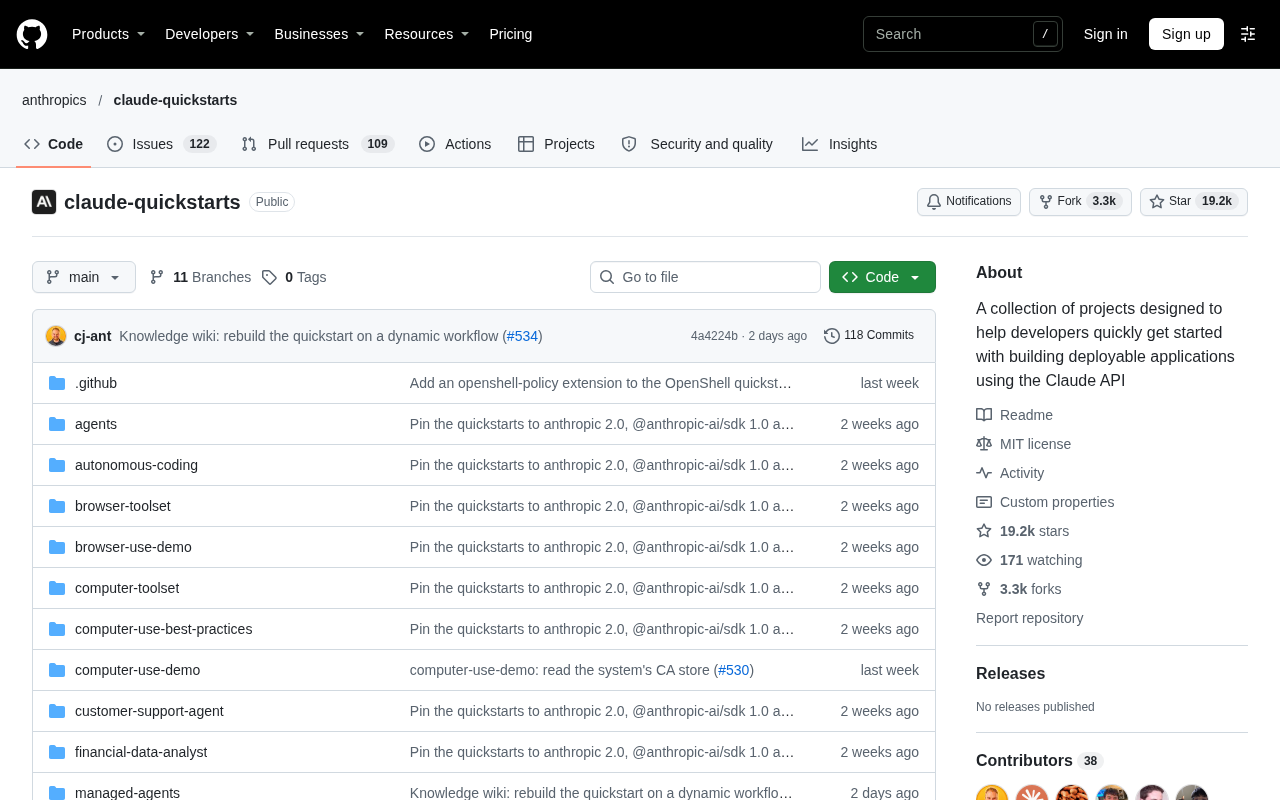
Claude API Quick Start: The Official Quickstarts Project Collection
Anthropic's official claude-quickstarts project collection helps developers quickly build deployable apps with the Claude API. Nearly 20k stars, Python-based, great for beginners and prototyping.
 Tech Frontiers
AI Agents Connecting Directly to APIs: Which Calls Can Be Safely Allowed?
AI agents can call any API, but the real challenge is deciding which calls can be safely allowed. This article analyzes allowance decisions from three dimensions—intent matching, least privilege, and controllable impact—and argues that the control layer should sit outside the agent, combined with audit traceability to build a trustworthy API call governance mechanism.