Dismissing LLMs Is Like Ignoring Jurassic Park: A Developer's Analogy

Simon Willison's Jurassic Park analogy urges computer scientists to engage with LLMs through curiosity, not avoidance.
Developer Simon Willison sparked discussion with a sharp analogy: a computer scientist indifferent to LLMs is like a geneticist unmoved by Jurassic Park. The comparison captures the growing divide in tech between enthusiastic adopters and deliberate skeptics. It carries two meanings — LLMs as an unmissable technological marvel, and the implicit warning of a park that ultimately lost control. The article argues curiosity and criticism are complementary, and that practitioners are better served by studying how LLMs actually work than by debating whether they are overhyped.
The Industry Tension Behind a Single Analogy
Prominent developer and tech blogger Simon Willison dropped a vivid analogy in a brief note: a computer scientist who isn't interested in today's large language models (LLMs) is like a geneticist who couldn't care less about a newly opened Jurassic Park.
Deceptively casual, the comparison cuts right to a subtle fracture running through the tech world. The explosive rise of LLMs has left many practitioners caught between two camps: those who are fully invested, treating this as a once-in-a-generation technological marvel, and those who remain skeptical — or who deliberately keep their distance from the hype. Willison clearly lands in the first camp. His point: this is a phenomenon no serious professional can afford to ignore.
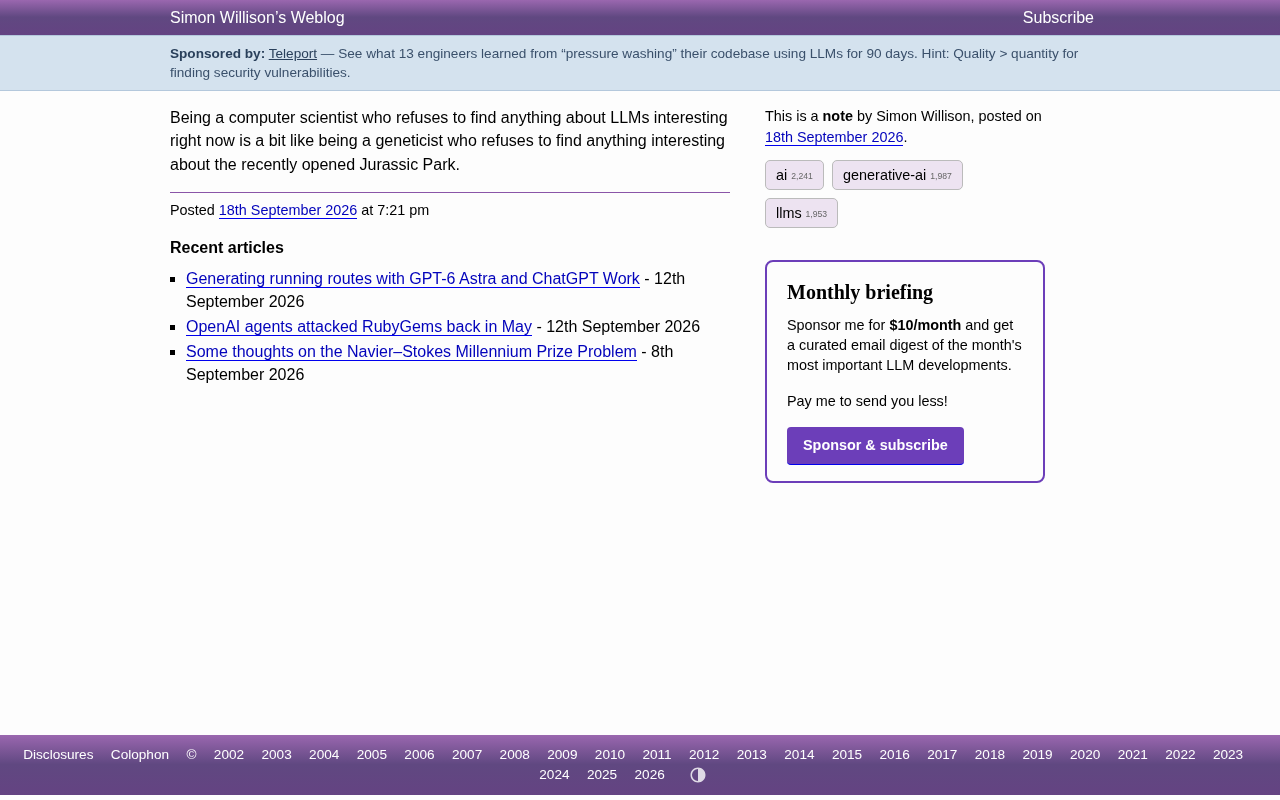
Willison is one of the co-creators of the Django framework and the author of the open-source tool Datasette. He has long been an active voice in the Python and data engineering communities. In recent years, he has devoted considerable energy to hands-on LLM research, consistently documenting real-world usage on his personal blog and social media — successes and failures alike. His credibility in tech circles stems precisely from his sustained stance of "use it, but don't blindly believe it" — a pragmatist, not a true believer.
Why Jurassic Park?
What makes the Jurassic Park analogy so effective is that it carries two layers of meaning simultaneously.
The first is pure technological wonder. For a geneticist, resurrecting dinosaurs represents the outer limit of what the discipline can achieve — something any professional would instinctively want to study. In the same way, the language understanding and generation capabilities LLMs exhibit are unprecedented research material for computer scientists. Whatever you think of the commercial prospects, the phenomenon itself is worth exploring deeply.
The second layer carries an undercurrent of risk and controversy. Anyone familiar with the film knows Jurassic Park ultimately loses control. The choice of this particular image may not be accidental — it's a quiet reminder that a captivating technology can also produce consequences no one anticipated. Willison doesn't unpack this layer directly, but the imagery leaves plenty of room for interpretation.
Professional Curiosity vs. Technical Skepticism
This brief note reflects a debate that has been running throughout the AI era: how should practitioners actually relate to LLMs?
Some argue that the hype surrounding LLMs is excessive, that their limitations — hallucination, reliability, cost — have been deliberately downplayed, and that keeping a measured distance is simply a rational professional stance. Others, like Willison, contend that regardless of one's final verdict, a technology actively reshaping the entire software industry is itself an inescapable object of study. To refuse to engage is to forfeit your voice on the defining question of the era.
It's worth noting that curiosity and criticism aren't mutually exclusive. Those who have studied LLMs most deeply are often the same people who can both appreciate their capabilities and clearly articulate their limits. Willison has long been known for exactly this kind of pragmatism — an active practitioner of LLM applications who also regularly writes sharp analyses of where they fail.
The core limitations of LLMs are worth briefly mapping out here, to understand where the skeptics are coming from. Hallucination refers to models generating factually incorrect content with high confidence — and being unable to reliably detect it themselves. Reliability issues surface when the same question yields contradictory answers across different runs, making LLMs difficult to use in systems that require deterministic output. On the cost side, the computational overhead of large-scale API calls or self-hosted deployment makes the economics questionable in many scenarios. These aren't theoretical concerns — they are engineering challenges developers run into repeatedly in real-world deployments. Confronting these limitations head-on is the foundation of the "critical curiosity" Willison advocates.
What This Means for Practitioners
For developers and researchers navigating this wave of technology, this short note offers a useful position to consider: rather than debating whether LLMs are overrated, get hands-on and understand how they work, where their capabilities end, and how they perform in practice.
- Maintain professional curiosity — treat LLMs as a phenomenon worth studying, not merely a business topic;
- Stay critical even as you engage — stay alert to the possibility that the technology could spin out of control;
- Let practice test your judgments, rather than staying stuck in a battle of positions.
The history of technology repeatedly shows that choosing to walk away when standing at the door of a major shift usually means missing the chance to help define the era. That may be exactly the point Willison wanted to make with a dinosaur analogy.
Related articles

Chain of Thought Isn't Just for AI: How Humans Can Use CoT to Improve Thinking Quality
Chain of Thought isn't just a prompt trick for large models. Starting from a Hacker News discussion, this article analyzes why CoT works for human thinking too, breaks down actionable ways to transfer it, and highlights the key differences between human CoT and machine CoT.
Cloudflare Teams Up with OpenAI: Closi…
Cloudflare Teams Up with OpenAI: Closing the Loop from Vulnerability Discovery to Defense with AI
Cloudflare uses OpenAI Daybreak to investigate security vulnerabilities and generate reviewable remediation plans, while developers use Codex to boost coding efficiency and quality.

Orca Multi-Agent Orchestration in Practice: A Guide to Parallel Collaboration with Claude and Codex
Orca is Stable AI's free open-source agent workbench supporting 34 agents like Claude Code and Codex in parallel. Learn its Git worktree isolation, multi-model orchestration, and mobile management.