Disney's First-Ever CTO Previously Led the AI Company Disney Accused of IP Infringement

Disney hired its first CTO from Character.AI — the very company it once accused of infringing its IP.
Disney has appointed the former CEO of Character.AI as the company's first-ever Chief Technology Officer — a dramatic move given that Disney had previously sent Character.AI a cease-and-desist letter over unauthorized use of its characters. The appointment signals a strategic pivot from defensive legal action to proactively recruiting AI talent, with Disney aiming to define how AI interacts with its IP on its own terms. The creation of the CTO role itself underscores Disney's view of generative AI as a key force reshaping content production, distribution, and user experience — and marks a broader industry trend of entertainment and AI companies moving from confrontation toward complex co-opetition.
A Dramatically Ironic Executive Appointment
Disney has appointed its first-ever Chief Technology Officer — and the new hire's background is nothing short of eyebrow-raising. He previously served as CEO of AI startup Character.AI, the very company Disney had sent a cease-and-desist letter to, accusing it of using Disney's characters without authorization.
This appointment places two former adversaries firmly on the same side of the table, reflecting a subtle but significant shift in how traditional entertainment giants are responding to the generative AI wave: moving from defensive legal battles toward actively recruiting core AI talent.
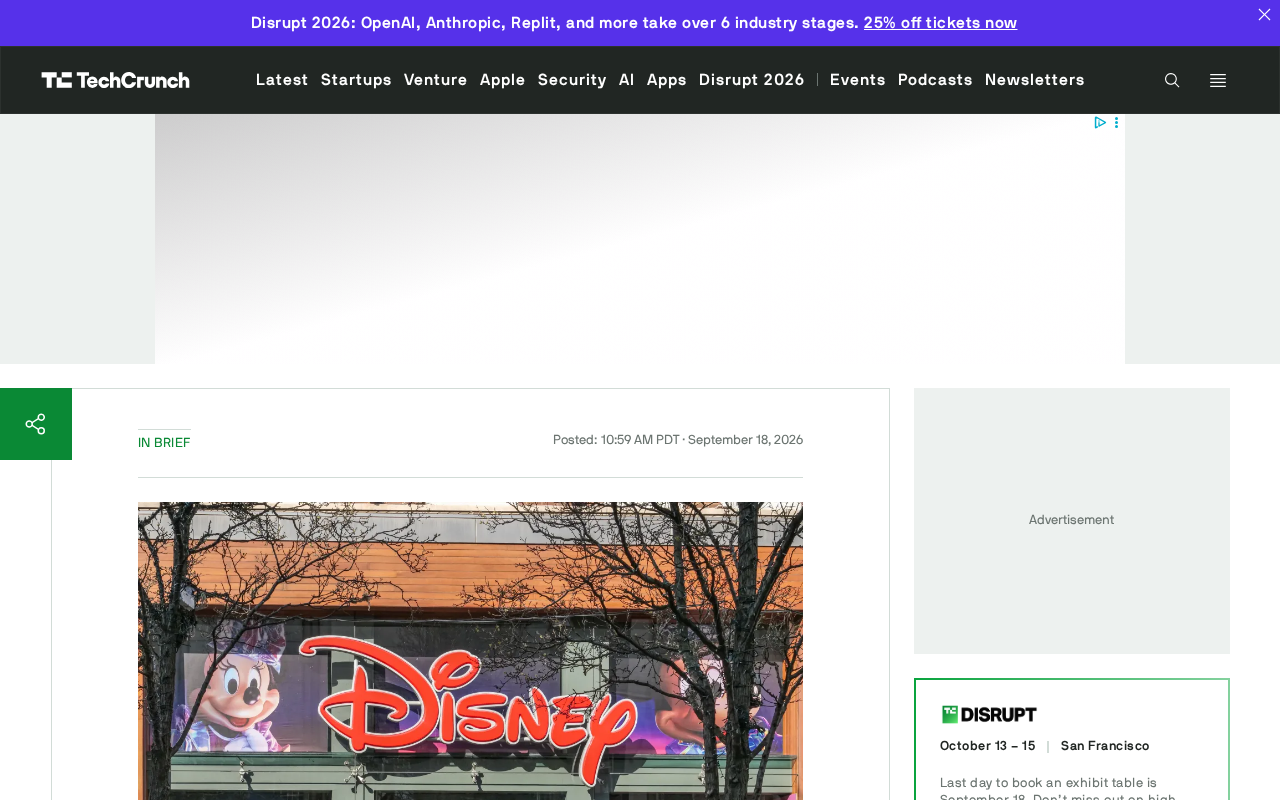
From Legal Opponent to Chief Technology Executive
Character.AI is an AI company known for its role-playing conversations, where users can interact with a wide range of virtual characters — including many based on popular culture IP. This freewheeling use of character likenesses crossed a clear line for Disney, which maintains strict control over its intellectual property, prompting the company to issue a formal legal warning.
Now, the former CEO of the company that once sat in the defendant's corner has become Disney's highest-ranking technology executive. This kind of role reversal is rare at the intersection of tech and entertainment, and it reflects an increasingly pragmatic stance in the talent war — where deep expertise in generative AI is beginning to outweigh past ideological differences.
Character.AI was founded in 2021 by former Google Brain researchers Noam Shazeer and Daniel De Freitas. Its core technology is a character dialogue system built on large language models, allowing users to create custom or choose preset "characters" for conversation. The platform amassed an especially large base of teenage users. The company closed a $150 million Series A round in 2023, with a valuation reaching approximately $1 billion, making it one of the most closely watched consumer-facing generative AI applications. However, the presence of large numbers of unauthorized Disney characters (such as Mickey Mouse and Elsa) and other well-known IP figures on the platform made conflict with content rights holders inevitable. This tension between its business model and traditional IP owners is a microcosm of the broader regulatory and legal challenges facing the entire generative AI industry.
Why Disney Is Creating the CTO Role Now
Notably, this is the first time in Disney's history that it has established a CTO position. As a company whose strengths lie in content creation and IP management, Disney has historically distributed its technology efforts across individual business lines — streaming, theme parks, film production — without a unified technology leadership role.
The deliberate creation of this position, and the choice of a candidate with an AI startup background, sends a clear signal: Disney now views generative AI as a critical variable shaping the future of content production, distribution, and user experience. Whether as a creative assistance tool, a personalization engine, or a medium for virtual character interaction, AI has the potential to reshape Disney's core business at every level.
Balancing IP Protection with AI Innovation
This appointment also puts a thorny industry dilemma front and center: how can entertainment giants with massive IP portfolios embrace AI innovation while protecting their intellectual property?
Disney's prior legal actions made clear it takes a hard line on unauthorized use of its character likenesses. Bringing in an executive who deeply understands AI character generation technology may signal that Disney wants to define — on its own terms — how AI interacts with its IP, rather than reactively fighting external infringement. In other words, rather than letting third-party AI companies use Disney characters without permission, Disney may prefer to own the relevant technology and set the rules itself.
For the broader industry, this could be a bellwether: the relationship between content companies and AI companies is shifting from outright opposition toward a more complex state of "co-opetition."
Against the backdrop of an unsettled legal framework for copyright and AI, the cease-and-desist letter remains one of the most commonly used legal tools for content companies. It doesn't carry the enforcement power of a court ruling, but it sends a clear legal warning demanding that the alleged infringing behavior stop immediately — or face formal litigation. In recent years, Disney, Getty Images, The New York Times, and many other rights holders have sent similar letters to AI companies or filed lawsuits directly. The core disputes center on whether AI training data constitutes copyright infringement, and whether AI-generated character likenesses infringe on existing IP. Major jurisdictions including the United States and the European Union have yet to reach definitive conclusions, leaving the legal boundary between content companies and AI companies in a state of ongoing, dynamic negotiation.
Conclusion
On the surface, this appointment may look like a routine executive reshuffling — but it reflects the deep-seated tensions and convergence playing out between traditional entertainment and generative AI. When a former legal adversary becomes the head of technology strategy, it signals that no one can afford to sit out the AI revolution, and that pragmatic collaboration often serves all parties better than prolonged conflict.
How Disney will use AI to reshape its content empire, and how it will strike a balance between innovation and IP protection, are questions well worth watching closely in the months ahead.
Related articles

Workbuddy for Absolute Beginners: How a Desktop AI Agent Fits Into Real Workflows
A beginner's guide to the Workbuddy desktop AI agent: installation, claiming credits, file management, and building automated workflows—compared with CodeX for fit and cost, helping professionals shift from AI question-askers to AI managers.

OpenAI's New Agent Stack: Computer Use, Decisions API, and Ultra-Fast Workflows
OpenAI Dev Day unveiled a new agent stack: Computer Use outperforms humans, Decisions API delivers ultra-low-latency classification via Luna, Agents API opens the same Computer Use capabilities, and GPT-6.1 Sol costs only one-seventh of Astra. Core updates, benchmark data, and developer insights.

Liang Wenfeng Open-Sources DeepInfo Inference Framework, Takes On U.S. Ban
DeepSeek open-sources its DeepInfo inference framework after its models, featuring GPU/CPU cross-pipelining, small-model prediction with large-model verification, and full Huawei Ascend and NVIDIA chip support—facing the U.S. federal ban head-on. This article analyzes its significance for AI deployment and open-source strategy.