Dissecting Cursor: How It Became a Groundbreaking AI Coding Company in Just Two Years

How Cursor grew from a VS Code fork to a groundbreaking AI coding company in just two years.
Based on a16z's full investment review from Series A to D, this article dissects how Cursor evolved from a VS Code fork into an integrated IDE, Agent platform, and model platform in just two years. It examines the startup's contrarian bets, relentless product focus, composure against giants like Microsoft and Anthropic, its "back door" business model strategy, and a craftsman-like team culture — revealing the formula behind one of the most remarkable startup stories in the GenAI era.
In today's fiercely competitive AI coding landscape, Cursor is undeniably one of the brightest stars. Recently, the a16z partner team systematically reviewed their investment journey with Cursor — from Series A through Series D — on a podcast, revealing how this startup evolved in just two years from a VS Code fork into a groundbreaking enterprise integrating an IDE, an Agent platform, and a model platform.
This article, based on the a16z team's in-depth conversation, dissects Cursor's key decisions in product philosophy, competitive strategy, business model evolution, and team culture.
Back to Early 2024: A Contrarian Bet
To understand Cursor's success, you need to rewind the clock to late 2023 and early 2024. As a16z partners recalled, the leading models at the time were GPT-4o, Claude 3, and Llama 3, and the undisputed king of AI coding was Microsoft's Copilot — Microsoft held OpenAI's model weights, VS Code, and the entire Office suite. Nearly everyone believed that "the victory in AI coding was destined to belong to Microsoft."
Within this landscape, players fell into two extremes: one camp believed "the only way to win in coding is to build a specialized code foundation model," while the other focused exclusively on Agents. Cursor sat squarely in the middle and firmly stood on the side of "not building our own model."
"We don't need to compete with Anthropic or OpenAI on models right now. The interface between humans and models is what matters."
From the very beginning, co-founders Michael and Aman repeatedly emphasized one perspective: the code of the future will look like pseudocode. You won't talk to models through code anymore — you'll use natural human language. Therefore, building a code model is essentially building a frontier language model — an extraordinarily difficult endeavor, especially when more focused companies are already doing it. This judgment was later proven entirely correct.
A Relentlessly Focused Product Company
The a16z partners' first impression of the Cursor team was their "extraordinary focus." They recalled that when Michael came to pitch to the GP team, 90% of the meeting was spent "saying no."
"VCs always ask dumb questions about other things you could potentially do, and Michael would just very politely listen to every question and then say: Hmm, interesting, no, we're not going to do that."
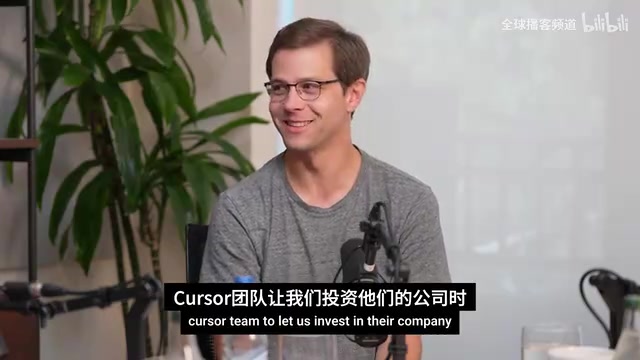
When asked the then-controversial question of whether they could win enterprise customers by forking VS Code rather than building a plugin, Michael looked the investors straight in the eye with unwavering conviction. The partners believe every decision Cursor made was backed by rigorous logical reasoning:
- Why not build a code-specific foundation model? Because you're having a conversation with the model in natural human language — the model must understand the breadth of human experience. That's essentially building a frontier language model.
- Why not build a plugin? If you truly believe in your product, you'd never build a plugin, because then you're just a part of someone else's product.
- Why not pursue enterprise sales early? Because the product itself is the best go-to-market engine, and enterprise sales should come later.
This "product is everything" conviction is strikingly similar to Elon Musk's way of thinking. The partners pointed out that many companies they've seen are patchwork creations that "try a little bit of everything," whereas Cursor has been a clearly focused product company from start to finish.
Facing Giants: The Winning Combination of Humility and Confidence
Cursor's entire growth story is essentially a history of continually confronting "existential threats." From Copilot in the early days, to Windsurf (which amassed a large user base through YC), to Cognition's Devin agent, to Anthropic's launch of Claude Code — competitors came and went in waves.
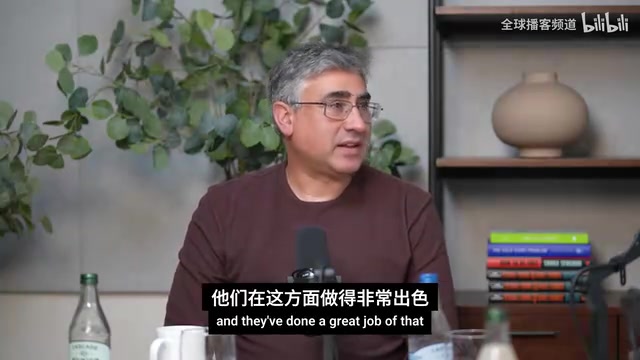
After Claude Code's high-profile launch, it became a formidable competitor. When the partners asked Michael how he viewed it, his response was memorable:
"We're entering the largest market in the world. There will inevitably be strong competitors. In fact, from the very beginning there's been a rotating cast of characters — Copilot was the first, and Claude Code is just one of them. In a big market, you'll always face strong opponents. That doesn't scare us."
The partners summarized this attitude as "a blend of humility and confidence" — maintaining paranoid vigilance while being utterly fearless about competition. They see this as the winning combination when challenging incumbents, reminiscent of Bezos's philosophy: "If you're smart and right, that gives you confidence and focus."
The moments that truly made the team think "Oh f***" were never about competitors — they were about the leapfrog advances in model capabilities. For instance, when Claude Opus was released, "the whole world was in awe." The pace of model improvement far exceeded everyone's expectations.
The Business Model's "Back Door Strategy": From IDE to Model Platform
Cursor's most admirable strategy is how it completed multiple acts of "self-disruption" within two years with Reed Hastings-level decisiveness: from IDE, to Agent platform, to model platform.
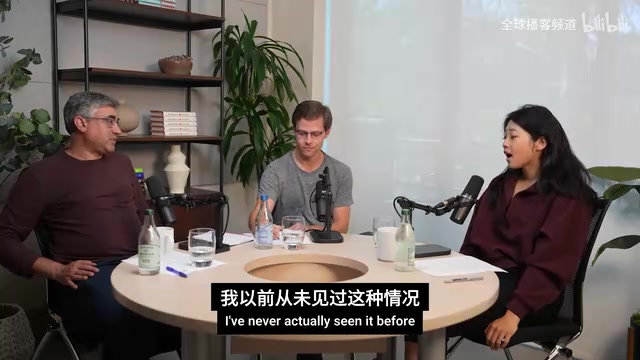
The partners cited a phrase to capture the logic: "Technology change comes first; business models come later."
X (formerly Twitter) was awash with skepticism about Cursor's gross margins. But the partners believe there was a massive disconnect between that noise and the business's actual performance:
"Technology change always precedes the formation of business models. Think about the internet era — we didn't figure out monetization for a long time. And here you have near-infinite demand, infinite growth, and profit potential."
Cursor's "back door strategy" is deeply instructive: First, acquire all users at record speed, capturing assets, data, and know-how, then circle back to build your own models. The partners noted that this sequence is virtually irreversible — "unless you start out as a frontier lab, you can't do this in reverse."
It's worth noting that Cursor was extremely restrained in sales early on, going so far as to only put a single enterprise inquiry email address on their website. But when they realized that "the profit is in the enterprise market," they went all in, building what was "possibly the fastest sales team ramp-up in the history of planet Earth," ultimately achieving over 50% penetration among Fortune 500 companies.
Team Culture: How You Do Anything Is How You Do Everything
Cursor's culture is threaded with one central principle: How you do anything is how you do everything.

This craftsman-like spirit and "taste" for detail extends beyond the product into hiring and workspace design. According to Sarah, the founders spent 40% of their time on recruiting — exceptionally rare for technical product founders. Their hiring methodology was extraordinarily rigorous:
- Identify benchmark companies: Find the top 10 companies that excel at a particular type of sales;
- Drill down to the team level: Identify the 10 best teams within those companies;
- Pinpoint individuals: Lock onto the first and second individual AEs who drove transformation, then confirm they're "superstars" through layers of back-channel reference checks.
Interestingly, the partners pointed out a paradox: the team originally came together out of a "pure love for writing code and building systems," but if you look at what they actually spent their time on later, it was mostly recruiting, go-to-market, and business model work. This demonstrates that high-energy founding teams always manage to do precisely what the business needs most.
Additionally, Cursor is considered one of the finest examples of integrating founders among this generation of GenAI companies. Rather than forcing founders into IC roles, they truly built the company this way — from Koala's Tito to the Graphite acquisition — demonstrating exceptional talent acquisition capability and cultural integration.
The Striking Parallel with SpaceX: Why a16z Bet on Cursor
The partners repeatedly drew comparisons between Cursor and Elon Musk's companies. In their view, the Cursor–xAI M&A combination may be "the best fit they've ever seen":
- Technology level: Elon has compute; Cursor has distribution channels and data;
- Vision level: Both believe code is the pathway to changing all of computing and even humanity itself;
- Culture level: Both are intensely product-engineering-centric, fast-iterating, and decisive about making hard calls.
They recalled meeting SpaceX in 2019, when the company was still just a rocket launch business but was claiming it would "power the internet for the entire world" — and there wasn't a single Starlink satellite in orbit yet. Cursor similarly moved fast, attacked a massive market, and ultimately won when facing Comcast-style "impossible competitors."
Conclusion
In two years, Cursor went from challenging Microsoft to competing head-on with giants like Anthropic, completely reconstructing its product roadmap and go-to-market strategy along the way, while also completing "one of the most complex M&As in history." As the partners put it, this is "a startup's magnum opus."
Its formula for success can perhaps be distilled into a few points: contrarian yet rigorously reasoned judgment, composure in the face of giants, the patience to let technology precede business models, and a relentless focus and craftsman's taste that runs through everything. For all entrepreneurs navigating rapidly changing markets, Cursor is a case study worth revisiting again and again.
Related articles

Python 3.15 New Feature: Is the sentinel Type Better Than None?
Python 3.15 adds the sentinel type, using named unique sentinel objects to replace None and bare object(), resolving confusion among missing values, explicit emptiness, and invalid input while avoiding type hint failures.

Deep Learning's Three Architectures and the Universal Approximation Theorem: A Complete Guide to MLPs, CNNs, and Transformers
Explaining the inductive bias differences among MLP, CNN, and Transformer, the existence meaning of the Universal Approximation Theorem (UAT), and the role of Taylor expansion in approximation analysis, while clearing up common misconceptions.

GitLab Emergency Patch Release: Analysis of Critical Security Fixes
GitLab releases critical patch 19.5.1, sparking 355 points of discussion on Hacker News. This article analyzes the background, upgrade steps for self-hosted instances, and verification points to help DevOps teams respond quickly to security updates.